
What ELSE don't I know about ammo for a Model 19, or .357s in general?

MRPMRP

Member
Joined
Apr 22, 2026
Messages
254
Reaction score
362
City & State/Province
Texas
In doing research about the proper long term care of the 2 1/2" Model 19-3 I inherited from my dad, I was surprised to find that the lighter weight .357 bullets are considered harder on the revolver, supposedly because the shorter projectile allows more hot gases/burning powder to come into contact with the forcing cone. Now, I'm sure this is a relative thing and firing the occasional few cylinders of .357 125 grain SJHP isn't going to erode the forcing cone into a slag heap (it certainly hasn't on my late father's revolver), but it's not something that was automatically intuitive... for me, at least.

So........ is there anything else important to know about the care and feeding of .357s in general, and my snubby K Frame in particular?

My recent test session with that revolver was so much fun I can see myself wanting to shoot it a lot more than originally anticipated. After years of training with my Model 29 snubby, the little Model 19 just fits my hands so much better, so it's a real sweetheart of a shooter. I can see why so many Model 19/66 owners hold them in such high regard.

So if I just wanna punch holes in paper using off-the-shelf ammo, and spend as little as possible, is there anything special I need to know? I'm thinking clean burning jacketed standard pressure .38 Special is the way to go, but are there caveats? Can anyone suggest $10 per box pinpoint accurate .38 rounds that magically clean your revolver while you shoot them? :ROFLMAO:

While I'm at it, even though the main purpose of this post is to learn any idiosyncrasies of .38/.357 ammo, especially with regard to K Frames, if anyone has studied defense loads for shorty .38/.357s, I'd love to hear their comments. My use case is home defense only, because my dad's revolver means too much to me to risk carrying it. So, in my case, short range quick energy dump is what I'm after-- the over-hyped FBI penetration criteria are not applicable to me. If Magsafe were still around that'd be an easy choice, and Glaser Safety Slugs are very much contenders, in spite of their smaller pellet size. But what's the best choice for a short barrel?

Anyway, this forum impresses with the depth and breadth of experience here, so I'm hoping you guys will teach me the ins and outs of ammunition choices with regard to Smith & Wesson revolvers.
 
Since it's your dad's gun, I'd almost skip shooting .357 ammo altogether, IMO. What *I* would do is shoot .38spl wadcutters. They can be found on-line cheaper than most .38spl ammo due to several reasons. They're REAL slow, something like 800-850 f/p/s. Some go lower than that, I believe.

Wadcutters bring multiple things to the table. 1) They're REALLY soft shooting, so they don't add wear to the gun. 2) They're REALLY accurate, so you can get good practice for accuracy. 3) They make THE coolest perfectly round holes in paper when they pass through.

The only (minor) drawback is, they're all-lead projectiles. So there may be some scrubbing of the bore required, but it's usually not much, IMO.

Yes, there's short-barreled ammo available from reputable makers. I think Hornady is one of them. A quick google of it should give you all you need, IMO. I'm no reloader, but I believe they use a faster burning powder in them? Might even have a little fire ball effect going on too? LOL!

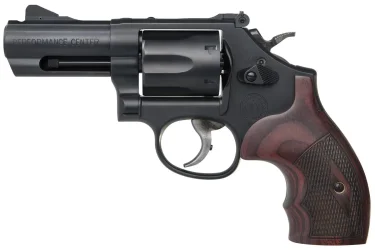
My snubbie is a 19-3, but I have retired it & bought a 19C. This is a recent make model with a comp & much stouter forcing cone, allowing 125gr loads all day long with no concerns of damage. I'll post a pic of one so you can see the difference.

I'm sure there'll be others to come along soon with more & better advice.

Hope this helps!

19C:
19C.webp
 
Last edited:
The light weight bullet issue revolved around full power magnum loads, the 125 grain bullet with a muzzle velocity of 1400-1450 fps, which use heavy charges of slow burning, spherical powder. If you use reduced power loads, those listed as having a muzzle velocity not more than 1250 fps from a 4 inch barrel, you will see far less erosion. With such a short barrel, you are likely to find magnum ammo of any power level to be not very pleasant to shoot.
 
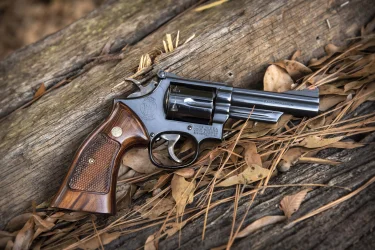
No expert here, but I believe the forcing cone issue on the earlier Model 19 is not erosion. Instead, it's about cracking. If you look at your forcing cone, you will notice the bottom of it is flattened out. This is to provide clearance for the gas-ring on the front of the cylinder. That little cut-out on the bottom of the forcing cone causes that area to be thinner, therefore it is the weakest part. If you take a piece of steel and smack it HARD with a hammer, over and over, for a long period, it will likely crack. So, think of your forcing cone as a piece of steel (which it is), and your bullet as a hammer. The bullet (hammer) slamming into that forcing cone, over a long period of time CAN cause cracking. The weak-point is that thinner section at the bottom of the forcing cone and that's where it CAN crack. A heavier bullet (although it may have more inertia) is generally not traveling as fast as a lighter bullet. As a result, a heavier bullet (think 140 grain and heavier) does not smack that forcing cone nearly as hard as a lighter bullet (125 grain and lighter). Now, an engineer may tell you that my explanation is hogwash, and they could be right (in fact, they probably are). However, it explains the problem in a way that even I can understand and make sense of. Keep in mind that it is generally accepted that those K-frame magnums were designed to be fed a steady-diet of .38 Special for training and practice, with .357 Magnum being used for business. I'm not sure if that's an S&W rule, but it's a pretty smart one. Bottom line is that I run .38 Special, or some lower-velocity handload .357 Magnums in mine for almost all my practice and fun-shooting. I may load a cylinder or two of .357 Magnum 125gr. JHPs at the end of the day, because I don't believe a small amount is going to do any harm. That load, or the 158 gr. version is what I would use if I were counting on this protect me and mine. Here is mine, a -4. Of course, it's not a snubby
 

Attachments

  • DSC_2371.webp
    DSC_2371.webp
    2.4 MB
I have several K-frame .357s and have reparied a few for customers that cracked forcing cones. While I got away with shooting 158 gr. .357s for some time, I no longer fire .357s in K-frames - the juice isn't worth the squeeze!

If I were to shoot .357s in K-frames it would likely be 145 Silvertips or the Remington Golden Saber which is a moderate load. Or handloads which are loaded a bit lighter.

Riposte
 
I worked with High Desert Cartridge Company to develop their 158 grain .357 load that is set up to use full length .357 cases to not leave a ring in .357 cylinders and not abuse the guns or shooters. I shoot a lot of this (currently 50-100 rounds a week) in my Highway Patrolman’s and 27’s. Steve also does a 125 grain .38 TMJ round that is shoot in snubs. It is not abusive to either the guns or shooter and keeps the guns clean with its total metal jacket. The nice thing is they also make identical loads with XTP bullets so you have a defensive hollowpoint that shoots to the same place as your training and utility round.
I am currently paying the price with severe arthritis in my hands from decades of shooting abuse with unlimited taxpayer ammo and buying into the shooting the hottest magnums possible in my early revolver years. Experience has led me to a place that a lot of the velocity is actually unnecessarily hard on shooters and guns for very little reward and almost no reward outside of very narrow hunting situations with larger game.
 
Have never fired a .357 in my 2.5" Model 19. Since it is my CCW, I developed a load based on the old FBI Load. It consists of 7.0 grains of HS-6 behind a cast 158gr SWCHP at 940fps. Yes, that's right, 940fps out of that 2.5" barrel. Since that's my cast bullet, I fired it into soaked newsprint, and that bullet expanded to about the size of a quarter. Simply no need for a .357 Magnum in that gun.

Don
 
Given that keeping the gun in pristine condition is important to you, I would probably do what others suggested and stick with .38s for fun at the range and not bother trying to press it into home defense use.

On the other hand, with my 2.5" 66, I've primarily shot .38s out of it, but did zero it for 25 yards and did some practice using .357 since I found myself carrying it a bit.

This is probably going to come as a surprise, given their reputation, but Buffalo Bore loads a Barnes 140gr. XPB to go 1150ish fps in a 2.5" barrel. It's their lead free, low flash, short barrel load. It's not moving very fast and if the overall bullet length concerns are true about 125gr projectiles, given that it is lead free, the 140gr XPB is actually longer than 158gr jacketed hollow points. You said you don't care about this, but the 140gr. XPB performs very well in gel tests in that speed range. The downside is, its not cheap.
 
If I didn't have a quantity of Gold Dot 135 grain short barrel 357 ammo, I would go the High Desert route for defensive ammo. I also have a quantity of Golden Saber which is also a mid-range power hollow point.

Most of my practice is with 38s in my 2.5" (both) 19-6 and 66-1
 
I worked with High Desert Cartridge Company to develop their 158 grain .357 load that is set up to use full length .357 cases to not leave a ring in .357 cylinders and not abuse the guns or shooters. I shoot a lot of this (currently 50-100 rounds a week) in my Highway Patrolman’s and 27’s. Steve also does a 125 grain .38 TMJ round that is shoot in snubs. It is not abusive to either the guns or shooter and keeps the guns clean with its total metal jacket. The nice thing is they also make identical loads with XTP bullets so you have a defensive hollowpoint that shoots to the same place as your training and utility round.
I am currently paying the price with severe arthritis in my hands from decades of shooting abuse with unlimited taxpayer ammo and buying into the shooting the hottest magnums possible in my early revolver years. Experience has led me to a place that a lot of the velocity is actually unnecessarily hard on shooters and guns for very little reward and almost no reward outside of very narrow hunting situations with larger game.
That's a great concept. Thanks for the tip. This is *exactly* why I asked the question-- until now, I had no idea something like this was available.

I'm sorry about the arthritis.
 
Given that keeping the gun in pristine condition is important to you, I would probably do what others suggested and stick with .38s for fun at the range and not bother trying to press it into home defense use.

On the other hand, with my 2.5" 66, I've primarily shot .38s out of it, but did zero it for 25 yards and did some practice using .357 since I found myself carrying it a bit.

This is probably going to come as a surprise, given their reputation, but Buffalo Bore loads a Barnes 140gr. XPB to go 1150ish fps in a 2.5" barrel. It's their lead free, low flash, short barrel load. It's not moving very fast and if the overall bullet length concerns are true about 125gr projectiles, given that it is lead free, the 140gr XPB is actually longer than 158gr jacketed hollow points. You said you don't care about this, but the 140gr. XPB performs very well in gel tests in that speed range. The downside is, its not cheap.
Thank you for the suggestion and adding to my knowledge base.
 
Have never fired a .357 in my 2.5" Model 19. Since it is my CCW, I developed a load based on the old FBI Load. It consists of 7.0 grains of HS-6 behind a cast 158gr SWCHP at 940fps. Yes, that's right, 940fps out of that 2.5" barrel. Since that's my cast bullet, I fired it into soaked newsprint, and that bullet expanded to about the size of a quarter. Simply no need for a .357 Magnum in that gun.

Don
Is there a comparable off-the-shelf .38 Special + P load? For years that revolver was loaded with Remington 158 grain lead SWCHP 38 Special + P loads and I'd have no qualms about continuing to keep them in the revolver for defensive purposes. Obviously, target shooting will be done with standard pressure .38 Special rounds, or the reduced pressure .357 loads mentioned above.
 
I have several K-frame .357s and have reparied a few for customers that cracked forcing cones. While I got away with shooting 158 gr. .357s for some time, I no longer fire .357s in K-frames - the juice isn't worth the squeeze!

If I were to shoot .357s in K-frames it would likely be 145 Silvertips or the Remington Golden Saber which is a moderate load. Or handloads which are loaded a bit lighter.

Riposte
Thanks for sharing your real-world experience. Out of curiosity, do you recall if any of the cracked forcing cones were on barrels with the smaller barrel extension cut? From what I've read here, at some point S&W moved the gas ring from the cylinder to the yoke, necessitating a larger clearance notch on the bottom of the barrel extension. That change didn't last too long, but when they returned the gas ring to the cylinder they left the larger cut in the bottom of the barrel extension, and it's said the vast majority of cracked forcing cones were on barrels with this larger cutout. Fortunately, my dad's revolver pre-dates those changes, and therefore has more meat on the barrel extension than later revolvers.

I agree about actually firing .357 rounds at paper-- I see no reason to do that, even in an N Frame .357. But I am interested in ideas for self defense ammo because I hide handguns throughout the house for home defense and an unloaded defense piece is of limited usefulness. The beauty of a revolver is that you don't need to fire a bunch of defense rounds through it to ensure its reliability, so I can load it with any factory .357 load and know it'll go bang, even without testing it. If squeezing off a round in self defense causes a problem with the forcing cone it's still not the greatest of my worries by a long shot.

That said, I'm not averse to using .38 Special +P loads for self defense-- as has been pointed out here, the little 2 1/2" K Frame gets pretty snappy with full-house Magnum loads, so that's a point in favor of .38 +P rounds.
 
No expert here, but I believe the forcing cone issue on the earlier Model 19 is not erosion. Instead, it's about cracking. If you look at your forcing cone, you will notice the bottom of it is flattened out. This is to provide clearance for the gas-ring on the front of the cylinder. That little cut-out on the bottom of the forcing cone causes that area to be thinner, therefore it is the weakest part. If you take a piece of steel and smack it HARD with a hammer, over and over, for a long period, it will likely crack. So, think of your forcing cone as a piece of steel (which it is), and your bullet as a hammer. The bullet (hammer) slamming into that forcing cone, over a long period of time CAN cause cracking. The weak-point is that thinner section at the bottom of the forcing cone and that's where it CAN crack. A heavier bullet (although it may have more inertia) is generally not traveling as fast as a lighter bullet. As a result, a heavier bullet (think 140 grain and heavier) does not smack that forcing cone nearly as hard as a lighter bullet (125 grain and lighter). Now, an engineer may tell you that my explanation is hogwash, and they could be right (in fact, they probably are). However, it explains the problem in a way that even I can understand and make sense of. Keep in mind that it is generally accepted that those K-frame magnums were designed to be fed a steady-diet of .38 Special for training and practice, with .357 Magnum being used for business. I'm not sure if that's an S&W rule, but it's a pretty smart one. Bottom line is that I run .38 Special, or some lower-velocity handload .357 Magnums in mine for almost all my practice and fun-shooting. I may load a cylinder or two of .357 Magnum 125gr. JHPs at the end of the day, because I don't believe a small amount is going to do any harm. That load, or the 158 gr. version is what I would use if I were counting on this protect me and mine. Here is mine, a -4. Of course, it's not a snubby
Nice revolver!

What you describe is exactly the way my dad's was used. The department provided .38 full wadcutter ammo for training purposes and that's mostly what this revolver saw, followed up by a few .357 mag loads at the end of the session to re-align ones muscle memory with the much stronger recoil impulse. I was quite young at the time and it was well before I'd gotten my Model 29, so I recall those full house .357 rounds as being not much fun at all to fire.

There's certainly no intent to fire magnum loads with any regularity at all, but since I don't know what I don't know I wasn't going to take the option off the table (for defensive purposes *only*) until seeing what you guys had to say.
 
Since it's your dad's gun, I'd almost skip shooting .357 ammo altogether, IMO. What *I* would do is shoot .38spl wadcutters. They can be found on-line cheaper than most .38spl ammo due to several reasons. They're REAL slow, something like 800-850 f/p/s. Some go lower than that, I believe.

Wadcutters bring multiple things to the table. 1) They're REALLY soft shooting, so they don't add wear to the gun. 2) They're REALLY accurate, so you can get good practice for accuracy. 3) They make THE coolest perfectly round holes in paper when they pass through.

The only (minor) drawback is, they're all-lead projectiles. So there may be some scrubbing of the bore required, but it's usually not much, IMO.

Yes, there's short-barreled ammo available from reputable makers. I think Hornady is one of them. A quick google of it should give you all you need, IMO. I'm no reloader, but I believe they use a faster burning powder in them? Might even have a little fire ball effect going on too? LOL!

My snubbie is a 19-3, but I have retired it & bought a 19C. This is a recent make model with a comp & much stouter forcing cone, allowing 125gr loads all day long with no concerns of damage. I'll post a pic of one so you can see the difference.

I'm sure there'll be others to come along soon with more & better advice.

Hope this helps!

19C:
View attachment 875239
Thank you for elaborating on wadcutters. That's almost all we shot through it way back when, and I honestly don't remember the revolver being terribly difficult to clean, but that was decades ago and I was young enough to have the time/enthusiasm to make the effort.

In later years I bought my GF a J frame at a gun show and picked up some "gun show special" wadcutters at the same time. Those bullets must have been cast from a crazy-soft alloy, because it took forever to fully remove the lead from that poor revolver. I swore off un-clad bullets during the hours it took to do so.

I do like the soft recoil and nice round holes though, so if you guys can suggest wadcutters that won't lead up the barrel I'll give them a try. Otherwise, I'm happy with standard pressure .38 rounds with jacketed bullets.
 
"gun show special" wadcutters at the same time. Those bullets must have been cast from a crazy-soft alloy, because it took forever to fully remove the lead from that poor revolver.
More likely they were swaged lead, which is a soft lead.
 
Another downside to the 125gr. projectile in the hot .357 format is the gas cutting that can occur to the underside of the top strap, just aft of the forcing cone.
 
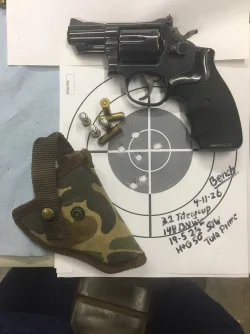
148 button nose is mostly what my 2 1/2'' gets. I shoot double action with my weak arm mostly . I bought mine new. My favorite load is 3.2 Titegroup or 3.1 Bullseye. This is a 25y bench load. Keep them under 920fps and throat size or .001over for no leading.
 

Attachments

  • IMG_3657.webp
    IMG_3657.webp
    493.9 KB
More likely they were swaged lead, which is a soft lead.
Thank you. I could tell they were waaay softer than anything I'd shot before, but I hadn't researched the difference-- I just stopped shooting lead bullets because they weren't really applicable for my needs at the time. But from what you guys are saying, a harder lead wadcutter would be great for plinking with the Model 19, so now I know to stay away from swaged projectiles.
 
GA Arms wadcutters won't. Been shooting them for decades.
Excellent! Thanks for the firsthand recommendation! I've saved brass for years but don't reload at this point in time, so knowing of an off-the-shelf round that won't lead excessively is great information to have.
 
148 button nose is mostly what my 2 1/2'' gets. I shoot double action with my weak arm mostly . I bought mine new. My favorite load is 3.2 Titegroup or 3.1 Bullseye. This is a 25y bench load. Keep them under 920fps and throat size or .001over for no leading.
Nice group, nice revolver!
 
Flame cutting is the bigger concern here. With the slower burning powder used with magnum loads - the lightweight bullet leaves quicker allowing high-pressure burning powder to escape (the flames you see coming out the side). This same flame will act like a torch and cut your top strap over time. Well used revolvers often have a line above the forcing cone where this has happened over time. Some Smiths like my 340PD have a plate on the top strap above the forcing cone to protect the Scandium.

I make 148gr wadcutters for my older 38s. I would use 158gr wadcutters in your Model 19 if it’s just for paper cutting. Shoot some 357 once in a while for fun. Just keep the grains higher is all.
 

Attachments

  • IMG_7220.webp
    IMG_7220.webp
    94.5 KB
Flame cutting is the bigger concern here. With the slower burning powder used with magnum loads - the lightweight bullet leaves quicker allowing high-pressure burning powder to escape (the flames you see coming out the side). This same flame will act like a torch and cut your top strap over time. Well used revolvers often have a line above the forcing cone where this has happened over time. Some Smiths like my 340PD have a plate on the top strap above the forcing cone to protect the Scandium.

I make 148gr wadcutters for my older 38s. I would use 158gr wadcutters in your Model 19 if it’s just for paper cutting. Shoot some 357 once in a while for fun. Just keep the grains higher is all.
Thanks for clarifying and elaborating on the things I'd read here. Now that you mention it, I recall a visible line in that area of the topstrap of a revolver I used to take care of-- maybe my GF's Bodyguard, but I'm not sure.

I just checked my dad's Model 19-3, which sparked my OP, and there's no evidence whatsoever of any gas cutting. But I honestly don't think it was fired all that much (my dad had an amazing natural talent which meant he didn't need constant practice to maintain proficiency) and, even when I managed to convince him to take me to the range so I could shoot it, almost all the rounds we fired were .38 wadcutters.

Right now I'd just like to be able to take it to the range every once in a blue moon without worrying about anything more than normal wear and tear, which is why I asked about loads for this model specifically.

I have a thing for short barrels and high powered chamberings, but I'm starting to see there's a downside to that equation. They're the sports cars of the handgun world-- fun and useful under certain circumstances, but less practical for everyday use than some other choices.

Thanks again for the reply.
 
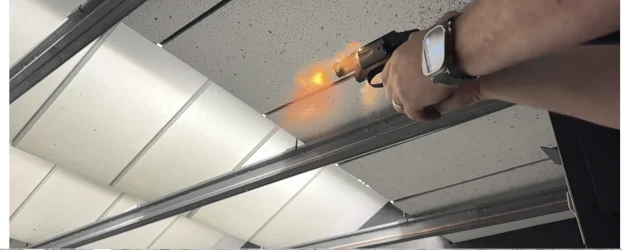
Years ago I got a smoking deal on a case of Federal Hi-Shok 110gr .357.
The ball of fire out the muzzle was so huge it was distracting.
None of the heavier Federal rounds had that huge ball of fire.
I ended up selling it to someone else that thought it was a smoking deal.
One of the fun parts of shooting Magnum loads out of my 3" Lew Horton Model 29 is the muzzle blast. My GF & I used to take turns loading it for one another from a mixture of full Magnum loads, .44 Special rounds, and empty cases. Then whoever wasn't shooting would stand a few feet to the side and just in front of the muzzle to watch for flinching (and to laugh about the muzzle blast). If you stood in the right spot it'd actually blow your hair back a little.

We shot outdoors during the day, so the fireball wasn't all that distracting to the shooter (who had the recoil to contend with anyway), but the muzzle blast still sticks in my memory after a lot of years. That, and how high the chunks would fly into the air when we used 180 grain JHPs to 'splode watermelons.
 
Excellent! Thanks for the firsthand recommendation! I've saved brass for years but don't reload at this point in time, so knowing of an off-the-shelf round that won't lead excessively is great information to have.


.Once upon a time, ammo makers used to buy used wheel weights from tire shops & so forth for casting materiel. Way, way too soft for shooting.

No clue what the cheap alternative source is these days.
 
Back
Top