
JWintergreen
Member
- Joined
- Jun 2, 2021
- Messages
- 187
- Reaction score
- 348

Have you had issues with 9mm variants of pistols jamming? My 9mm M&P 2.0s work fine with JHP if I shoot them with a loose 2 fingered grip. Haven't tried that with my 40 slide yet. The theoretical feeding advantage of 357 SIG compared to my M&P 9 2.0s is likely to be simply theoretical in nature just as the flatter trajectory is.??? Where did I say I had a Glock? My .357's are S&W, Sig, 1911's, and FN none have ever jammed, but you seem to speak from experience?

You posited that the case design of .357 SIG is a major advantage for feeding. Over what 9x19? .40 S&W?Q? What does the 9mm have to do with my comnent or the thread?
Do you own a .357 Sig? No? Maybe a 9x25? No? If not you simply have no idea what a well constructed round brings to the table.You posited that the case design of .357 SIG is a major advantage for feeding. Over what 9x19? .40 S&W?
Energy/temporary stretch is not a primary wounding mechanism in common service pistol cartridges. Permanent wound cavity (the hole the bullet crushes/cuts) is. Most tissues are quite elastic, with the nervous system, liver, pancreas, and kidney, tissue being exceptions. As I said before, Federal 9BPLE 115 gr +P+ has more energy than HST 124 gr +P or 147 gr +P. It's also got more energy than HST 230 gr .45 ACP. What does it do with that energy? Shed a bunch of weight with core/jacket separation resulting in an overall shallower, smaller hole. Sure, the Illinois State Police had good results with 9BPLE, but like many state police, they also have higher shooting standards than most municipal police departments. They've also been happy enough with .40 S&W to stick with it since they switched from 9mm, but that may change in the future as .40 S&W pistol availability declines (the ISP 100th Anniversary Commemorative pistol was humorously a Glock 17 instead of a Glock 22 because Glock wasn't scheduled to make any G22s in 2022).Uh... The 40 S&W hardly has "better terminal ballistics" than 357 SIG... Tests of 9mm, +P and +P+ vs. 357 SIG are really not even close, unless you feel +15% in velocity and often up to +40% in energy are somehow merely "niche" advantages?
Cheers!
P.S. Look at what some of the typical Alaskan gun sites say about the effectiveness of 357 SIG solids on large dangerous quadrupeds. Now, that specific application may in itself qualify as "niche", but 357 SIG "terminal performance" is definitely better (not worse).
I've shot both, but don't own either, so I'll never have to deal with the cognitive dissonance of having invested hundreds to thousands of dollars for non-existent to niche gains. Maybe I'll buy a 357 conversion barrel one day, but that money would probably be better spent on milling my 40 slide for an optic. Still, I've certainly bought sillier things out of curiosity.Do you own a .357 Sig? No? Maybe a 9x25? No? If not you simply have no idea what a well constructed round brings to the table.


It always amazes me that every couple weeks this topic comes up. For years as an LEO, we were issued 40 caliber ammo to be used in a departmentally approved firearm ( think Smith and Wesson, Glock, Beretta, etc.) The whole department, which included Male and female officers qualified twice a year without a problem. The main firearm that was used was either a Glock 22 or a Glock 23. After shooting thousands of rounds of all calibers. (9mm, 40 cal, 45 acp and 10mm). Working the street or defending my home, I still trust the 40 caliber. I have been lucky with my local Gun shops because they marked the 40 caliber down quite a bit and I grabbed them.. variety is the spice of life. Now if you want to talk about a caliber that’s on life support, it’s the 30 Super carry. Ammo and guns are marked down at local gun shows and gun shops and no one will take them on trade.
This message establishes and announces the real reason for the lack of .40 caliber pistols. Blatant stupidity based on personal (corporate political) preference.Yes, .40 is considered a solution in search of a problem. It is harder to shoot the 9mm, beats the gun up, and offers minimal performance advantages over 9s.

Yeah..that’s the ticket!Twenty odd years ago I dated a pathological liar and weird gal for a little while and she would have told you she invented the gel
Bet ya never owned a 40 and ya are only repeating unproven facts ya read somewhere else..........Speak the truth or don't speak at all.Well you know better than the FBI so who am I to argue?
My cast .40 bullets are truncated too..........Just guessing.......Mebbe to feed better.Anybody know why the FMJ 40 S&W rounds are always truncated? Even the defensive rounds aren’t round profile. Does it have to do with feeding based on OAL?

Yes, I think so. It keeps the rounds short enough to work in a frame shared with 9mm.Does it have to do with feeding based on OAL?

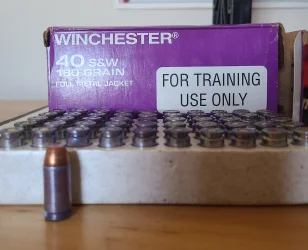
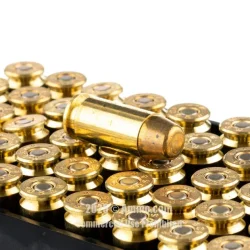


IIRC, it's because the .40S&W cartridge was designed to fit into pistols with 9mm size grip frames and the truncated cone allowed that to happen by reducing the overall length to not exceed that of 9mm.Anybody know why the FMJ 40 S&W rounds are always truncated? Even the defensive rounds aren’t round profile. Does it have to do with feeding based on OAL?

Yep, I've heard retired cops say that the rollout of the S&W 4000 series was not without serious teething issues.Regarding .40S&W "beating up the gun"; it's an artifact of some manufacturers (like Glock) originally shoehorning .40 into pistols originally designed as 9mms.
The S&W M&P .40 as introduced, was originally designed for .40 S&W, the caliber, followed in the market by the M&P 9 using the same design and basic components.
Treads that have a few pages to tend do then to drift away from the opening tread . Thats life on most any forum.Q? What does the 9mm have to do with my comnent or the thread?
I didn't know we had the handgun (and overall) genius on here, so I stand corrected. I'm sure your entire life has validated your advanced intelligence, so I'll just stand here and bask in your superior intellect. Thanks for taking time out from running the world to grace us with your wisdom.This message establishes and announces the real reason for the lack of .40 caliber pistols. Blatant stupidity based on personal (corporate political) preference.
Thanks for suspecting another reason. That comment wasn't directed initially at the firearms community. Allow me to fill in the blanks,I do think that this last observation might be a tad harsh...? I don't consider use of the term(s) "personal (corporate political) preference" to be directed at any individual (or group of such, i.e. thread contributors) but more likely a generalized indictment of all aspects of the firearms community.
Just an IMHO...
Cheers!
As somebody who began carrying a .357 Magnum revolver in the early 80's when most people carried revolvers, I don't understand why so many people say the .40S&W is snappy and hard to shoot.Thanks for suspecting another reason. That comment wasn't directed initially at the firearms community. Allow me to fill in the blanks,
The initial idiotic opinion was the FBI - under the control of the leftist group mind - decided the 9x19mm round is just as good as one of the real calibers.
This decision was based on the results of gelatin testing penetration and expansion and ignoring any energy transfer.
This decision was based on the failure of too many candidates failing the handgun qualification. The massive (in some manner to the control faction) was a result of the chosen and politically correct candidates not being able to control the hideous recoil and muzzle blast of the terrifying .40 S&W round.
The only reason to put any blame on shooters is the blind belief of the announced results of the above mentioned gel testing.
Note: I am roughly five foot, five inches tall. I was in pretty good heath (overweight) during the time involved. In the time preceding 'issue' arms only, I carried an H&K USP in .40 S&W. We had three firearms qualifications a year. I typically scored in the top two or three officers. My small size was no problem compared to my hard head.
I'm pretty sure that I posted in here that I think that a lot of .40 S&W's 'snappy' reputation comes from most widely being used early on in slippery Gen 2 and Gen 3 Glocks with the ergonomics of... a Glock.As somebody who began carrying a .357 Magnum revolver in the early 80's when most people carried revolvers, I don't understand why so many people say the .40S&W is snappy and hard to shoot.
How did people back in the day ever qualify with .357 Magnum revolvers?
I personally never owned a 9mm until about 12 years ago or so because I needed a pocket pistol.


