Snubby practice distances

I qualified with three snub nosed revolvers (340, 64-4 and SP-101) last week, which included shooting at 25 yards. I had no problem shooting perfect scores with those guns.

My range has backers at 12 and 25 yards, so most of my practice is at those distances. Occasionally I’ll go over to the rifle range and shoot the handguns at 50 and 100 yards. You can hit a man size target at 100 yards with a 2” revolver. There may not be a lot of practical applications for shooting a snub at 100 yards, but it’s fun.
 
I rarely shoot at any distance closer than 25-30 yards with any handguns and I make no exceptions for snubs.
I primarily shoot nothing but steel plates. I was a fabricator for a long time and I have steel plates I made scattered all over the ranch and farm. I’m just as likely to be found shooting at a plate 100 yards away as 50. When you get to where hits on a 12” plate are routine from 100 or more the closer shots seem easy.
 
Snubs are not inherently inaccurate, they just require more of the shooter. I love the challenge, as well as the look, feel, and general aesthetics of snub revolvers. But it is strictly avocational for me, the fun, I do not carry for personal defense and do not live in an area where I have ever felt the need. So a different perspective, not better or worse, just different.
 
I only practice from 7 yards in with my m and p 340 and 327 pc , I dont see the need to try and hit something 100 yarda away like the honest outlaw. Thses guns are for I. Close encounters. Anyone else practice from longer distances.
I do but I live on 28 acres of woods that joins a national forest. Chance encounters
with 4 legged critters that can do real damage is real as well as 2 legged trespassers.
I practice out to 25 yds with every handgun I carry, snub or otherwise.
But, it's situational. If I lived in the suburbs or the city, I can see you point and agree.
Dano
 
I have to qualify with my 442 on the same course of fire as my issued Glock.

100 rounds. Out to 25 yards. A bunch of strings of fire that require multiple reloads.
Basically, it sucks, but it’s great practice and has made me a much better snub shooter.
 
Most of the time 5,7 and 15 yards with my 442 and I do shoot some at 25 yards with my 2 1/2 66-2 and 19-4 also 2/12.
Yes Sir!!, at 25yds model 19 and 66 with 2,5" barrel are plenty accurate, l remember shooting a friends 19 2,5 barrel at the range capable of consistent 9 ringo and some 10 with 158gr SWC .357 loads!!!
 
When the time comes to fight someone, you will be limited to what you can do. The only reason to practice close is for speed. Once you can do it fast enough, and accurate enough,
Back up!
How is this a bad plan?

Here I comment on ideas I hear at this forum, in anticipation of correction and contradiction, for which I am grateful.

"Have a gun"
The idea is that in many encounters the attacker leaves at the prospect of offered resistance. The person who is fast and accurate at distance can do this.

"Shot Placement"
The idea is that no matter what weapon you use, you must score anatomically significant hits. The person who is fast and accurate at distance can do this.

"3 Shots, 3 Yards, 3 Seconds"
If you accept this mantra, then you must certainly see why someone who can do 3 shots, 25 yards, 3 seconds can also do it.

"Typical Distance, Typical Gunfight"
The idea is that there is no typical gunfight. The fight is "dynamic, fluid, unpredictable," etc.
if you can fight while moving,
if you can fight at longer range,
if you can hit a moving target at 25 yards,
then you may stay in the fight as these apply.

"Bad Guys Don"t Practice"
The idea is that the CCW defender will have overwhelming advantage at longer distances having learned how to be fast and effective at range.

Honestly, my experience is that people who practice with a j-frame at 25 yards are not fast, but neither are the ones who practice at seven yards.
Those who have the fastest draw use fancy race equipment.
Those who have fast split times are happy with an 8 inch group.
I see folks at the range holding their pistol up, pointing at the target, waiting
waiting,
Waitinggggg,
I'm like,
"Shoot!!"
They are waiting for the sights to settle down and be still.
They are waiting for the trigger break to "surprise" them.
Nobody ever needs to do this.

Good thread. Thanks.
Kind Regards!
Brian D
 
From what ive read ( probably here) many jurisdictions consider 10 yards to to the limit for a legal self-defense shooting ( obviously there can be numerous extenuating circumstances, like someone repeatedly firing at you from farther away, but in this case, it's probably considerably easier to just jump behind a tree or vehicle, than to engage an active shooter, with my piddly 5-shot Airweight 38, wasting rounds on a target that I, and most of us, have virtually no chance of hitting.)
I'm not saying practice and proficiency shouldn't be undertaken, just that these ( usually absurd) "shot-placement/double-tap/ multiple-target" scenarios that are so rigidly clung to on all the gun forums, are more suited to a Liam Neeson movie, than real life.
So, definitely under 10yds, for me personally. I'm not regularly wasting expensive ammo on 25-100 yard shots, that have almost no real-world value (YMMV, let the flames begin).;)
 
Last edited:
I practice most the time at 20-25 yards. I have good days, and bad days. But it builds my skills. Three to seven yards only makes me feel good! Most of us like the "feel good", so we never want to move back into the hard
we stay in our "feel Good"!

In practice if you find it easy, your building you ego. If you find it difficult, your building your skills.

When you then test your skills in competition or shooting a qualification, you will feel confident , and it will show in the results.

So I suggest, train beyond your requirements.

One thing I will add.
 

If you are practicing for personal defense than beyond around 20' is just fooling around. When I was a tad younger I could actually hit something with a S&W 642. I was chief of the dept shot this during a night qualification. Borrowed one of my officers handguns.

Rich


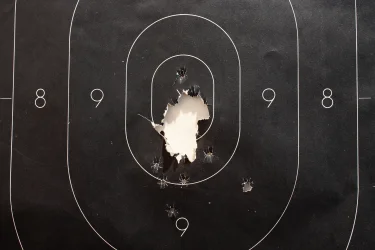
IMG_3535_Qual Target_07-03-11.webp


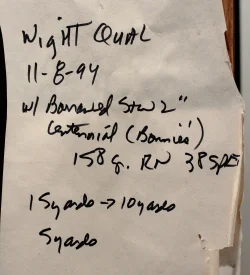
IMG_3542_Qual Target Words_07-03-11.webp
 
In North Carolina law enforcement officers are required to qualify, at least annually, on a state approved course of fire. The current course requires shoot any handgun back to 25 yards. The state does not make exceptions for the type of handgun or barrel length.

When I started in 1979 we shot qualification out to 50 yards. I started with a Model 66-1 with a 2.5 inch barrel. We did OK out to that distance. The trade off was no night qualification then.

I was initially trained by the NC State Highway Patrol (my agency sent agents to three NC SHP Basic Schools). The SHP shot out to 60 yards at that time.
Yes. We had to qualify on a standard range out to 25 yds, with whatever we planned to carry on or off-duty. I prefer a K frame snubbie in my pocket, but I qualified every year with my P-64 as well.
 
Given the magical distance that 7yds represents, I often start most warm ups at 7 yds in an effort to get what that distance is engrained in my head. I then will stretch practice with my 340 or Tomcat to 12yds and others to 25 yds. The goal here is to force the aim small miss small idea.
 
I've my a 2in model 10 and colt dic special 38 i have shot from 35 yrds. A torecass model 85 i got from my dad i havent figured out at that range. Few small semi auto at the same range. I have a SCCY i won in a raffle that surprisingly is very accurate but the trigger is horrid. I agree with the earlier posts. On close in shooting drills.
 
I do the Old Bakersfield Qualification course with everything I carry. Distance goes out to 20 yards and I use the shot timer. I can easily qualify with my 2" 940 under the semiauto times. Moonclips make the difference.

I have used the 43C in Steel Challenge and to practice for that I was hitting paper dessert plates at 25 yards. This revolver is very accurate and minute of man to at least 50 yards.

Back when my eyesight was 20/15 I shot my custom 2" 625 at 100 yards. I needed to hold up the entire front sight in the rear notch but I have already put all six on a man size target at that distance, shooting off the bench.

I shoot quite a bit less these days and most of my time at the range involves shooting for accuracy.
 
People get freaked out when a loaded gun goes into their hand, as well as with short sight radiuses, recoil anticipation, small targets, distance, and performance anxiety. Practicing at distance helps overcome many of those obstacles. It builds confidence.

I have to shoot out to 25 yards for my LEOSA qualification and still have this competitive drive to have my “pass” associated with a score as close to 100 percent as possible, but certainly at least above 90. That means I have to still be able to hit tighter groups than the proverbial broad side of a barn with a 642 at 25 yards. I’d still practice at farther distances except that I no longer have much of any access to ranges deeper than 25 yards for pistol.

I have a 36 no-dash from 1987 that has a fine, thin front sight ramp. This revolver is easily my most accurate J and will perform very well at distances beyond 25 yards if I do my part and have good light to be able to see the sight alignment. Of course with practice and judicious application of marksmanship fundamentals, great iron sight handgun accuracy can be demonstrated at longer distances.

For those who say that practice beyond 21 feet is unnecessary, Can you still manage to maintain an adult human fist-sized group at that distance under the stress of a sub two seconds draw from under a concealment garment with five shots unleashed in less than a total of five seconds? Running the target out to 25 yards be working on grip, sight alignment, trigger control, and patience will help develop skills necessary to perform at shopping cart or SUV distances.
 
Last edited:
Keep forgetting that the Model 19 2.5" actually qualifies as a snubbie and shoot it right along with the Models 66 & 686...

In comparison it doesn't do too badly, either...?

Cheers!

P.S. re: The original premise, I practice with all short-barreled firearms (1.75 to less than 4") at around 7 to 9 yards, longer with silhouette targets.
 
Snub-nose revolvers are typically effective for close-range shooting, with most users finding accuracy at distances up to 10 to 15 yards. Some skilled shooters can achieve hits at longer ranges, but snubbies are primarily designed for self-defense situations that occur at close quarters.

I practiced mostly at 3,5, & 7 yards point shooting a 6" paper plate and sighting on a 3X5 card. I did shoot up to 25 yards as required by my department when qualifying with the Colt Detective Special as a duty and off duty weapon.
 
First, I agree that in the unlikely event a non-LEO civilian gets involved in a defensive shooting, it will probably be at bad-breath distance. As such, spending time practicing at 10 yards or so and closer makes sense.

But by the same token, there is absolutely no harm in stretching the range out a bit—or even way out—on occasion.

On a related note, one of the reasons I strongly recommend action pistol sports is that it allows you to gain a realistic view of your own abilities, in that it forces you to learn what it’s like to engage targets in locations and at ranges not of your choosing. As a wise man once said, “A man’s got to know his limitations.”
 
My comments are not intended to be criticism of the FBI or law enforcement. My comments are just my observations of violent criminals in violent gunfights with law enforcement.

I have recently watched 3 YouTube videos by The FBI Investigates. The videos appear to be a very accurate re-enactment of the events. I watched the Miami shootout, the Hollywood shoot out, and the newer video on the 1997 Richmond bank robbery in Virginia.

I was curious to learn something from events of a gunfight with multiple gun-wielding bad guys. Of course, the events were part of criminal investigation by law enforcement that lead to a shooting with multiple firearms, and killing, of civilians and law enforcement people.

I have multiple take-aways, and questions, after viewing these videos. The biggest standout for me was the apparent lack of target accuracy. Was the inability for those officers to hit an A-zone, C-Zone, a headshot, or the un-armored pelvis area due to the lack of training, their firearm’s performance, or other factors? Some of the distances were extremely close range. Some distances looked like 20 to 30 yards.

Or... is being in the stress of a violent gunfight cause muscle memory and trained reactions to fade?

The Honest Outlaw has repeatedly shown the accuracy of handguns out to 50 and 100 yards. Was he in a gunfight. NO, but he demonstrated the potential accuracy of the firearm.

The 22-year old, Elishsha Dicken, inside the Indiana mall, fired 10 rounds striking the killer 8 times at a distance of about 40 yards from a 9mm Glock 19. I consider that to be incredibly accurate shooting under an extremely violent few seconds.

Is practicing and training at 7, 12, and 15 yards good enough for an average defense carrying civilian? Is it a good idea to also practice 25 or 30 yards?

The famous 1986 Miami FBI shoot out has been widely publicized and analyzed. And eventually changes were made as result of what they learned. 11 years later, did the FBI in Hollywood use any of what was learned from the 1986 FBI Miami shootout?
 
Last edited:
If you are practicing at 3 yards, that is fine.
If!
Place three 8 inch paper plates side by side as targets.
In the center of each plate, draw a one and a half inch black spot as a bullseye.
From low ready,
Fire one in the center,
One in the left,
Another in the center,
One in the right,
One last shot in the center, for a total of five rounds.
Par is 3 seconds.
Add a full second for each round not touching black.
Any round more than one inch from the black is a DQ.

If you can do this...
...you are too close.
 
I use the NRA basic pistol achievement targets from 3 out to 20yrds for snub work. Like everyone has said if you can hold 5 shots in a 5inch circle at 20yrds. Then anything closer is easier. At 50yrds the group opens up a little, but it's still enough to take out a B27.
 

Attachments

My comments are not intended to be criticism of the FBI or law enforcement. My comments are just my observations of violent criminals in violent gunfights with law enforcement.

I have recently watched 3 YouTube videos by The FBI Investigates. The videos appear to be a very accurate re-enactment of the events. I watched the Miami shootout, the Hollywood shoot out, and the newer video on the 1997 Richmond bank robbery in Virginia.

I was curious to learn something from events of a gunfight with multiple gun-wielding bad guys. Of course, the events were part of criminal investigation by law enforcement that lead to a shooting with multiple firearms, and killing, of civilians and law enforcement people.

I have multiple take-aways, and questions, after viewing these videos. The biggest standout for me was the apparent lack of target accuracy. Was the inability for those officers to hit an A-zone, C-Zone, a headshot, or the un-armored pelvis area due to the lack of training, their firearm’s performance, or other factors? Some of the distances were extremely close range. Some distances looked like 20 to 30 yards.

The Honest Outlaw has repeatedly shown the accuracy of handguns out to 50 and 100 yards. Was he in a gunfight. NO, but he demonstrated the potential accuracy of the firearm.

The 22-year old, Elishsha Dicken, inside the Indiana mall, fired 10 rounds striking the killer 8 times at a distance of about 40 yards from a 9mm Glock 19. I consider that to be incredibly accurate shooting under an extremely violent few seconds.

Is practicing and training at 7, 12, and 15 yards good enough for an average defense carrying civilian? Is it a good idea to also practice 25 or 30 yards?

The famous 1986 Miami FBI shoot out has been widely publicized and analyzed. And eventually changes were made as result of what they learned. 11 years later, did the FBI in Hollywood and Virgina use any of what was learned from the 1986 FBI Miami shootout?
Dicken fired four times from the trash can and missed twice.
Then he closed half the distance and fired several more.
Closed half the remaining distance and fired again.
There is reason to believe the two misses were from the longest distance,
There is no way to know.
The gunman reacted to the first shot, he may or may not have been hit. The video was never released.
This is not to disagree with your worthy perspective.

The main reason for the misses is movement.
When you fire you assume the bullet arrives immediately and that the target is stationary.
 
Dicken fired four times from the trash can and missed twice.
Then he closed half the distance and fired several more.
Closed half the remaining distance and fired again.
There is reason to believe the two misses were from the longest distance,
There is no way to know.
The gunman reacted to the first shot, he may or may not have been hit. The video was never released.
This is not to disagree with your worthy perspective.

The main reason for the misses is movement.
When you fire you assume the bullet arrives immediately and that the target is stationary.
Hello Brian,

I have not read any details of Dicken's movements during his stopping the shooter. My point is... apparently a young civilian was able to do something in less than 30 seconds that highly trained law enforcement have shown are unable to do. It would be nice to know how much actual firearm defense training or practice Dicken had at the time. If Dicken started at 40 yards and missed twice, that's understandable. If he closed the distance to 20 yards and fired again, and didn't miss that is understandable. If he closed the distance again to 10 yards and fired again, he shouldn't miss.
 
Back
Top