One of the First Model 66's

Joined
Dec 31, 2010
Messages
13,100
Reaction score
34,141
City & State/Province
Atlanta area
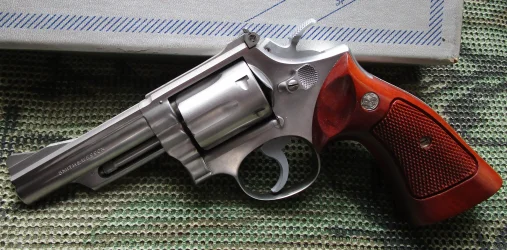
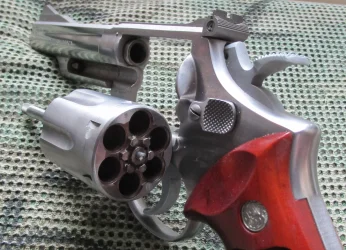
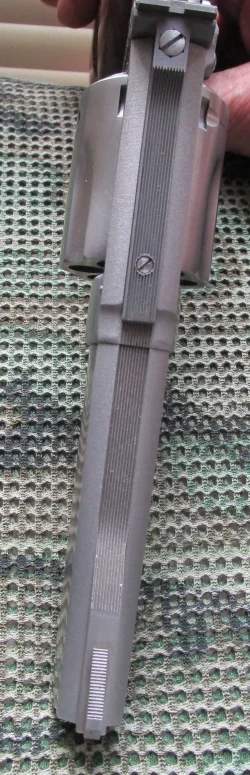
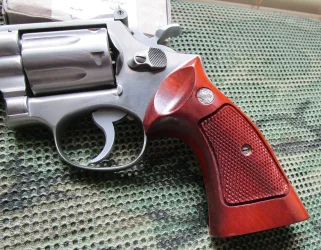
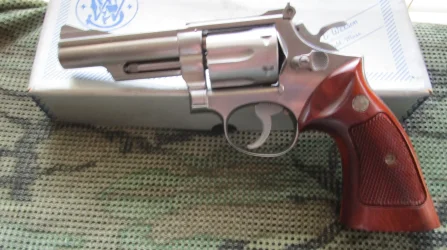
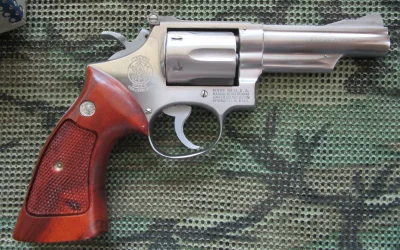
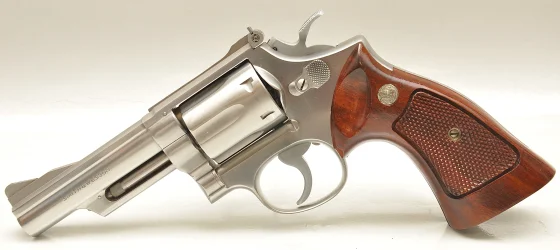
I posted about this on the Collector Association site back in March when I obtained it. Doc44 was very helpful in helping me learn the details about the development of these guns. In May, 1970 S&W made a run to test the tooling for their new stainless Combat Magnum. These guns are considered pre-production prototypes. The Model 66 was officially announced in July of 1971, and according to Doc, many of these "prototype"s were kept in the factory and eventually shipped to G.T. Distributors in 1975. G.T. Distributors was owned by S&WCA founding member, Bill Orr. My gun came in the grey box, normally associated with nickel plated S&W's, but that is what they used. The owner's manual is for a Model 19 Combat Magnum, with the parts diagram dated 2-70, which make sense, as at the time there was no Model 66. They were equipped with a target hammer, standard trigger and target stocks.

When I was bidding on this one, K949212, I knew it was an early 66 but I had no idea at the time that it was one of the pre-production guns. I am patiently waiting for my letter to learn more about this special revolver and will post that information when I have it in hand. In the mean time, here are some photos of my 66. Doc, I hope I accurately portrayed the information.IMG_2273.webpIMG_2272.webpIMG_2274.webpIMG_2275.webpIMG_2277.webpIMG_2184.webp
 

Attachments

  • IMG_2186.webp
    IMG_2186.webp
    969.8 KB
  • IMG_2187.webp
    IMG_2187.webp
    2.1 MB
Beautiful example of one of the touchstones in S&W revolver history, especially for the stainless side. Congrats on it being a pre-production-run one, as well - enjoy in good health.
 
Spectacular acquisition for your collection! Congrats on a fine pickup.
I've sought out the early No-dash examples in several models. But this one would easily be considered a "Grail" revolver by most. A true piece of S&W history there. Hope to see the Factory letter when it arrives. I've never done a letter on any in my meager accumulation, but this one is certainly worthy.
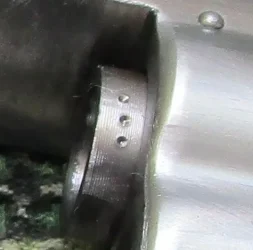
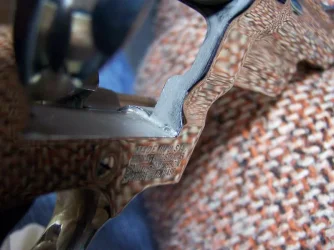
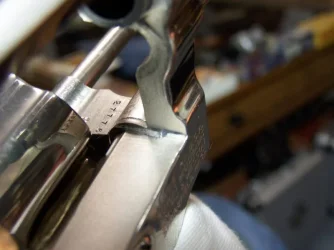
A question?? The punch marks on side of barrel breach. Inspection marks or possibly hardness testing?
 
Such a cool piece of history. Thanks for sharing its story. I didn't realize the Model 66 dated back that far, but now I want one more than ever. I, too, am curious if there is a consensus at the meaning of the punch marks on the barrel extension. Seems like only one would be required for hardness testing, and that it wouldn't be as deep, yet I haven't noticed those marks on the pedestrian Smiths I've worked on.

Also, I gotta know, even though people will probably be aghast at the concept, but will you shoot it? Because I'm pretty sure I would, at least as long as I could tell it had been fired outside the factory. It wouldn't be in my regular rotation, but it'd be cool to experience that particular piece of history firsthand.

Congratulations on a very nice addition to your collection.
 
Glad I wasn’t the only one wondering about those.
Looking at them again, maybe they actually are for hardness testing. At first I thought they were too deep for that, but that's a pretty close up photo. And, while it'd be odd to test the same part three times in a production environment, maybe they were just triple checking since it was a prototype.

Hopefully, someone with real world experience will set the record straight.
 
Glad I wasn’t the only one wondering about those.
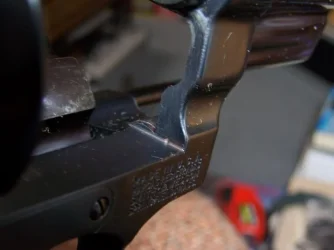
S&W used punch marks on revolvers to signify that the gun was test fired and passed, but they typically marked them on the bottom front corner of the frame window.

Here's a few from the early 60's to the mid 1970's.

IMG_4761.webp
IMG_4762.webp
IMG_4763.webp
 
S&W used punch marks on revolvers to signify that the gun was test fired and passed, but they typically marked them on the bottom front corner of the frame window.

Here's a few from the early 60's to the mid 1970's.

View attachment 878872
View attachment 878873
View attachment 878874
Thanks for the lesson. I'm almost exclusively a semi-auto guy, so I'm not well versed in S&W lore, and therefore appreciate the learning opportunity. I just checked the circa 1970 Model 19-3 I inherited from my dad and it does indeed have a very small punch mark in that very spot. I wouldn't have thought twice about it if you hadn't pointed out its purpose.

Those marks look smaller than the ones on the OP's barrel extension, which causes me to question even more whether or not they could be from hardness testing.
 
Those punch marks on the outer area of the forcing cone remain a mystery. Because these guns were made to test the tooling required to make the production guns I suspect they were part of the testing process, although, so far, I have not heard of this on any of the other test guns, including Doc44's example. There are several theories but no one knows for sure.
 
I sold my early 66 to a buddy.
It was in similar condition.
I can still shoot it whenever I want!
 
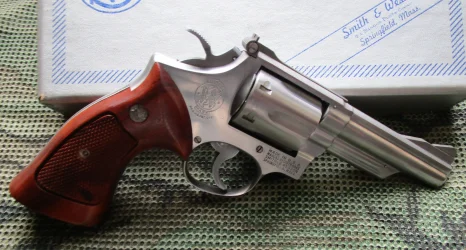
Your summary about the Model 66s made to test the tooling for the stainless .357 Combat Magnum is correct. Below is a photo of K949138 for comparison.

K949212 shipped to Bill Orr's Company, G. T. Distributors, on November 7, 1975. Like K949138 and many of these guns made to test the tooling, they were kept in the factory collection for five years before being shipped.

Bill

DSC_0023.webp
 
Last edited:
I was issued a 66-1 to replace an old Colt Trooper 6" and when I left the dept. I asked the chief if I could buy it, the answer was no!
many years later at a gun show I met a S&W collector who was looking for a Model 27 (Which I had picked up years before for a good price).
After a little horse trading we agreed to an even trade. I now have a 66-1 with the box from my duty gun!
 
Of course they came with an integral (not replaceable) stainless front sight and the rear sight was stainless as well. Later in the no-dash production they changed the rear blade, if not the whole sight, to blued.
 
Of course they came with an integral (not replaceable) stainless front sight and the rear sight was stainless as well. Later in the no-dash production they changed the rear blade, if not the whole sight, to blued.
The rear sights on Doc44's gun and mine are obviously stainless but have a different color than the other early production 66's with the stainless rear sights. These are a dull grey color. The complaint, as I remember, about those rear sights were they were too reflective, so S&W changed them.
 
To answer some of the questions that have come up, It's my understanding that there were approximately 100 of these guns made to test the tooling in 1970, but I really don't know the actual number. Hopefully my letter will clear that up, but maybe not. Will I shoot it? I would, but that's way down the road. As for the punch marks, the folks that made these guns have long gone from the factory and we may never know why it was done. I'm hoping more of these guns surface over time so we can see if the practice was common or not. For now this one will sit on the shelf with Combat Magnum, K260528, that shipped in the first block, six months into the K frame magnums.
 
Back
Top