
3913 Ejection Problem

lwestatbus

Member
Joined
May 28, 2017
Messages
66
Reaction score
46
City & State/Province
Cocoa Beach, FL
I have a 3913 which has started failing to eject 1 - 2 rounds per 8-round magazine. A round will fire and the slide will cycle and wedge the nose of the next round up under the rim of the case on the just fired round which remains in the chamber. The problem exists with two different magazines and with a couple of different factory ball 115 grain ammo types and does not seem to depend on which round in the mag is being fired. I bought this used from a dealer who said it was a police department turn-in (the dealer supplied firearms to LE agencies) so I have no idea of the gun's history. It fired reliably for several years, though it wasn't a mainstay in my range line up. Finally, I don't see any visible issue with the bolt face and parts but am not really sure what to be looking for.

This pistol had occupied a narrow but important place in my CCW line up but I clearly can't carry it now until I can get this issue fixed.

Has anyone else had this issue and can you point me to a probable cause? I don't want to just start swapping parts on speculation and a new Extractor is $100 on Numrich while the Extractor Spring is only $3.50. Willing to pay if this is the issue but not on speculation. Again, the issue is not every round but very, very frequent.

Many thanks.

Larry
 
Last edited:
First thing that comes to my mind is a build up of powder residue and old lubricant in the extractor slot. Aerosol gun cleaner or non-chlorinated brake cleaner will flush out that gunk. It's happened to me and that was the solution to the problem.

Beyond that, inspect the extractor hook for a chipped or worn edge. If the tip of the hook is damaged, the extractor will need to be replaced. The other possibility is a weak extractor spring.
 
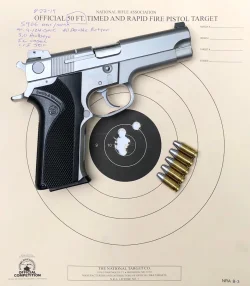
Began to experience the same kind of extraction failure, a couple decades ago, in this 5906:

FullSizeRender 207.webp

I determined the cause to be a weakened coil spring which tensions the extractor. Replacing that spring solved the problem. The 3913 uses the exact same specification extractor and coil spring.
 
I had this exact problem with my 5906TSW a month or so ago. I posted about it here, https://smith-wessonforum.com/threads/extraction-problem.794889/

Field strip the gun, give the extractor a good cleaning with Hoppe's Elite Aerosol Gun Cleaner spray or Birchwood Casey Gun Scrubber spray. Just note that the Birchwood Casey stuff has a strong odor.

If you're willing to do a bit more work, you can remove the firing pin and spring from the channel and give that a good scrubbing as well. On my 5906TSW that was pretty grungy as well.

After that, the problem was solved and the gun shot fine.

 
Last edited:
Thanks for the input and apologies, I didn't realize that I hadn't replied yet.

I'm going to try both the new spring and the detailed cleaning that Exchipy and GaryS mentioned. Spring is on the way and I'll do the cleaning when I disassemble to replace the spring. If I'm lucky, I'll put it all back together correctly. :oops:
 
You probably know this already or you’ll look it up, but the extractor pin is tapered and is removed from top to bottom.

Not sure if it really helps but I’ve always sprayed Kroil a day or two ahead. They are almost a press fit and some come out easier than others. I had a 4516-2 that was a total b but I eventually got it driven out, (and back in.)

Jim
 
Before you go to the Trouble of replacing extractor spring, I would suggest a good cleaning and new recoil spring (always for a used pistol) and try again. I bought extractor spring for used 4006TSW and was waiting for it but decided to clean and replace recoil spring and problem went away before extractor spring arrived.
 
I had no need to replace the extractor springs on any of the 14 or so 3rd Gens I've cleaned since I had the problem with my 5906TSW. A good cleaning did the job.

Recoil spring? Yes, that's just cheap insurance.
 
First thing that comes to my mind is a build up of powder residue and old lubricant in the extractor slot. Aerosol gun cleaner or non-chlorinated brake cleaner will flush out that gunk. It's happened to me and that was the solution to the problem.

Beyond that, inspect the extractor hook for a chipped or worn edge. If the tip of the hook is damaged, the extractor will need to be replaced. The other possibility is a weak extractor spring.
"First thing that comes to my mind is a build up of powder residue and old lubricant in the extractor slot."

2 times that ^^^^

My BG2 and P365s build up hard packed ammo residue very quickly at the extractor. I spend extra time cleaning that area with Bore Tech C2 Copper Cleaner, and put a small drop of Clenzoil on the extractor claw and striker lock.

Too often I read post about a problem and it does NOT fully describe the maintenance frequency, the cleaner and lubrication, and specific cleaning and inspection process. I clean and inspect my firearms after every use, but some of my range buddies think I'm goofy.:rolleyes:
 
If it were me, I'd check the ejector to see if the tip has broken off.

The older ejectors had a short tip, and a sharp corner underneath the rear of the tip. Sometimes with enough use, the tip might snap off at the sharp corner. The tip was eventually lengthened, to help with ejection when +P & +P+ loads were use (and produced faster cycling) ... and the sharp corner under the tip was revised to be a curve, to prevent a stress riser from developing.

The ejector and extractor work together, so it's prudent to check both to make sure they haven't been damaged over time and use. Everyone looks for a badly chipped or broken extractor, but often forgets to look across the frame at the ejector.

In this pic you can see the sharp corner under the rear of the tip in the bottom ejector, which is an older version. The top ejector is the newer version with the longer tip and radiused angle that replaced the sharp corner under the tip.
 
If it were me, I'd check the ejector to see if the tip has broken off.

The older ejectors had a short tip, and a sharp corner underneath the rear of the tip. Sometimes with enough use, the tip might snap off at the sharp corner. The tip was eventually lengthened, to help with ejection when +P & +P+ loads were use (and produced faster cycling) ... and the sharp corner under the tip was revised to be a curve, to prevent a stress riser from developing.

The ejector and extractor work together, so it's prudent to check both to make sure they haven't been damaged over time and use. Everyone looks for a badly chipped or broken extractor, but often forgets to look across the frame at the ejector.

In this pic you can see the sharp corner under the rear of the tip in the bottom ejector, which is an older version. The top ejector is the newer version with the longer tip and radiused angle that replaced the sharp corner under the tip.
A picture is worth a thousand words.(y)
 
Back
Top