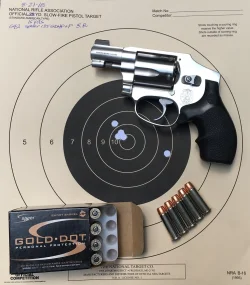
Snubby revolvers are not hard to shoot accurately

Alk8944

US Veteran
Joined
Jan 28, 2007
Messages
10,666
Reaction score
14,026
City & State/Province
Sandy Utah
The only reason many have a hard time shooting a snubby revolver is because so many make the claim they are hard to shoot to excuse their poor performance. They have heard this so long, and believe it so they accept poor shooting because they believe it is the guns fault, not theirs.

Let me give you an example of my own experience. Years ago when I was regularly shooting the PPC, Police Pistol Course, with my department. The state competitions included shooting the full course of 600 points with both target revolvers and snubbies, full course with either gun. At the time I shot NRA Master Class with both guns. My typical scores were in the 590s/600 with my 6" K-38. My scores with my snubby, a 2" Model 12 Airweight typically were only 12-15 points less than with the K-38. These were for the full PPC course that extended to 50 yards and included both single and double action fire for those of you unfamiliar with the PPC.

Snub nose revolvers are just as inherently accurate as longer barrels, don't let anyone tell you differently! All you need to do is put in the shooting time to achieve this level of accuracy.

Now, what is your excuse?
 
I admit, I do shoot my K-frame (older Mod. 66-2), better than my J-frames (642, 638, 60, 432UC, but not too bad with my 640Pro) or my LCRX 327. I wouldn't mind a good Mod. 12 snubnose, I just never came across one to buy.
 
Now, what is your excuse?
Mine is that I stink. Sometimes I’ll blame the weather though.

Not necessarily apples to apples, but when I qualify with my Glock 43, I usually score about the same as with my Glock 19 or 45. As a matter of fact, I recently did a two day red dot transition and I shot my G19 the first day and G43x the second day and actually shot the 43x better.

I’ve never shot a J frame. I’ll get one eventually. I will admit, though, that as much as I like their appearance, I struggle with S&W’s traditional fixed sights.
 
Snubnoses are indeed no more or less inherently mechanically accurate than longer barrel revolvers. Heck, in theory, a shorter barrel could have less barrel whip then a longer pencil barrel.

Now, that being said, most people will find common snubnoses like J-frames to be less accurate in practice due to small, fixed sights, short sight radius, grips chosen for concealment over ease of shooting, and recoil (whether anticipation or fatigue setting in more quickly).
 
I have a 2" Model 15 that is really accurate. Almost as accurate as my K-38 Masterpiece with a 6" barrel. But the 15 has the best S&W trigger that I have ever fired. It is the classic 'breaking glass rod': a very thin glass rod.
 
Unless I'm reading wrong you relate an example of a fairly accomplished and well practiced revolver shooter that does just a little worse with a K frame snub nose than a 4 inch K.

I think that more proves the old saw than dispels a myth. Snub nose revolvers are harder to shoot accurately. They are not intrinsically inaccurate, but they certainly demand more from the shooter.
 
My excuse is that I don't practice enough. That being said the factory trigger pull on current J frames is excessively heavy. Coupling that with an air weight or air lite frame along with typical boot grips is not a recipe for success.
 
My experience with a S&W 640-1, 19-3, and 29-3 has been that the smaller the platform, the harder they are to shoot well. Mechanically, they are all capable of great accuracy. The shorter the sight radius, the harder it is to make precision shots. The difference in lock work design and grip size also makes the small J frame harder to shoot accurately. Can I do it? Yes, I can, it's just easier to do with the K or N frame.
 
I remember taking my Ruger Speed Six (2&3/4" stainless .357) to the range. Guys were always telling me how worthless/inaccurate the snub nosed guns were. Then the little Ruger would amaze them. It was my off duty gun, my winter time back up gun, my fishing gun (with snake shot).
 
Difference in accuracy is based on two things shooting load snub nose was regulated for and sight radius of longer barreled guns is superior for most shooters performance.
 
A "snub nose," suffers from, a short sighting plane, rudimentary sights, heavy trigger pull, light weight. All of these can be overcome. Training, range time is invaluable. The biggest problem with snubs, is the insane tendency of people who have watched too much tv, to want one as a beginner gun. Sure, I saw "Cannon," the overweight detective, shoot a motorcycle at 200 yards offhand, making it explode,but I think (lol) that was with a little help from the special effects guys. They are NOT a beginners gun. Seems it is either the customer, who watched too much tv, or the sales guy, who knows nothing, who recommends them to beginners. And that's where the, "You can't hit anything with a snub," reputation begins.
 
Several years ago I was teaching a class and had the one blowhard in class that everyone quickly gets fed up with. He knew everything there was to know about guns, just ask him. He made the comment that at 100 yards he'd let someone with a 2" snub shoot at him all day long. They were inaccurate. When we went to the range I set up a B-27 target and we got back to 100 yards. I had my S&W 49. Load was my standard carry W-W 158 gr LSWCHP. I said we'll see how accurate a 2" snub is at 100 yards. I fired 5 rounds standing 2 hand and we checked the target. All 5 rounds center mass. The blowhard said anyone can get lucky. So back to the 100 yard line and fired 5 more rounds. All 5 center mass.
100 yards is really not difficult. Rest the head on top of the front sight. Makes a great reference point. Then remember the basics of shooting. Too many never learned them. Sight alignment, breath control, trigger pull.
 
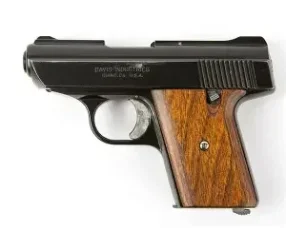
1783259699372.webpImage taken from the web. Davis .32
Not a J frame obviously, in the last century leaned over a truck hood I could keep all shot on a paper plate at 50 yards.
Nice to know if I was ever attack by a paper plate and at 50 yards as that .32 bullet sauntered down range a fellow would have time to light a cigarette and step out of the way. ;) :ROFLMAO: :ROFLMAO: :ROFLMAO: :ROFLMAO: Trigger time, trigger time, trigger time.
JMHO. J frames are for self-defense. Each of us needs to determine what range is REALISTICLY what we are going to need and do the bulk of our practice there. Sure, throw a few long-range shots in from time to time for poops and giggles. The Dickens Drill is all well and good, just don't get lost in the weeds. The ability to get your roscoe into action and going to work at just past bad breath distance is what you'll need the most, and god forbid you ever need that.
 
I was at the range some time ago, and a young-ish man was there. He went up to the bench, took a Ruger SP 101 out of a factory box, and shot a cylinderful of 5. He retrieved his target, looked at it; most rounds were on the paper, packed up his gun and left. Probably where some of the reputation for "hard to shoot well" originated.
 
Last edited:
My excuse is that I don't practice enough. That being said the factory trigger pull on current J frames is excessively heavy. Coupling that with an air weight or air lite frame along with typical boot grips is not a recipe for success.
I hear ya. I have a Model 60 no dash that is smooth as can be, but very heavy. I had to work hard to get fairly accurate with it. I also have a 432 UC that has nice sights and a trigger that rivals or bests any of the LCRs I have had/or fired. BUT to get that nice trigger S&W apparently went with a 7.5 lb mainspring in place of the typical 8 lb'er. So great trigger, great sights. From the first shots keeping everything on the inside of an 8.5 plate (meaning inside all the fluting at the edges of the plate) at ten yards was no problem...but, I need to make sure to keep all my ammo American made with non CCI primers. Otherwise I get 2 out of every 6 to be light hits. I wish they either would go back to the 8 lb spring, spec out a slightly longer firing pin, or spec out a lighter hammer return spring. Bottom line this is an "easy to shoot" snubby from the get go, but need to be very attentive to the ammunition you use.
 
I'm quite sure it's just me anticipating the recoil, but I shoot my model 36 snubby more accurately with Hogue Monogrip stocks vs. the original S&W wood stocks. However, if I carry it, I do so with the wood stocks since they are smaller.
 
I’ve shot stock J-Frames for over 20 years. I never was a great shot but I think I do ok shooting at the 7yard line. I recently got a Diamondback SDR. It’s about the same size as a J-Frame. It has nicer sights and a better trigger. I shoot it better. So, better sights and trigger must help.
 
I have a 2" Model 15 that is really accurate. Almost as accurate as my K-38 Masterpiece with a 6" barrel. But the 15 has the best S&W trigger that I have ever fired. It is the classic 'breaking glass rod': a very thin glass rod.
Back when I was regularly shooting NRA 2700 bullseye matches in the early 1970s, using a 6” K-22 and a 6” K-38 for the rimfire and centerfire portions, I’d walk down the firing line, when it wasn’t my relay shooting, till I found a revolver competitor shooting patterns instead of groups. When he finished, I’d engage him in friendly conversation, eventually steering the topic to 6” versus 2” revolvers, until he made the typical “everyone knows” declaration. He’d then invariably take my offered $20 bet to “let’s see if “ I could outshoot him and his 6” revolver with my 2”. I used my 2” Model 15, set up exactly like my Model 14 (except for barrel length, of course). took his $20, and went on my merry way. I never did that more than once per match location, as I didn’t want to risk being ID’d as a hustler.

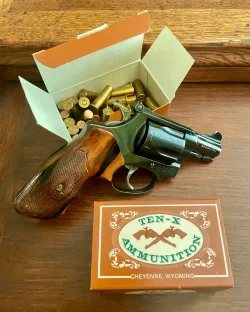
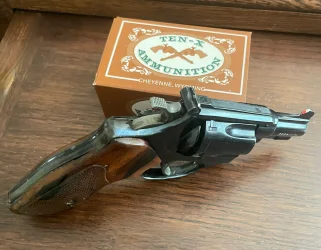
IMG_6956.webp
 
Last edited:
I may be the oddball, here. I have no formal training. All my "practice" has basically been, casual and non-completive. I've never shot NRA pistol, but I have done quite a bit of shooting, usually one hand, usually right, DA, at 25 yards. Somewhere between slow and timed fire.
My experience has been that, on those days when my eyes cooperate, and I can get a good all-around sight picture, the snubbies can do as well or better than the 4 inch barrels, especially with magnum loads. I think it has something to do with the moment of recoil being of shorter duration, in the shorter barrel.
 
Several years ago I was teaching a class and had the one blowhard in class that everyone quickly gets fed up with. He knew everything there was to know about guns, just ask him. He made the comment that at 100 yards he'd let someone with a 2" snub shoot at him all day long. They were inaccurate. When we went to the range I set up a B-27 target and we got back to 100 yards. I had my S&W 49. Load was my standard carry W-W 158 gr LSWCHP. I said we'll see how accurate a 2" snub is at 100 yards. I fired 5 rounds standing 2 hand and we checked the target. All 5 rounds center mass. The blowhard said anyone can get lucky. So back to the 100 yard line and fired 5 more rounds. All 5 center mass.
100 yards is really not difficult. Rest the head on top of the front sight. Makes a great reference point. Then remember the basics of shooting. Too many never learned them. Sight alignment, breath control, trigger pull.
Far too many of the law enforcement people I worked with, over the years, firmly believed they would be perfectly safe from any miscreant shooting at them with a handgun from more than 50 yards away. Well, that’s often true, but certainly not always. During my first retirement job, as a U.S. Justice Advisor for the U.S. State Department in Afghanistan, our security team leader firmly believed what “everyone knows,” until I borrowed his M9 pistol at the range and bounced an empty ammo can around on the 100 meter berm. He began training his guys to consider that potential.
 
Last edited:
This is one of those “moth to a flame” threads.

In terms of practical accuracy, I don’t think there is much of a difference. Model 14 clamped into a vice versus a Model 36 two inch, both shooting wadcutters at 50 yards, and I nobody has used the Model 14 barrel for a jack handle or scoured it out with a drill and a steel brush, the the Model 14s likely going to have an edge in accuracy. Jerry Miculek with a 642 vs _____(fill in blank name of any anti gun politico)_____, Jerry’s going to make the 642 perform by a wide margin.

Sights, sight radius, trigger control, and pure mind games as the distances increase are going to affect accuracy. But again, in terms of practical accuracy for even amateur shooters, negligible. I saw similar results when we carried Glock 26/27s to back up 22/23s. The sight radius and grip length were major issues for some shooters to overcome. But when they were, the short slide guns held their own in terms of practical accuracy.
 
The only reason many have a hard time shooting a snubby revolver is because so many make the claim they are hard to shoot to excuse their poor performance. They have heard this so long, and believe it so they accept poor shooting because they believe it is the guns fault, not theirs.

Let me give you an example of my own experience. Years ago when I was regularly shooting the PPC, Police Pistol Course, with my department. The state competitions included shooting the full course of 600 points with both target revolvers and snubbies, full course with either gun. At the time I shot NRA Master Class with both guns. My typical scores were in the 590s/600 with my 6" K-38. My scores with my snubby, a 2" Model 12 Airweight typically were only 12-15 points less than with the K-38. These were for the full PPC course that extended to 50 yards and included both single and double action fire for those of you unfamiliar with the PPC.

Snub nose revolvers are just as inherently accurate as longer barrels, don't let anyone tell you differently! All you need to do is put in the shooting time toand achieve this level of accuracy.

Now, what is your excuse?
I agree fully agree that snubbies have as much inherent accurately as any revolver. However, to say that they are as easy to shoot accurately as it is a larger, longer barreled gun is a completely different story. Smaller grips, rudimentary sites, more muzzle rise, make it much more challenging to get good accuracy from a snubby. I could shoot the center out of a bullseye with my model 60... resting on a bag, taking my time and shooting single action. Shooting that same pistol un-supported, rapidly, in double action will get completely different results. I'm doing well to keep all 5 shots inside the 8 ring of a B-27.
 
Last edited:
  • Like
Reactions: TST

Latest posts

Back
Top