Important thing to do to keep knives sharper, longer and in tip-top shape - many miss this simple procedure.

Indeed!


I make my own strops. Easy easy project that provides great benefit. I've been using the green, white and red polishing compound, but I'll be trying diamond paste next.
Try the Jende brand - 4 mcron is great! Once and done for many many knives! No mess either after drying.
 
I also have a set Wusthof knives. Not a production set, just a collection of their kitchen knives (18 or so) we’ve collected over the years. I usually use a steel before each task because that edge doesn’t hold up long.
I’ve been viewing the videos referenced above and am seriously considering adding a couple of stones and a strop (may make it myself) soon. I’m hoping I can learn to put a good edge on them so I use the steel less….or not at all.

Oh, regarding the serrated knives….we do have 3 of them. A 3” we use on fruit/etc; a 6” we use for sandwiches, bagels, and the like; and a 12/13” we use for the bread loaves I make. I hate it when restaurants give you a serrated knife to cut your steak with. Tells me they’re serving low quality meat.

by the way…..Thanks for the post !
 
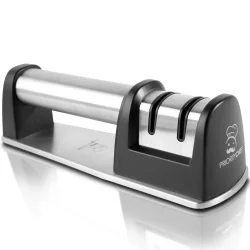
I don't know if ceramics eliminate the need for stropping, but I'm far too lazy to do all that work when my ceramic knife sharpener gets my blades as sharp as I need them. This thing works great and is very safe to use:

1783367999441.webp

Mine is not the same brand, but that's of no consequence. I have a couple of other useful devices for knife sharpening, and a whetstone or two, but I have been using this for years without any serious effort and, believe me, I dislike serious effort for so simple a task!
 
Most of my good knives are from the grocery store era 30s-60s I happen to have 5 or 6 cleavers...mostly older but the best of the bunch is a Craftsman my father bought in 53 I used it on pork chops etc from 57 to 1988 when we raised our own critters... a hundred or two deer over the years...Quit making chops on deer...just boned it out and made butterfly steaks ...no bones. My father in law gave me a great knife...not sure what it really was made for ....vegetables? 16 inches wide blade at the handle thin at the point. carbon steel and sharp Still have my shaving knives for hog killing...you would probably have to know...LOL
 
Thanks, but I had already acquired some sold by TEMO, before I read your OP. I'll start with the 3.5 micron paste.
Try the Jende brand - 4 mcron is great! Once and done for many many knives! No mess either after drying.
 
Last edited:
I also have a set Wusthof knives. Not a production set, just a collection of their kitchen knives (18 or so) we’ve collected over the years. I usually use a steel before each task because that edge doesn’t hold up long.
I’ve been viewing the videos referenced above and am seriously considering adding a couple of stones and a strop (may make it myself) soon. I’m hoping I can learn to put a good edge on them so I use the steel less….or not at all.

Oh, regarding the serrated knives….we do have 3 of them. A 3” we use on fruit/etc; a 6” we use for sandwiches, bagels, and the like; and a 12/13” we use for the bread loaves I make. I hate it when restaurants give you a serrated knife to cut your steak with. Tells me they’re serving low quality meat.

by the way…..Thanks for the post !
The main reason an edge does not "hold up" on a good quality knife is because once it's sharp the burr has not been properly removed. Most burrs can not been seen by the naked eye. Assuming it was properly sharpened in the first place, the burr is what folds over to make the edge feel dull again. It's just that simple and this is pretty much why I stared the thread. Stropping will remove the burr on a sharp knife - keeping it sharp for a longer period.

I do not like restaurant serrated knives either! The basic reason steak houses like Capitol Grill, Chops, Long Horn etc. use them is that they are not in the knife sharpening business and do not want to constantly sharpen steak knives. Almost all restaurant knives are cheap Chinese implements that probably cost the restaurant a few bucks and are considered disposable. They are probably cheaper and more useful on a restaurant steak than a cheap standard blade knife of the same quality. You don't get much for a buck or two. High end steak houses are cutting corners and not serving the best prime meats as they used to.

What the high end steak houses are serving these days does not hold a candle to what I grill in my Lanai! I buy only Prime meat (most restaurants do not) and grill to our and our guests liking in small batches so I can get excellent results. Only once in a blue moon do I get a "stinker". I am not bragging about my ability as a Chef and only claim a few select items I can do well. Steaks, Omelets, Nachos, Burgers and BBQ shrimp - that's about it. Anything else I leave up to the Wiffie - lol
 
I've got only one half-serrated pocket knives because I too dislike sharpening them.
 
Thanks, but I had already acquired some sold by TEMO, before I read your OP. I'll start with the 3.5 micron paste.
3.5 micron will work well - close enough. I've never heard of that brand but there are probably many I have not heard of yet. Let me know how it works and how the longevity is please.
 
I SUCK at sharpening. Have probably thrown out several hundred dollars worth of sharpening gizmos over the years. I tried strops, they seemed to make the knife duller. Right now I use one of these

https://worksharptools.com/products/guided-field-sharpener

So far it seems to work the best. A few seconds of use and the knife is good to go. Not shaving sharp but cuts meat effortlessly
 
I SUCK at sharpening. Have probably thrown out several hundred dollars worth of sharpening gizmos over the years. I tried strops, they seemed to make the knife duller. Right now I use one of these

https://worksharptools.com/products/guided-field-sharpener

So far it seems to work the best. A few seconds of use and the knife is good to go. Not shaving sharp but cuts meat effortlessly
Any sharpening devise that gets you the results you want is the best for you. If stropping dulls your knife you are doing so at the incorrect angle and rolling the burr over.

I suggest watching the video on stropping on the OUTDOOR55 youtube channel. I’ve got no affiliation with him at all but think his YouTube channel is about the best I’ve seen!

Most of successful knife sharpening is about keeping a consistent angle. What the exact angle you sharpen at is actually less important than consistency. Holding a consistent angle is also the most difficult part especially if sharpening freehand. Guided sharpeners such as the KME, Worksharp, and similar ones are fairly foolproof but have become pricy and are more time consuming. That said, they will usually work well even for first time users.

Stropping will remove the final burr which will prolong the usefulness of a sharpened blade. It will also polish and to some extent restore your blade to being sharp again assuming it has not gone too far. IMHO stropping is worth the small learning curve and effort it takes. I know some just don’t give a hoot.
 
I currently have 11 knives with a professional sharpener with whom I’ve had good success. Dropped them off yesterday. Hope to pick them up soon.

I am okay at sharpening, I suppose. Maybe even better than most. But nowhere near as good as a good pro. (And I have used poor sharpening services as well, so not all pros — places that charge for sharpening, e.g., hardware stores— are good at it.)

I really appreciate a good knife, and without a good sharp edge, well… It’s like… I dunno… having a great car with bald tires that can’t hold the road..

I am gonna try that strop idea. I’ve been using a steel on my kitchen knives, with some success, as a way of prolonging the edge
 
I rarely strop because I use ceramics to sharpen/polish (Spyderco Sharpmaker). It is my understanding that using fine ceramics negates the need to strop.
I too own a Spyderco ceramic Sharpmaker along with a half dozen other pieces of sharpening equipment and machines. The ceramic rods included in the Sharpmaker do` a very good job without leaving any big burrs behind. That said, the Sharpmaker works best when you use it on a blade that has only marginally dull - and not beyond bringing back. Once the edge gets beyond a certain point the Sharpmaker will take all day and isn't really the way to go. If you catch your knives at the right time, the Sharpmaker works terrifically.

I will say that since using diamond sharpening stones over the last few years I have not used my Sharpmaker, KME, Lansky or other pieces of equipment since. Freehand sharpening takes a lot of practice and patience however once you get the muscle memory and routine down pat it is something you never forget. It is fast & efficient and puts an excellent edge on every knife made - including the super hard edged Japanese knives.
 
I currently have 11 knives with a professional sharpener with whom I’ve had good success. Dropped them off yesterday. Hope to pick them up soon.

I am okay at sharpening, I suppose. Maybe even better than most. But nowhere near as good as a good pro. (And I have used poor sharpening services as well, so not all pros — places that charge for sharpening, e.g., hardware stores— are good at it.)

I really appreciate a good knife, and without a good sharp edge, well… It’s like… I dunno… having a great car with bald tires that can’t hold the road..

I am gonna try that strop idea. I’ve been using a steel on my kitchen knives, with some success, as a way of prolonging the edge
Just mirror the angle the blade is sharpened to and you will be pleased with the stropping results I think.
 
The traditional way of prepping a strop is with lead, cigar ash and oil.

Apply oil liberally, then throw a little ash on the leather, and then rub some lead over it. It creates a thick, almost grease-like scrubbing compound which works like a charm. And wash the items properly - lead is bad for the health.

NNNB: DO NOT rub a knife back and forth over the strop like in the movies. It is the wrongest and stupidest move! It rounds the cutting edge and makes it blunt in the long run. The correct way is to put down the blade and move it in a singular movement, the most important part is to maintain the angle between the strop and the blade.
 
I'm practicing freehand to get to this level:
I will say that since using diamond sharpening stones over the last few years I have not used my Sharpmaker, KME, Lansky or other pieces of equipment since. Freehand sharpening takes a lot of practice and patience however once you get the muscle memory and routine down pat it is something you never forget. It is fast & efficient and puts an excellent edge on every knife made
 
I saw a suggestion here once, I believe by Absent Comrade Dick Burg, to mark the edge of a blade with a felt marker/magic marker as an aid to visually determining whether one had the angle right when sharpening.
That is a guide so you can SEE the relative angle you are sharpening at, how to adjust the blade angle to replicate the factory edge and if you are being consistent. If just starting out at knife sharpening it is good suggestion and one I used to use years back. I have sharpened enough knives at this point to have the feel when the angle is right for the knife I am sharpening. I also got proficient at holding a consistent angle. When I sharpen kitchen knives that have different specific purposes I will adjust the angle accordingly. Santoku and carving knives get sharpened to a lower angle so they are sharper (but more fragile) and work horse knives receive a larger angle which will make them less fragile but not quite as sharp.

All that said, a consistent angle is what you primarily want and the exact angle is less important, assuming you are at least in the recommended ball park for the edge of the knife you are sharpening. For most kitchen knives a 14º - 17º consistent angle will work fine. For most daily user general purpose pocket knives, a 20º - 23º angle will give the user better longevity.
 
Most of my day-to-day sharpening is done on a Work Sharp Guided field Sharpener. One of the things I really like about it is the incorporated strop. It has two grades of diamond plates and a ceramic rod, but the strop gets by far the most use, followed by the fine diamond plate. The strop will get almost all of my knives to shave arm hair.
The other thing I like is the size, about as big as a large harmonica and easy to throw in a bag for travel.
 
The most important rule for maintaining a sharp edge on a kitchen knife in my house is to keep it away from the rest of the family. They seem determined to destroy the edge, throwing it in the sink, cutting on the granite counter or a ceramic plate, putting it in the dish washer, etc.

Believe it or not, I keep a set in the big toolbox in the garage, so far they haven’t caught on.

Ya’ll have any thoughts on the kyocera ceramic kitchen knives? I got several of them years ago, and they are sharp enough, but the lack of weight and flex causes them to feel wrong.
 
The most important rule for maintaining a sharp edge on a kitchen knife in my house is to keep it away from the rest of the family. They seem determined to destroy the edge, throwing it in the sink, cutting on the granite counter or a ceramic plate, putting it in the dish washer, etc.

Believe it or not, I keep a set in the big toolbox in the garage, so far they haven’t caught on.

Ya’ll have any thoughts on the kyocera ceramic kitchen knives? I got several of them years ago, and they are sharp enough, but the lack of weight and flex causes them to feel wrong.
My only experience with ceramic knives are the two my daughter brought home from college when she graduated. IMHO - they sucked! Now to be fair maybe they were cheap ones, abused or maybe they just suck - lol. I asked her if she wanted them back and she said nope. I tossed them in the garbage.
 
Just mirror the angle the blade is sharpened to and you will be pleased with the stropping results I think.

field expedient way to bring an edge back is using the top of your pickup's door glass to straighten the edge
The Key is to Always Try to maintain the Factory angles, whatever sharpening tool that you choose to use.
Tim, my Grandpa was old time carpenter, No power tools. Everything made by Hand, wood joints, fittings etc.
He would use a beer bottle as a Level, then strop his knife on that glass bottle also. I only wish that I had a fraction of his skill and knowledge.
 
My only experience with ceramic knives are the two my daughter brought home from college when she graduated. IMHO - they sucked! Now to be fair maybe they were cheap ones, abused or maybe they just suck - lol. I asked her if she wanted them back and she said nope. I tossed them in the garbage.
I would have loved to be your garbage man ;)

Ceramic knives are simply marvelous to work with but very hard to sharpen. Once blunt (from a glass or stone cutting board) they need real tlc to get them working again.
 
The most important rule for maintaining a sharp edge on a kitchen knife in my house is to keep it away from the rest of the family. They seem determined to destroy the edge, throwing it in the sink, cutting on the granite counter or a ceramic plate, putting it in the dish washer, etc.

Believe it or not, I keep a set in the big toolbox in the garage, so far they haven’t caught on.

Ya’ll have any thoughts on the kyocera ceramic kitchen knives? I got several of them years ago, and they are sharp enough, but the lack of weight and flex causes them to feel wrong.
When we are finished with dinner in our home I personally collect all the good knives and hand wash them myself. I do this first of all because they are quite sharp and I do not want guests to cut themselves. Secondly, I cringe when they just get thrown into the sink or get put in the dishwasher. Hand washing a knife is not a big deal.
 
That is a guide so you can SEE the relative angle you are sharpening at, how to adjust the blade angle to replicate the factory edge and if you are being consistent. If just starting out at knife sharpening it is good suggestion and one I used to use years back. I have sharpened enough knives at this point to have the feel when the angle is right for the knife I am sharpening. I also got proficient at holding a consistent angle. When I sharpen kitchen knives that have different specific purposes I will adjust the angle accordingly. Santoku and carving knives get sharpened to a lower angle so they are sharper (but more fragile) and work horse knives receive a larger angle which will make them less fragile but not quite as sharp.

All that said, a consistent angle is what you primarily want and the exact angle is less important, assuming you are at least in the recommended ball park for the edge of the knife you are sharpening. For most kitchen knives a 14º - 17º consistent angle will work fine. For most daily user general purpose pocket knives, a 20º - 23º angle will give the user better longevity.
for the non-professional person -- trying to get those exact angles is difficult. "eyeballing" the angle is the most used practice. Getting exact angle is a guess and a prayer.
 
for the non-professional person -- trying to get those exact angles is difficult. "eyeballing" the angle is the most used practice. Getting exact angle is a guess and a prayer.
Yes however I assure you that if you manage to keep the angle mostly consistent, the exact degree of angle won't matter too much in the knife's performance. A consistent angle of 20º will outperform a 15º multi faceted angle all day long!
 
I also like a very sharp knife. I use my Grandfather's two piece razor strop and treat it with buffing compound. Instead of matching the sharpening angle, I strop at a very flat angle.
 
I also like a very sharp knife. I use my Grandfather's two piece razor strop and treat it with buffing compound. Instead of matching the sharpening angle, I strop at a very flat angle.
A flatter angle will probably work with a Barber's strop because of the flexibility of the leather. On a Barber's strop a flatter angle is probably better than trying to match the edge angle because if you tried to match it you would probably roll the edge and over strop the angle.

That would not apply to a leather strop adhered to a piece of wood of course. With a rigid strop holding the knife too flat would not hit the edges - just the main body and effectively not do anything. Too much angle and you will roll the edge.
 
A flatter angle will probably work with a Barber's strop because of the flexibility of the leather. On a Barber's strop a flatter angle is probably better than trying to match the edge angle because if you tried to match it you would probably roll the edge and over strop the angle.

That would not apply to a leather strop adhered to a piece of wood of course. With a rigid strop holding the knife too flat would not hit the edges - just the main body and effectively not do anything. Too much angle and you will roll the edge.
That makes sense to me.
 

Latest posts

Back
Top