Strange Hammer On A Post War Pre 14 Target Masterpiece

Crookedcreek

Member
Joined
May 6, 2008
Messages
293
Reaction score
517
City & State/Province
Missouri
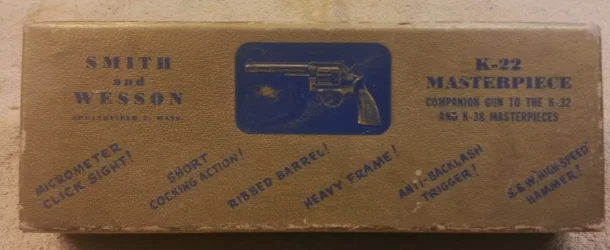
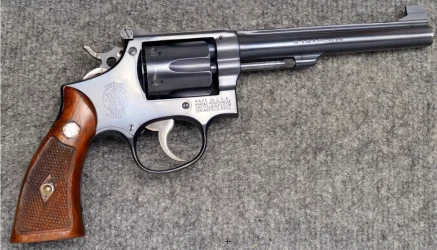
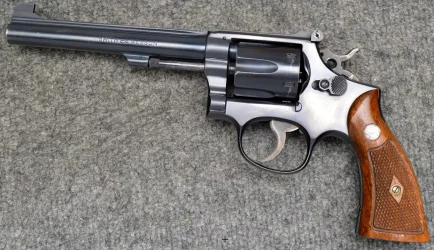
This one was converted to SAO, I assume for Bullseye) with a skeletonized hammer. Tried looking it up to see who made it, but came up short....anyone recognize it? The gun comes with the original hammer and block, so it could be restored to original SA/DA. Appears to be a second hole or slot in the hammer beneath the 'hump'. Serial number of K 50454 puts the date about 1949ish:
Screenshot (38).webp
Screenshot (37).webp
 
Looks like the factory installed "Speed Hammer" with a hole drilled in it.
It could be a 'factory' Smith speed hammer that has been modified, but the ad says the 'original' trigger and block come with the gun. It was converted to SAO after shipping. Bob Chow was known to have 'drilled' hammers to lighten, but I can't find any photos of his revolver work to compare.
 
Setting up a pistol like this is all about balance. Light hammer with proper spring tension ( I am probably using the wrong terminology) and appropriate ammo, yes some primers are harder than others. You said the original hammer and block are included. If that hammer block has been removed I would reinstall it. It is there for a very real safety reason. Also make sure the strain screw that impinges on the spring has not been eased out. Along with spring tension it insures proper spring arc so the spring clears the trigger rebound slide. I am sure I am missing some things, but that should get you started.
 
I agree. It's also machined further down, I would think this modification with a much lower mass, could cause light strikes. How does it work.
It works because V is squared (E=MV^2). The lighter hammer picks up enough extra velocity to keep energy flat or even improved.

Edit: I got the formula wrong. High school is long ago and far away… the proper formula for kinetic energy is KE=.5MV^2
 
Last edited:
No argument at all. I'm assuming it was put together by a 'professional' that knew what they were doing, and then used for many years so configured by the owner (perhaps the same individual). Safety is certainly paramount, don't know what all was done to the 'innards'. If it was strictly used on a 'Bullseye' firing line (plus practice), I think the definition of 'safe' can be different than when carried in a holster and where body movements can certainly impact the 'control aspect' of the firearm. Getting in/out of any variety of vehicles, jumping across a stream, climbing a tree stand, running from a street gang, can be viewed differently than carrying an unloaded gun in a case to a firing line table, loading it and shooting at a target until it is empty. I don't discount the possibility of of a person having a heart attach, or a sneezing fit, on a firing line and dropping the gun....s**t happens (especially at my age)! If I get the gun, it will be thoroughly checked out.
 
My 18oz ball peen hammer hits much harder than my 8 oz.
Only because you don’t swing the 8 ounce fast enough. The physics are pretty basic. The hammer mass is reduced by some amount and because of that the spring can accelerate it to a higher speed. The higher speed reduces lock time and that is desirable for accuracy. The higher speed also maintains total energy to keep the gun reliable.

It should also be noted that many tasks your ball peen hammers perform require momentum rather than energy.
 
IMG_2254.webpI’d be curious to know if the single action notch was reworked to make it a true short action.
The guys who did the best work of this type wanted to reduce the amount of effort needed to cock the hammer.
That’s what is needed for the Bullseye game: a short hammer throw to help get through the five shot “rapid fire” and “timed fire” strings.

It takes a lot of practice to be able to proficiently cock and recock the hammer without losing your grip and/or sight picture.

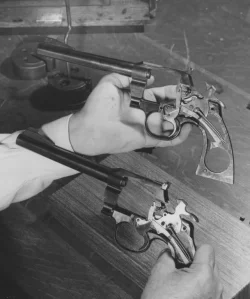
The guns shown above are Colts, but you get the idea. The top gun is a normal hammer and action single action. The bottom gun is SAO short action where you can see the hammer doesn’t have to be pulled back as far.
 
So, after all this and still not knowing whose hammer it may be......is the gun a good one to purchase?
 
I would wager it will shoot .38 wadcutters in nice tight clusters. 😎
Lots of bullseye and PPC handguns were modified in different ways to do just that. Most have very nice triggers.
 
It should be fine single action and I suspect that's why the D/A was deactivated. It increased the lock time for the hammer and decreased the impact on the sights with the hammer fall. This is well done looking and I would shoot the heck out of it.
 
I would wager it will shoot .38 wadcutters in nice tight clusters. 😎
Lots of bullseye and PPC handguns were modified in different ways to do just that. Most have very nice triggers.
if we're talking about single action only triggers, I believe PPC revolvers must be capable of shooting double action. Unless USA PPC rules differ to the international WA1500 rules, double action must be used for all shots except those at the 50m line.
 
if we're talking about single action only triggers, I believe PPC revolvers must be capable of shooting double action. Unless USA PPC rules differ to the international WA1500 rules, double action must be used for all shots except those at the 50m line.
I guess I wasn't clear. I was trying to say that modified revolvers for shooting in different disciplines usually had very nice trigger pulls and were tuned to work very well for the purpose, single or double action. Of course that would depend on who did the work.
The OP was worried if it might be too light. his revolver looks very well done and sorted out. I think it will be very accurate and he should enjoy it very much.
 
View attachment 897673I’d be curious to know if the single action notch was reworked to make it a true short action.
The guys who did the best work of this type wanted to reduce the amount of effort needed to cock the hammer.
That’s what is needed for the Bullseye game: a short hammer throw to help get through the five shot “rapid fire” and “timed fire” strings.

It takes a lot of practice to be able to proficiently cock and recock the hammer without losing your grip and/or sight picture.

The guns shown above are Colts, but you get the idea. The top gun is a normal hammer and action single action. The bottom gun is SAO short action where you can see the hammer doesn’t have to be pulled back as far.
IMG_1940.webp
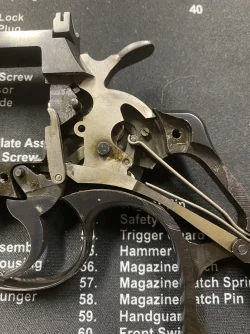
In point of fact , on the Colt modification there is a hammer stop that prevents hammer over travel. It is the screw stude right above the mainspring stirrup.
 
PS: It would be nice to see the OP’s revolver with the sideplate off!

If a picture is worth a thousand words, I bet there’d be a lot to learn and study from seeing the inner workings.
 
Back
Top