
K-22 lockup problem

Joined
Jun 24, 2018
Messages
3,318
Reaction score
4,995
City & State/Province
West Virginia
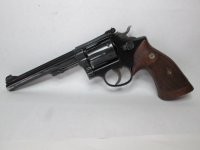
I have a fine K-22 pre-17, 1948 version, 6". A real target pistol. Any .22LR I try in it shoots pretty much to the same POA, from cheap, slow and dirty, to expensive and fast.

Today at the range I had a problem. I hadn't fired it since about two weeks (three range visits) after I took possession in 2021, after buying it from a member on the Ruger Forum.

Squeaky clean, tried Federal HV Match, some Armscor High Velocity, and a few CCI Mini-mags. 100% hits on an 8" plate at 15 yards, 6/12 at 30 yards. After about 24 rounds, the cylinder started hanging, both in SA and DA. It would not cock, seemingly locked up.

It felt like the cylinder was not setting in the notch on the two chambers opposite the serial number on the cylinder, but dry firing at home proved that was not the case. I could wiggle the cylinder and get it to cycle, and finish each cylinder.

The cylinder tolerance is tight - tiny front and rear gap, barely any play in the lockup, no endshake or movement. No dirt under the extractor, good solid firing pin hit, smooth cartridge insertion and ejection.

What am I seeing here? Worn hand or worn cylinder stop? I know S&W won't work on a 76 year old revolver, but the "best local gunsmith" is not as good as I hoped. I'm mechanical enough to know what I'm doing for simple gun stuff. Suggestions?
 
First, it's not a good idea to dry fire S&W rimfire revolvers. I assume you already know that, and are using snap caps or empty casings.

I would guess that if it worked ok before this long time in storage, and it's not functioning correctly now, perhaps a good cleaning and re-lubrication would be in order. Even light lubricants designed for firearms can degrade over time. Cylinder assembly and yoke would be the likely problem areas, then the internals.

If the gun is still very "tight" after this cleaning etc, you might also check the spec's regarding cylinder clearance at the barrel/cylinder interface, and in the rear between the breechface and the rear of the cylinder. (headspace)

If these measurements are incorrect, this can cause binding, or even dragging (contact) between the front of the cylinder and the barrel extension caused by build up of shooting debris. You may be able to see contact marks on the front of the cylinder, if there is insufficient gauge (space) at that location. (approx .004"-.006")
 
Last edited:
If a smith & wesson 22 revolver works fine dry firing without cartridges, but jams up on the range, here are two common causes:

1) Dirt under extractor. This makes the ratchets sit slightly higher than designed and can jam up when the hand is trying to rotate. Solution: clean the revolver

2) Excess endshake. In this case, the gun will work perfectly fine when cycled without ammo. But if there is endshake, the rimfire cases will flow out and expand during firing, causing them the cylinder to jam forward and lock things up. Solution: Stretch the yoke, or drop a couple of endshake shims for a quick fix

If it cycles fine when dry firing without cartridges at home, it's not a timing problem in respect to the hand / cylinder stop
 
Last edited:
I cleaned it after I received it. After unboxing at the LGS/range I fired it at the FFL, six rounds only. I just wanted to make sure it worked. Scrubbed it as a museum piece (where I worked), carefully and completely. Opened the side plate and cleaned there, too. Nothing was disturbed when opened. It was very clean inside. Rubbed patches, then lightly lubed.

Two more target sessions, about 50 rounds each, cleaned again, then put away. I don't remember if there was a lockup then.

It locked up a couple of times at home after the range trip, and a cursory wipe/clean before I tried. Dry firing, I've long known about the 22LR-sized wall anchors.

I think it's a worn part problem.
 
I think it's fixed. Cleaned it with the side plate off. Insides were not very dirty, nothing bent or seemingly worn, other than a little shine on the cylinder lock. Then, with a strong light, spotted a bit of (shock) corrosion along the side and top edges of the slot for the hand. Got out the sharp picks, scraped off a bit of hard brown crud, cleaned with a stripped down q-tip and CLP. Loaded up the snap caps and dry fired 60 times - not one hesitation and hang up.

So it was dirty, but not in the usual way. The tiny slot is so narrow that many of us don't usually do more than a cursory pass with the edges of a oiled or solvent soaked cleaning patch.
 
I think it's fixed. Cleaned it with the side plate off. Insides were not very dirty, nothing bent or seemingly worn, other than a little shine on the cylinder lock. Then, with a strong light, spotted a bit of (shock) corrosion along the side and top edges of the slot for the hand. Got out the sharp picks, scraped off a bit of hard brown crud, cleaned with a stripped down q-tip and CLP. Loaded up the snap caps and dry fired 60 times - not one hesitation and hang up.

So it was dirty, but not in the usual way. The tiny slot is so narrow that many of us don't usually do more than a cursory pass with the edges of a oiled or solvent soaked cleaning patch.


Good to hear that it is fixed! Enjoy it.
 
Another common cause -- ejector rod unscrewed. It's good practice to check it regularly for tightness.
 
Oh I do enjoy it! Any brand of "high speed" ammo shoots to the same POA as the sights were set to when I bought it, and just have to hold a bit up off square for standard velocity. And, as with my 617 and my Ruger Six and Ten, no more bargain bulk stuff in it, ever.

I wish I could scrape the bad places off my 73-year-old chassis as easily my 75-year-old Smith.
 
Last edited:
Oh I do enjoy it! Any brand of "high speed" ammo shoots to the same POA as the sights were set to when I bought it, and just have to hold a bit up off square for standard velocity. And, as with my 617 and my Ruger Six and Ten, no more bargain bulk stuff in it, ever.

I wish I could scrape the bad places off my 73-year-old chassis as easily my 75-year-old Smith.

If I couldn’t shoot it with Federal Auto Match from bulk boxes, my 1948 vintage K-22 would be fired very little! My revolver seems to digest them with aplomb and only the slightest extractor drag as it gets real dirty.
Froggie
 
Federal Auto Match is one most of my .22's just don't like. Federal HV Match is a better choice for me. Ditto for CCI Maxi-Mag, Armscor 36gr high velocity, and Aguila .22 Interceptor. Have almost too many Winchester Super-X and X-Pert, not yet tried those in my revolvers. My rifles prefer the very high velocity Super-X and the equally high velocity Aguila Interceptor, so I'm saving them for the rifles.
 
Federal Auto Match is one most of my .22's just don't like. Federal HV Match is a better choice for me. Ditto for CCI Maxi-Mag, Armscor 36gr high velocity, and Aguila .22 Interceptor. Have almost too many Winchester Super-X and X-Pert, not yet tried those in my revolvers. My rifles prefer the very high velocity Super-X and the equally high velocity Aguila Interceptor, so I'm saving them for the rifles.

I use Federal Auto Match in all of my autos and it works fine for me. I tend to use all the others in my revolvers.
 
No .22 works well with every ammo. Mine didn't. Glad you can use Auto Match, it costs less than HV Match most places I look.

I have only ever had one .22 auto pistol that had to have HV ammo to get it to run well. That was Norinco copy of a Walther 1936 Olympia, pistol was accurate, but would only work with CCI Stinger in it.
 
I always use the CCI Standard Vol. in my 617, with great results. I use only about four drops of oil on the inside on trigger and hammer total. To much builds up crud fast and causes problems.
 
I've never ever had an issue with my K22, November 1950, Dad's gun. Since I've had it the only issue was a bad cartridge (?) that left the bullet in the barrel. During my few extended range sessions with it, maybe 50-60 shots, it's gotten a little tight. MY only finds was a small build up of burnt powder or dirt, whatever, under the extractor. Small nylon brush was all that was needed. Great gun you have, for sure. Mine's probably the most accurate hand gun I own. No, it IS the most accurate.
 
I keep a pack of pipe cleaners in my cleaning kit. I use the ones with the fine wire woven in them for the hand slot and firing pin holes. The plain ones for cleaning screw holes. Learned from the old man who was a pipe and Prince Albert guy.
 
50 target, good idea. I found a .22 nylon bristle brush at the LGS last week while I was there shopping for something else. It's in my range bag cleaning tools now. I have used pipe cleaners in the past, but they always seem to shed some fluff on the sharp edges.
 
Orange stick, the wooden stick used to beautify nails work great for scraping crud.
 

Latest posts

Back
Top