
Remington Rand 1911A1Thumb Safety

Joined
Apr 11, 2026
Messages
12
Reaction score
20
City & State/Province
Hickory, NC
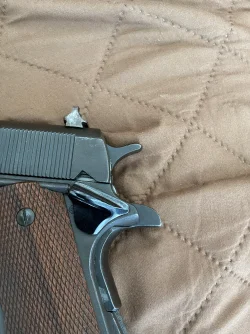
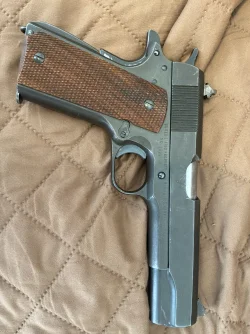
Recently purchased this Remington Rand and noticed the thumb safety is different than most of I’ve seen on WW2 era pieces. Besides not being parkerized, the top is longer. Is it an aftermarket addition someone added later, or were some original thumb safeties like that. The one I just purchased also has walnut grips which makes me think the piece was later modified. Other than that, it’s in pretty good shape.
 

Attachments

  • image.webp
    image.webp
    1.7 MB
  • image.webp
    image.webp
    2.1 MB
  • image.webp
    image.webp
    2.1 MB
It's a good looking gun. Someone or multiple someone's just tweaked a few things through the years. Somebody took some pride though the grip screws are indexed. I'd function check it real good the thumb safety is a fitted and critical part just make sure it does what it's supposed to.
Have you field stripped it yet?
 
It's a good looking gun. Someone or multiple someone's just tweaked a few things through the years. Somebody took some pride though the grip screws are indexed. I'd function check it real good the thumb safety is a fitted and critical part just make sure it does what it's supposed to.
Have you field stripped it yet?
The gunsmith at the range where I shoot checked it yesterday and said it was good to go. Thanks again.
 
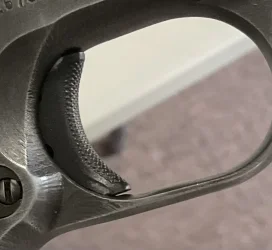
Looks like it has a replacement trigger. In 1943 Ithaca developed a stamped trigger that Remington Rand and Colt adopted. Remington Rand adopted it in mid 1943 with transition from milled to stamped in the 925000-935000 serial number range. Your serial number (1944) indicates your pistol should have a stamped trigger. Yours looks to be a milled trigger. Picture of a stamped trigger on my 1943 Ithaca 1911A1. The stamped trigger reduced cost of each pistol and easier/faster to make.IMG_0596.webp
 
Last edited:
A lot of WW2 vintage 1911s have been "upgraded" to meet the owner's needs and perceptions for shooting, so finding really good ones that haven't been touched is always a bit difficult... and I admit I've 'dinked around' with almost all my 1911s! Grips, sights, and any 'tweaks' that make them (a) better shooters, or (b) simply look like I want them to. Accuracy is key... How does yours shoot?
 
Looks like it has a replacement trigger. In 1943 Ithaca developed a stamped trigger that Remington Rand and Colt adopted. Remington Rand adopted it in mid 1943 with transition from milled to stamped in the 925000-935000 serial number range. Your serial number (1944) indicates your pistol should have a stamped trigger. Yours looks to be a milled trigger. Picture of a stamped trigger on my 1943 Ithaca 1911A1. The stamped trigger reduced cost of each pistol and easier/faster to make.View attachment 873702
Thanks. Looking through eBay to find correct period parts for all of these aftermarket mods. This helps a lot.
 
A lot of WW2 vintage 1911s have been "upgraded" to meet the owner's needs and perceptions for shooting, so finding really good ones that haven't been touched is always a bit difficult... and I admit I've 'dinked around' with almost all my 1911s! Grips, sights, and any 'tweaks' that make them (a) better shooters, or (b) simply look like I want them to. Accuracy is key... How does yours shoot?
Haven’t fired it yet but the gunsmith at the range I belong to says it’s good to go except for the rear sight that slides off on its own (already ordered a period correct one that hasn’t been installed before.
 
Haven’t fired it yet but the gunsmith at the range I belong to says it’s good to go except for the rear sight that slides off on its own (already ordered a period correct one that hasn’t been installed before.

If by chance the dovetail is too large, you can throw up a couple of burrs in the bottom of the slot, using a center punch.

That style safety is found on 70 series Colt Government Models.
 
My first impression is that the slide release is not original either. I reserve the right to be wrong.

If by chance the dovetail is too large, you can throw up a couple of burrs in the bottom of the slot, using a center punch.
Why do that to the dovetail slot, seems cheaper and lower risk to peen the base of the replacement sight.
 
Recently purchased this Remington Rand and noticed the thumb safety is different than most of I’ve seen on WW2 era pieces. Besides not being parkerized, the top is longer. Is it an aftermarket addition someone added later, or were some original thumb safeties like that. The one I just purchased also has walnut grips which makes me think the piece was later modified. Other than that, it’s in pretty good shape.
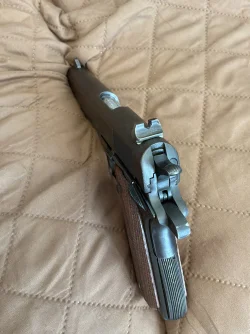
Not original sights or thumb safety, no collector value but a good shooter I expect.
 
Changes to the small parts occurred throughout production to facilitate interchangeable parts between manufacturers, reduce costs and speed production. By late 1944 into 1945 all previously checkered parts - safety, hammer, slide lock, mainspring housing (back strap) went to serrated design.
 
That looks like a standard Colt commercial safety from the 60s. They are much better and work a lot better than the standard Army part and are very easy to use. A lot better than some of the aftermarket cosmic junk slapped on 1911s today. A simple sliding motion with the thumb needed to either put it on or off.
 
Great that your pistol doesn’t have arsenal rebuild marks on it. Curious on what barrel it has. Likely it is not a war time but you never know. When you field strip look for any stampings on it. Colt made their own barrels but Ithaca and Remington Rand used barrels made by High Standard (HS stamped) or Flannery Bolt Company (F stamped). Keep us posted on your progress.
 
Great that your pistol doesn’t have arsenal rebuild marks on it. Curious on what barrel it has. Likely it is not a war time but you never know. When you field strip look for any stampings on it. Colt made their own barrels but Ithaca and Remington Rand used barrels made by High Standard (HS stamped) or Flannery Bolt Company (F stamped). Keep us posted on your progress.
It’s a Colt MK IV Series 70 which I’m replacing with a WW2 era High Standard barrel.
 
It’s a nice old gun. Any US PROPERTY 1911 has collector value.

All original is more valuable, but impossible to find, or even verify.

Slightly modified like yours makes it better for shooting, and it’s still a historically significant gun

Worrying about details kept me from buying one for too long. I wished I’d have jumped in, even if I overpaid. They’d be worth far more now, and they keep climbing.
 
Back
Top