Ha! I knew I would get an entertaining answer from you Gnarls. Clearly you have a scientific background and a really "gnarly" sense of humor.

I will, for the moment, ignore the fact that you achieved 3 significant figures in a conclusion based on 1 significant figure of starting "data". But I'm most interested in how you arrived at the 35 fps increase based on a 50% increase in barrel length.
And of course the point about velocity was not about how soon the bullet would hit the pert, but about what that bullet would accomplish after it reached its target.

But you already knew that.
Hello tarheel13,
I was hoping you’d appreciate my sense of humor.

One of my favorite words is precursor. In Science, Chemistry, and Biology
“it refers to a basic substance, compound, or cellular component from which a more complex or mature substance is formed. For instance, cholesterol is a precursor to testosterone, and stem cells are precursors to specialized cells.”
I look at velocity as the speed and time it takes to reach my target, and the precursor to any damage to my target.
Since statistically a civilian self-defense event only lasts a few seconds. If the target appears to be an impending lethal threat time is most critical in my defense.
If the bullet does not reach the target in time to stop the threat, damage caused by an additional 35 or 100 feet per second does not matter.
Velocity as speed is the precursor to bullet penetration and bodily damage.
As shown in the math, 0.0008 seconds is 16 times faster than the human eye-brain can detect.
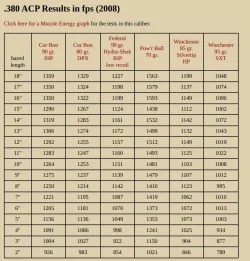
Just for gits & shiggles let’s use the difference in velocity between a 2.75” BG2 barrel and 4.0” BG2 barrel as
1,000 fps.
The 2.75” barrel, 900 fps, will hit a target 21 feet away in 0.0225 seconds or 22.66 milliseconds.
The 4.0” barrel’s increased velocity to 1,000 fps will hit the target in 0.0023 or 2.3 milliseconds. That is 150 times faster than a single blink of a human eye.
However, the difference of an increased velocity to 1,000 fps increases kinetic energy by 23.46%. Will that increase cause more tissue damage? In ballistic measurements, that ~ 23% increase rarely causes significantly more tissue damage.
So… the difference may be insignificant, but certainly desirable.
Yes…
"that extra muzzle velocity would potentially be very useful"
By the way, the license plate on my 1986 Toyota Xtracab is “2NARLY”.