

You are using an out of date browser. It may not display this or other websites correctly.
You should upgrade or use an alternative browser.
You should upgrade or use an alternative browser.
Pre Model 16 question
- Thread starter gjamison
- Start date



handejector
Staff member
- Joined
- Mar 17, 2005
- Messages
- 31,163
- Reaction score
- 48,474
What serial range?
Is the barrel numbered? Yoke? Extractor?
Is the barrel numbered? Yoke? Extractor?
OP
gjamison
Member
K312831
Im not sure about the barrel, yoke or extractor.
Im not sure about the barrel, yoke or extractor.

22hipower
Member
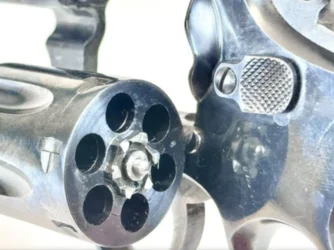
According to the Standard Catalog (5th) that SN is 1957. Right about the time of model numbers showing up and the soft fitting with SN stamped on parts stopping. Might, or might not have the SN stamped on the cylinder or the barrel, wouldn't be surprised if the SNs weren't there.

There is your answer. That unit most likely shipped in 1958, based on quite a few nearby serial numbers. As Jeff mentioned, by that time, S&W had stopped serializing the cylinder and barrel flat. Conventional wisdom says that practice stopped with the elimination of soft fitting in 1957.K312831
Model numbers start showing up at around K316000 on the Model 19. A bit later on the Models 14, 15, 16, 17 and 18, with one very early exception on a special-order Model 14 (K314496, shipped on July 28, 1958).

The K-32 was shipped in December 1957 and most likely made after Soft Fitting was eliminated (no number on cylinder or barrel). Generally, model numbers were stamped beginning later in 1958.
Bill
Bill

Alk8944
US Veteran
Dry Firing. I am a school trained gunsmith and have been a police armorer, Army Ordnance, as well as a store gunsmith in several gun stores over the past 60+ years. In this time I have personally seen the following damage done to S&W D/A revolvers by dry firing: Broken hammer nose, loose hammer nose rivets to the point they will fall out, badly burred hammer nose bushings, broker hammer and trigger studs, broken rebound slide studs. In addition to mis-aligned yokes, loose frame studs etc. from other mis-handling of the guns. Do you still want to do un-limited dry-firing with your revolver? Yes, dry-firing can do many different types of damage if done to excess! Personally I do very little dry-firing of my S&Ws

BC38
Member
I'm not making a connection between this post and the question about a non-serial-numbered cylinder.Dry Firing. I am a school trained gunsmith and have been a police armorer, Army Ordnance, as well as a store gunsmith in several gun stores over the past 60+ years. In this time I have personally seen the following damage done to S&W D/A revolvers by dry firing: Broken hammer nose, loose hammer nose rivets to the point they will fall out, badly burred hammer nose bushings, broker hammer and trigger studs, broken rebound slide studs. In addition to mis-aligned yokes, loose frame studs etc. from other mis-handling of the guns. Do you still want to do un-limited dry-firing with your revolver? Yes, dry-firing can do many different types of damage if done to excess! Personally I do very little dry-firing of my S&Ws
But the answer to preventing the problem you posted about is easy
Snap Caps.
I just put my finger between the hammer and frame.
Cylinder does NOT turn.
The First S&W I bought just over a year ago was serial # K323372, NO model number. Serial number on the back of the extractor, none on the bottom of the barrel, back of the cylinder. 4 screw .
I had to tell them to make sure to INCLUDE the K in the serial number to avoid potential duplication of serial numbers.
Cylinder does NOT turn.
The First S&W I bought just over a year ago was serial # K323372, NO model number. Serial number on the back of the extractor, none on the bottom of the barrel, back of the cylinder. 4 screw .
I had to tell them to make sure to INCLUDE the K in the serial number to avoid potential duplication of serial numbers.
Last edited:
BC38
Member
I could check your car's cooling system for temperature and flow with that same hand (finger) AND I could check your fan clutch, in a matter of seconds.
No charge diagnosed in seconds
Bad fan clutch, stop the plastic fan and spin it backwards while the engine was RUNNING !!!!!!
No charge diagnosed in seconds
Bad fan clutch, stop the plastic fan and spin it backwards while the engine was RUNNING !!!!!!
OP
gjamison
Member
Thank you gentlemen.
BC38
Member
FUNNY!I could check your car's cooling system for temperature and flow with that same hand (finger) AND I could check your fan clutch, in a matter of seconds.
No charge diagnosed in seconds
Bad fan clutch, stop the plastic fan and spin it backwards while the engine was RUNNING !!!!!!

But keep in mind there may be people reading your post who don't recognize it as sarcasm.
FWIW....

- Joined
- Sep 6, 2024
- Messages
- 705
- Reaction score
- 780
Dry Firing. I am a school trained gunsmith and have been a police armorer, Army Ordnance, as well as a store gunsmith in several gun stores over the past 60+ years. In this time I have personally seen the following damage done to S&W D/A revolvers by dry firing: Broken hammer nose, loose hammer nose rivets to the point they will fall out, badly burred hammer nose bushings, broker hammer and trigger studs, broken rebound slide studs. In addition to mis-aligned yokes, loose frame studs etc. from other mis-handling of the guns. Do you still want to do un-limited dry-firing with your revolver? Yes, dry-firing can do many different types of damage if done to excess! Personally I do very little dry-firing of my S&
For as long as I’ve been shooting (a day or two), I have heard about the damage done to revolvers (we’re talking center fire here) from dry firing. The only thing is, I have yet to see any ! From my own personal experience extensively dry firing my own revolvers, revolvers dry fired by local law enforcement, working with five large town gunsmiths, not a single gun have I seen damaged by dry firing. To date, I have extensively dry fired (over a period of 50+ years) over 55 S&W’s. 25 Colts and Rugers, yet not a single one damaged-Ever !Dry Firing. I am a school trained gunsmith and have been a police armorer, Army Ordnance, as well as a store gunsmith in several gun stores over the past 60+ years. In this time I have personally seen the following damage done to S&W D/A revolvers by dry firing: Broken hammer nose, loose hammer nose rivets to the point they will fall out, badly burred hammer nose bushings, broker hammer and trigger studs, broken rebound slide studs. In addition to mis-aligned yokes, loose frame studs etc. from other mis-handling of the guns. Do you still want to do un-limited dry-firing with your revolver? Yes, dry-firing can do many different types of damage if done to excess! Personally I do very little dry-firing of my S&Ws
No sarcasm just facts. Very impressive demonstration. NOW YOUR ignorance is obvious. Fan clutch uses a bimetallic to control a restriction in a fluid coupling. Less restriction more slippage. Max speed 2500 RPM when air flow over the clutch gets higher fan speeds faster. When it is worn out you can actually stick your finger in the downstream part of the fan and stop it and spin it backward. ENGINE RUNNINGFUNNY!
But keep in mind there may be people reading your post who don't recognize it as sarcasm.
FWIW....

Good radiator removes heat from the engine top hose hot bottom colder good radiator when it gets plugged enough it will not cool enough for higher loads.
Remember the song Maybelline, partially blocked radiator cooling passages.
Facts Son, you playing in my area of expertise and your accusation of dishonesty is duly noted.
Facts can be clearly demonstrated
MY dry firing method, using a finger, STOPS the turn line completely, cylinder does not revolve. Allows dry firing without any other damage. Wear pattern on trigger and hammer interface , improves, measurably unless pattern is already established with wear and turn line.
- Joined
- Sep 6, 2024
- Messages
- 705
- Reaction score
- 780
We talking guns or computers ?MY dry firing method, using a finger, STOPS the turn line completely, cylinder does not revolve. Allows dry firing without any other damage. Wear pattern on trigger and hammer interface , improves, measurably unless pattern is already established with wear and turn line.
- Joined
- Sep 6, 2024
- Messages
- 705
- Reaction score
- 780
Why ? The line that dry firing center fire revolvers somehow damages them, is in my experience and observation, bs.
Yes my Apple 44 Special, right? Jus’ Kiddin’ so stay calmWe talking guns or computers ?

- Joined
- Sep 6, 2024
- Messages
- 705
- Reaction score
- 780
AlwaysYes my Apple 44 Special, right? Jus’ Kiddin’ so stay calm
Blackstone9x19
Member
Amen, pure fuddlore by those who want an excuse for why they don't practiceWhy ? The line that dry firing center fire revolvers somehow damages them, is in my experience and observation, bs.


chiefdave
US Veteran
For the money K32's are bringing I would want all of the usual parts numbers matching.As you can see from the picture the cylinder isn’t numbered. Is this correct? I’ve never owned one but have owned many pre model guns and all have had numbered cylinders. Thank you you all.
Never there. (the numbers)

Just for fun. All the numbers are there. And yes, they can be pricy. 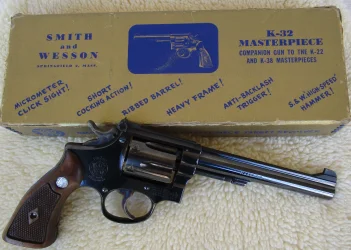 can be pricy.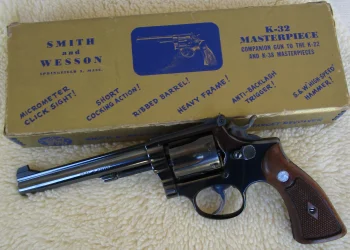
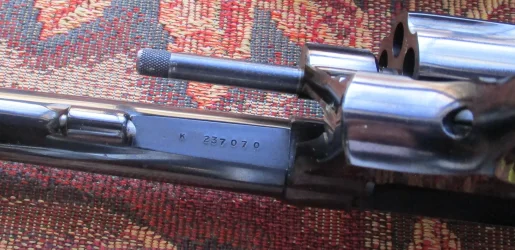
can be pricy.


That is real close to mine, K 237070.I’ve got 2370xx
Similar threads


- Replies
- 48
- Views
- 2K

- Replies
- 3
- Views
- 783


