125 gr & Model 19

leemar28

Member
Joined
Feb 7, 2009
Messages
39
Reaction score
24
City & State/Province
Virgina USA
I've read several times that shooting 125 gr (110's too) bullets in .357 could crack the forcing cone.
Never have read or heard why. Is there anything to this ?
 
I was an LEO during the heyday of the Federal 125gr JHP that was a common issue to PDs. I never saw a cracked forcing cone (I was an FTO for many years), but I saw a lot of flame cutting on our revolvers. My Model 65 from that era still sports some ugly flame cutting above the forcing cone on the back strap.

The performance of the Federal 125gr JHP was pretty good, and it was apparently worth the wear on the revolvers. Gun fights are pretty dicey affairs (I can confirm that) and any advantage is worth the cost.

The heavier and larger L Frame came out in the early 80s to rectify the problem with the split barrels on the lighter K Frames.

Having said all of that, if you're reloading, just keep your loads down to a sane level and you'll not have any issues using the lighter bullets in the 357 Magnum.
 
Last edited:
Extended use of jacketed lighter bullets in the K frames could damage the forcing cone. If you have one of the new release K frame guns the problem has been fixed. The cutout at the bottom of the forcing cone on the older K frames to aid in closing the cylinder was the weak point. The newer K frames have been redesigned.
 
The Internet has GREATLY exaggerated the Urban Legend of Cracked Forcing cones

I feel about Forcing Cones the same way I feel about a tire or starter motor or A/C compressor. I am going to use them and if they break then I am going to get them repaired.

Can you imagine the world if all of us stopped using things because we were afraid we might break them?

Back in my day we were 1700 sworn and issued Model 66s. I recall one, perhaps two cracked forcing cones. However I did not know the history of those revolvers.

As a hand loader, I am very fond of the Winchester 125 JHP over a big charge of H110

125%20JHPs.jpg

My family and I have put more than 10,000 of those down range over the past four decades.
 
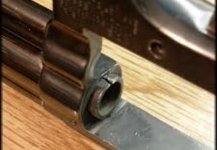
Yes, it is a thing. The original Model 19 (not the new one in the Classic line) had a flat at the 6:00 o’clock position on the barrel shank. The original load was 158 grain and that load is fine. When Federal (I think it was Federal) introduced the 125 grain Magnum at 1,400 fps the problem was encountered. Laboratory study found that the issue was caused by searing hot gases causing flame cutting in that thin section of the barrel shank. Eventually, a crack would sometimes develop. Testing revealed that the problem was caused by the length of the bullet. The longer 158 grain sealed the barrel/cylinder gap for a longer time than did the shorter 125 grain at that blistering velocity. Keeping the gap sealed that tiny fraction of a second longer basically eliminated the problem. Testing revealed that the K frame barrel shank was safe with longer bullets and the Models 13 and 19 would not have the problem with 145 grain and heavier (therefore longer) bullets, which sealed the gap for a longer time allowing the hot gases to be less violent and less likely to cause a split at the thin 6:00 o’clock position in the barrel shank. This is why the FBI adopted the 145 grain Silvertip for the Magnum load in its K frame Model 13s. Note that this is only a problem with the hot, violent, light bullet Magnum loads. It is not a problem with any 38 Special load including Plus-P or Plus-P-Plus. I should also point out that it doesn’t always happen. That said, use of Magnum loads less than 145 grains will increase the chances of failure of the barrel shank at its weakest point - the 6 o’clock position. Remember that S&W no longer has barrels for that vintage of K frame.357 Magnum revolvers.
 

Attachments

  • A0F686E8-5498-4DCA-B83C-2CF7FFA98734.jpg
    A0F686E8-5498-4DCA-B83C-2CF7FFA98734.jpg
    45.9 KB
Last edited:
The old red box Fed 357B 125 JHP IIRC was the culprit . Light slug , high velocity & lots of hot powder gas from a case full of slow ball powder . Weak design of Model 19 barrel shanks etc . I've never saw a 66 , 65 or 13 with a split . Flame cutting for sure as ammo was stouter .
If I had a 19 , it would only see cast loads . Still plenty of authority to a SWC / WFN 158 - 170gr @ 1200fps . Nice old gun will last longer too .
 
A friend of mine here was a former US Border Patrol armorer back in the day. He told me as others noted above, the flat portion of the old forcing cones being the contributing factor to the cracking with magnum (frequent shooting) loads.

He told me that they were issued only 48 magnum service loads to shoot in their Model 19’s in one year. All the ammo they practiced with were wadcutter type 38 loads.
 
Last edited:
A friend of mine here was a former US Border Patrol armorer back in the day. He told me as others noted above, the flat portion of the old forcing cones being the contributing factor to the cracking with magnum (frequent shooting) loads.

He told me that they were issued only 48 magnum service loads to shoot in their Model 19’s in one year. All the ammo they practiced with were wadcutter type 38 loads.

As the armorer, did he observe or experience cracked forcing cones, frequency?
 
…I’ll ask him about any specific numbers he recalls when I’m up there again.

I thought it was interesting about just 48 rds per year being issued (my humble opinion, maybe a conservative corrective action to the original Mod 19’s forcing cone flaw). I never owned a Mod 19, always preferring a heavier N frame as Mod 28s.
 
cracked forcing cones

My answer to 125 gr bullets cracking forcing cones is sight your revolver in with 125 grainers and only use them for serious business. If you are killing paper, it doesn't care if you are using 125 gr hot loads or 38 wadcutters. The only cracked forcing cones I've encounter were on 2 M-15s.
SWCA 892
 
I seldom shoot jacketed bullets of any kind in a handgun and am not very familiar with them. Is there an advantage to using a 125 grain jacketed (or cast) bullet over a 158 grain cast SWC that the .357 was designed for? If the accuracy is noticeably improved with the lighter bullet, their use certainly makes sense. As for sheer power or textbook energy, any .357 load should have plenty, regardless of bullet weight.
 
I had one 19-5 that I killed with lots of full power 110 &125 JHP factory loads.
I was young and thought that high fps and noise was really "Cool" back then.
I later learned that these light bullet actually are all the way out of the case
when on the way to the forcing cone, and unsupported by the barrel, yet.

One reason I call the early M19, a 38 +P model revolver, if you need to shoot these light bullets.

I agree on the 140 gr bullets or heavier, for full loads in this style of revolver.

My new 686 6" solved this problem and maximum 110 Gr. JHP can be shot w/o any problems.
 
While certainly not mythical, EXTREMELY rare to say the least. As for 125gr bullets in 357mag, it's a bad concept to begin with, that bullet weight in that diameter is for 9mm, NOT 38spl/357mag. Knowledgeable loaders/shooters NEVER bought into the 125gr craze. Stick with 158gr lead, or Jacketed, you're welcome.😉👍🏻
 
The 125 JHP load was intended for felonious bipeds with anti-social tendencies . At pre-neutered load levels it offered explosive expansion . Standard cup & core HP pushed fast . Same deal Federal did with the 9mm 9BPLE +P+ load .
 
I've shot S&W's for 40 years, including a Model 19. The only cracked forcing cone I've ever seen was on a buddy's 586. He's back in business after giving S&W $350 for a rebarrel.
 
125 jhp is my favorite 50 yard bench load with my 19-3. but I use 2400 or 4227. I remember 110 jhp's may give a problem.
 
I also think the crack issue has been way over blown. However, some years ago I bought a used Model 19-5 that had an unrelated issue and had to go back to the factory for repair. While they had it, S&W went completely through the gun. They set back the barrel and recut the forcing cone due to erosion.
That hot, light bullet ammo will do that.
 
Colt SAA, I could not agree more. Everything is exaggerated online. Lots of “gun pro’s” just repeating what they’ve heard. Mechanical devices break and wear out SOMETIMES. If they do we fix them. Simple as that.
 
Is it possible the barrel has been replaced already or did you buy it new?

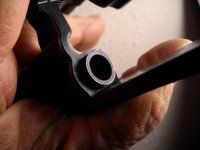
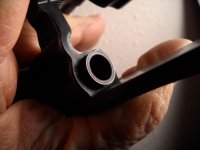
Yes it is possible, to be replaced. the over all blue finish is impeccably marvelous. The t pull a bit light. What would be the pure factory O.D. of the bbl stud? Of the cylinder front rotational O.D. of a non customized 19-2? Was there a procedure to reduce the requirement of that dia to not require the flat spot on the bbl stud?
 

Attachments

  • sw 046.JPG
    sw 046.JPG
    151 KB
Last edited:
Yes it is possible, to be replaced. the over all blue finish is impeccably marvelous. The t pull a bit light. What would be the pure factory O.D. of the bbl stud? Of the cylinder front rotational O.D. of a non customized 19-2? Was there a procedure to reduce the requirement of that dia to not require the flat spot on the bbl stud?

I'm sorry, those questions are way out of my league. Once I get past the basics I'm lost. I would never want to give out bad information I'm not sure of. I'm sure there are others here that can help you who have knowledge of what you are asking about.
 
I'm wondering if some master G Smiths actually stretch a bbl stud in similar way a yoke bbl is stretched in lieu of using shims to reduce end shake.
 
I bought my M19-5 new around 1981. I bought two boxes of factory loads but at $18.99 a box thought they were too expensive so I started reloading the following month. I put thousands of 110 grain and 125 grain JHP's through that revolver for many many years. The only results I could see wre a loss of nickel above the forcing cone on the top strap inside. I generally used a max load of Hercules 2400 as it was consistent and accurate. Tried Bullseye and W-W 296 but they did not do as well.
 
Back
Top