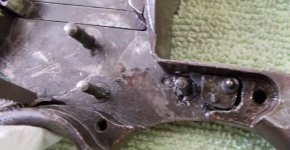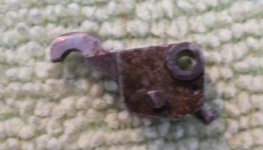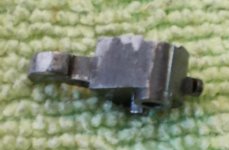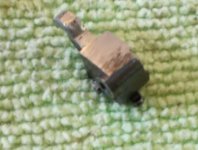

1902 Cylinder Stop problems...

Daniel Howe

US Veteran
Joined
Mar 26, 2019
Messages
512
Reaction score
961
City & State/Province
Marshall, MI
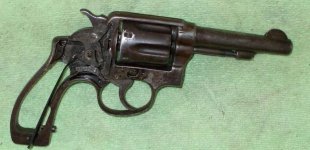
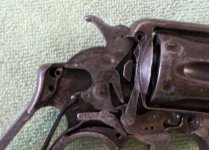
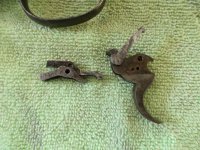
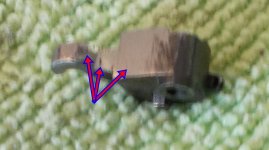
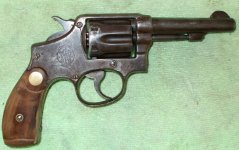
The cylinder will free wheel clock wise when the trigger is at rest. Sounds like a card in the spokes of a bike. I thought maybe the cylinder stop was not raising high enough (there is no turn line on the cylinder either). So I took it out and filed it down a little. First remove the main spring, hammer and cylinder. In this first set of pictures you can see I used a pair of needle nose vice grips to hold the flat spring down. I put plastic on the teeth so they wouldn't mark the gun, it didn't work. You can also see the rebound, I laid it out so you can see how it goes together and into the trigger.
 

Attachments
  • Step 1.jpg
    Step 1.jpg
    99 KB
  • Step 2.jpg
    Step 2.jpg
    76.3 KB
  • Step 3.jpg
    Step 3.jpg
    85.6 KB
  • Cylinder Stop 4.jpg
    Cylinder Stop 4.jpg
    96 KB
  • Step 5.jpg
    Step 5.jpg
    140.8 KB
Last edited:
In the last picture you can see the 3 places I removed a little metal. I put the gun back together and it does work a little better but not cured yet. Might have to try again. Assembly, cylinder stop first, the trigger and rebound go it together. You will have to fiddle with it to get all three lined up right. Then take pliers off. Pull the trigger a little and drop the hammer in. Then cylinder and main spring.
 

Attachments

  • Step 6.jpg
    Step 6.jpg
    64.5 KB
  • Step 7.jpg
    Step 7.jpg
    51.9 KB
  • Step 8.jpg
    Step 8.jpg
    62.6 KB
  • Step 9.jpg
    Step 9.jpg
    76.2 KB
  • Step 10.jpg
    Step 10.jpg
    59.2 KB
I'm certainly not an expert on this particlar model, but one suggestion I would make after looking at your photographs would be that, prior to evaluating the action further, I would thoroughly and completely clean every internal part, the internal portion of the frame, and the entire cylinder assembly and re-lubricate them.....especially the cylinder stop slots and the cylinder stop plunger and spring. This will most likely involve a lot of soaking and scrubbing, but you really can't properly evaluate the working condition of the action without doing this extensive amount of work first.

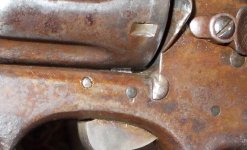
From the photographs, it appears that the cylinder stop and stop slots are showing quite a bit of wear, and perhaps some peening damage. Perhaps you could also try to rule out the possibility that the cylinder stop plunger and c. stop spring are not placing adequate force on the stop for it to function properly.

I'm not sure if new parts are available for this particular model, (perhaps from Jack First) but replacement and re-fitting of the cylinder stop may be necessary to restore proper function.
 
Last edited:
I soaked it for 48 hours in a 50/50 mix of transmission fluid and acetone. It still came out looking dirty so I put it in my ultrasonic cleaner with pine-sol and the temp set at 180 for an hour. Rinsed it off with hot tap water and let it air dry. Put a drop of oil on a Qtip and run all over everything with it and it stayed clean. I can assure you it is not dirty, I also can not explain why it looks that color. After all that is why I decided to work on the cylinder stop.
You can hear it snap into place so I know it is working freely. I took the cylinder out of a 1905 .38S&W today and put it in the 1902 .38 Special and it functions perfectly. Put the 1902 cylinder in the 1905 and it is free wheeling now. Now I know the problem is in the cylinder.
 
It may work right with a newer cyl with crisp notches, but that doesn't mean you can't fix it by fitting the cyl stop better.

The work you did is fine. But I think the cyl stop is the main problem from studying your photos. The stop ball is incorrectly shaped. In this photo I see that the stop ball is contacting the notch at the very back edge of the notch. See the shiny spot in each notch?

attachment.php


The ball is too high on it's rear slope.

To test: with a knife point, scribe a line on one side of the stop ball even with the bottom of the cyl window. Now swing open the cyl and see if the scribed line is higher than the bottom of the cyl window. If so, lower the rear of the ball slope. It's preventing the ball from rising all the way.

Then test for full contact of the stop ball in the bottom of the notch by 'painting' the bottom of the stop notches with a black Sharpie felt tipped pen. Cycle the cyl around several times and check the painted spot for contact. Once you have contact, it shouldn't free wheel any longer.
 
Last edited:
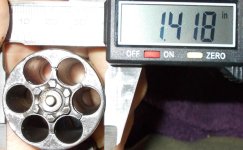
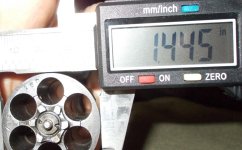
Ok Jim I'll check that tomorrow, misplaced my blue dye but the sharpie should work just fine. Since I went through the trouble to measure the cylinder I'll mention that now. The 1902 problem cylinder is 1.418" the 1905 good cylinder is 1.445"

I'll take another or better look at the stop and see if I can't get it to fit better.
 

Attachments

  • 1418.jpg
    1418.jpg
    87.7 KB
  • 1445.jpg
    1445.jpg
    93.1 KB
That's a typical nominal amount that cyls of different vintage can differ, especially since the cyl appears to have been refinished in the past. Is the cyl serial number matching to the gun?
 
Last edited:
Back
Top