
22/32 Question

Jfkidaho

Member
Joined
Jun 25, 2016
Messages
32
Reaction score
124
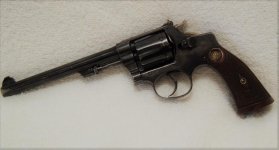
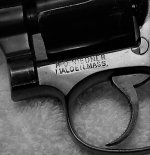
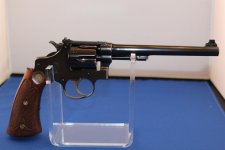
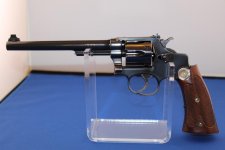
Hello all! I am looking at what I think is a cut down Heavy Frame Target. It is serial number 39950X and has a 3.5 inch barrel. The chambers are not recessed. Is it safe for modern 22 LR if it’s in good condition? The picture I have is not great but should be helpful:
Jfbw1LG.jpg

jWUIRwI.jpg

EAu8tdD.jpg

8tV3Zoo.jpg
 
Your revolver dates to the mid-'20s, at which time the .22/32 model was available only with a six inch barrel. So yes, this is a cut-barrel HFT.

I can't at the moment recall when the high-speed .22 LR cartridge was introduced, but I think it was a few years after this time. Standard velocity ammo should be fine in this modified revolver, and I doubt that high-speed ammo would cause a failure. But the gun is now nearly a century old, and it deserves to have softer exercise than it might have experienced in the past. Go ahead and shoot it, but maybe let the hotter and hottest ammo be reserved for guns that were specifically designed for it.
 
Last edited:
That's a little beauty! A home made early "Kit Gun".

The cyl chambers were recessed at the beginning of the 1930's because of and roughly coinciding with the introduction of high speed ammo. It is documented that S&W cyls were heat treated by 1920. Therefore I have no qualms about shooting HS .22s in it from a strength perspective.

However the main issue was about blowing out the case heads in non recessed chambers....AT THE TIME. Nowadays brass production quality is likely much improved.


But as David wisely posted, why stress such an old gun, that's the reason I shoot only standard velocity .22s in my homemade HFT/Kit Gun from the late 1920's, 3 3/8" barrel:

medium800.jpg


and my 1st year of introduction Kit Gun w/recessed chambers:

orig.jpg


or even in my post war models with improved steel (in 1945 when heat treating ceased except for magnum cartridges). This one w/3 1/2" barrel:

standard.jpg
 
Jim
I might have asked this of you before, but were the prewar Kit Guns available with the two-screw target stocks in those days? I know the HFT was . . .

Those are all three very nice revolvers. Thanks for showing them.
 
Hi Jack,

Yes they were. Those on my pre war are original on the gun and 'almost' #'d to the gun....almost? I say that because it's one of those factory anomalies we observe on occasion; the # is only a number or two off on the right end of the #. Obviously switched at the factory assembly bench. Otherwise what's the odds of the gun and stocks #s being that close if swapped after shipping?

The pre war Kit guns were also shipped with rd butt grips - both rd butt and target stocks on non-rebated grip frames.*

The third option was Regulation Police stocks on rebated grip frames.


• Prior to WW I, .22/32 Heavy Frame Target models were supplied with two screw extended target stocks as standard.

Above serial number ~258000 (right after WW I), the standard HFT stocks were replaced with Regulation Police stocks on rebated grip frames, at first with recessed gold plated brass medallions in the late 'teens. Checkered two-screw extension target stocks with gold plated brass medallions in ‘dished’ stock circle tops were optional from WW I until 1920 on HFTs, and w/o medallions until change order 2/11/1929.

By ~1920 Reg Police stocks (all stocks) were changed to rounded, convex tops w/o medallions. The two screw target stocks with convex stock tops and w/o medallions remained optional* until 1923 when they were reinstated as the standard stocks once again.

*Target stocks on a rebated grip frame is a dead giveaway that they were spl ordered during the period that RP stocks were standard on HFTs, or obviously if the serial # doesn't match the gun, swapped aftermarket.
 
Last edited:
By ~1920 Reg Police stocks (all stocks) were changed to rounded, convex tops w/o medallions. The two screw target stocks with convex stock tops and w/o medallions remained optional* until 1923 when they were reinstated as the standard stocks once again.

*Target stocks on a rebated grip frame is a dead giveaway that they were spl ordered during the period that RP stocks were standard on HFTs, or obviously if the serial # doesn't match the gun, swapped aftermarket.
As an aside, I'm still on the hunt for proper stag grips for my Reg Pol with rebated grip frame which will be used to complete my BBQ Gun Trifecta...Just finding a grip maker who even knows what a rebated grip frame is has proven a challenge, and the ones who know aren't taking new orders...:(...Ben
 
As an aside, I'm still on the hunt for proper stag grips for my Reg Pol with rebated grip frame which will be used to complete my BBQ Gun Trifecta...Just finding a grip maker who even knows what a rebated grip frame is has proven a challenge, and the ones who know aren't taking new orders...:(...Ben

I have never seen bone, antler, or stag grips made for a rebated frame. They'd be too easy to crack off the thin pieces that fit into the rebate.
 
Last edited:
ammo

It should be noted that CB & standard velocity 22 ammo is more accurate than high velocity ammo. Here is my unusual 22/32, with original grips lettered to the revolver, factory replaced barrel, & A O Niedner [high end gunsmith] stamped frame from the Michael Petrov collection.
 

Attachments

  • DSCF6192.jpg
    DSCF6192.jpg
    55.7 KB
  • DSCF6195.JPG
    DSCF6195.JPG
    114.2 KB
Why a cut down barrel on a 22?

The gun pictured by the OP looks to have been done professionally at the time. The re-crown and front sight attachment look like a factory job, or were gunsmiths of the day just really skilled on machine tools and rebluing, etc.?

What is the front sight on the OP gun? Doesn't appear to be Paine, or ??

I thought the 22/32 HFT was always intended to be a target gun, and as such, long barrels would seem to be most desirable by all shooters, especially when short barrel tip-ups were on the market for those that wanted pocket style guns.

My only 22/32 HFT shipped in 1915 per LOA, and was not a true Bekeart,:( but is "minty" including box and accessories.

I know now that mine was way too early to be Annie Oakley's but maybe the OP should get a LOA on the posted gun...could be a "special order" by Frank Butler for Annie to carry concealed.:D
 

Attachments

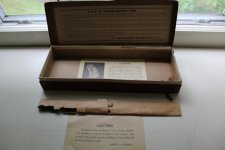
It's awfully nice to see them as they were delivered brand spanking new way back then.

The OP's front sight is custom, not something that would come from the factory, therefore not worth $100 for a Letter Of Authenticity.

Most of these cut down HFTs were done so because of a bulge in the barrel due to bad ammunition with another shot fired behind a stuck bullet.

And the long barrel clearly was intended for target work. But someone finally realized the utility and handiness of a short barrel gun w/adjustable sights that packed easily into a fishing or hunting kit and the Kit Gun was hatched!

There were no short or long barrel alternative .22s tip up or break top at the time of the HFT except the tiny M frame .22 Hand Ejector - Ladysmith. But it was hardly a field gun. That's pretty much why the .22/32 HFT was such a hit with the market.
 
Last edited:
I have never seen bone, antler, or stag grips made for a rebated frame. They'd be too easy to crack off the thin piece that fit into the rebate.

Hondo44, I’m speculating here, but suppose one were to blend off the bottom portion of the rebated grip frame? It seems like there’s plenty of steel there so that what is left wouldn’t be weakened appreciably. If one is altering a frame anyway...

I thought of this because I have a nice pair of Sambar stag grips that is unfortunately a little too small for any I frame I have. They were originally purchased for use on my Baby Chiefs Special, but too much of the back of the frame sticks out. HMMMM. :rolleyes:

Froggie
 
I seem to remember just that being done in one case. Yes, the grip frame is plenty strong enough, it's not a stress area anyway. But it would narrow the grip frame feel in the hand more than one might expect of an already small grip.

I your case, my choice would be to add two filler pieces of stag, 1/2 glued to each panel:

Notch the back of both grips with a straight cut to cover the rebate of the back strap.
Install the grips on grip frame. Glue two flat pieces of stag with bark facing rearward, and seam in the middle so they'll separate when grips are removed.

You can even make the filler pieces taller than the rebate notch in the back strap (just like the I/J post war target grips), if the upper back strap is exposed by the too narrow grips. Once the glue dries, finish up the filler pieces flush to the grips and polish with white rouge on a cotton buffing wheel.

You'll have a cool set of grips with wrap around bark as if the grips were made from a stag "round" like a knife handle. And they'd be more hand filling.
 
Jim (Hondo44) says it's documented S&W cylinders were heat treated by 1920 (Post #3). I have a copy of a March 1, 1934 letter from D. B. Wesson that says they weren't-------at least K-22 Outdoorsman cylinders weren't---as of March 1, 1934---says "------the steel as it comes from the mill shows a tensile strength in the neighborhood of 80,000 lbs., which does not make the additional strength gained by treating a necessity-----"------says heat treating such steel isn't necessary"------"-----even in our larger calibres". (sic) (But they did it in their larger calibers.)

So, on the one hand we have them treating 1920 steel, and not treating 1934 steel (for .22 cylinders); and the discussion may end right there. We also have little cylinders vs. big cylinders (and the corresponding wall thickness), so that's another place for it to end. I don't know where it ends. I do know I listen when Jim says pretty much anything, so now we have a problem---albeit not much of a problem: Who's on first?

Ralph Tremaine
 
Introduced in 1931, the K22 is a bit of a wild card. Started out with heat treated cyl because that was the protocol since 1920. As steel was improving all the time, it likely became the first to undergo questioning of the need for such a large cyl with small holes. I suspect this questioning/testing culminated in the order to delete HT by 1945 affecting all cyls of non-magnum calibers and the 38-44 models since they're not specifically listed as being dropped from heat treating.
 
Hello I'm a little late to this party. The stocks on this gun are from a later date. Based on the serial number this gun would not had had S&W medallions on the stocks. The silver medallions did not appear until around 1930.
 
And they aren't even a pair. They are both post war because they have the curved nickel plated brass medallions.

And they are both post 1968 1/2 because neither have the diamond around the screw and therefore both post Model of 1953 J frame grips that had to be shortened to fit the pre war to 1953, 1/8" shorter I size grip frame.

In addition, the left side with larger checkering field is earlier than the right side grip with the later smaller checkering field!

Visibly they can be distinguished as shown below on this Improved I frame top, and Model of 1953 New I frame bottom, and by the curved lower checkering border and difference in un-checkered wood below the checkered area, mini Magnas on top, I & J frame Magnas bottom:

KitGunsCompared004.jpg
 
Last edited:
Hello I'm a little late to this party. The stocks on this gun are from a later date. Based on the serial number this gun would not had had S&W medallions on the stocks. The silver medallions did not appear until around 1930.

If we're still talking about the grips on the OP's revolver in post #1, aren't those post 1968 Magnas?
 
Back
Top