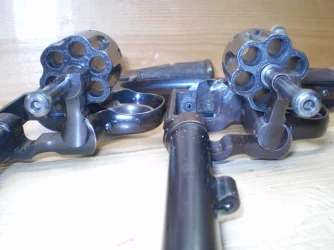
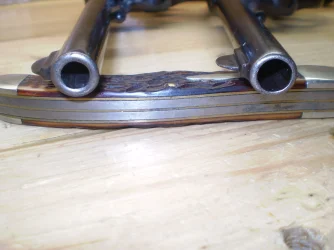
The earliest K-Frame S&W revolvers had hardened inserts in the cylinder stop notches to protect them from battering. These were eliminated fairly early on and battering of the stop notches apparently became a problem as when bad enough the cylinder can then "throw by", or skip, a chamber. My belief is that the cylinders were later heat-treated to harden them to reduce the problems of battering of the stop notches, not to strengthen the cylinder, as the cylinders had proven to be adequately strong as they had been since 1899.
Many S&W .32-20 revolvers have been fired extensively with even the "rifle only" 80 grain JHP load, that has not been manufactured since about 1960, without catastrophic results. As a matter of fact the early Lyman manuals made no distinction between rifle and revolver loads. I personally have shot many rounds of .32-20 loaded from the Lyman data in my own Model 1902 first change with no adverse effects when I first bought it in 1959 or so. I only paid $12 or $15 for it then as it was non-functioning, but, I discovered, only because the strain screw was loose. (Sound familiar??)
My point is that any of the .32-20 S&Ws are capable of safely firing ammunition loaded to higher than SAAMI standards without suffering catastrophic failure, but there are other things to consider! Higher pressure ammunition will cause accelerated wear to these early guns due to increased battering. The biggest problem would be with the Model 1899 and 1902 guns before 1st change. The barrel shank of those earliest guns was very thin. The diameter was increased to strengthen the barrel shank, probably there ere barrel shank (so-called forcing cone) failures of those earliest guns. (Sound familiar, like the Model 19 .357 Magnums??)
So, to OP, go ahead and shoot higher pressure loads in our ,32-20s if you want, they are far stronger than many may think. But do so at your own risk, but catastrophic failure of the cylinders is not an issue.. I would strongly recommend that you develop your own loads and not blithely use information obtained from any other re-loaders! Just like the common caution to not shoot the reloaded ammunition of others! Make your own mistakes and take your own chances!