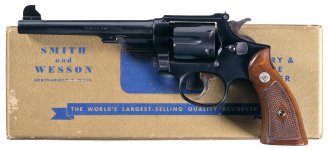
38 M&P?

LMD

Member
Joined
Feb 19, 2024
Messages
5
Reaction score
37
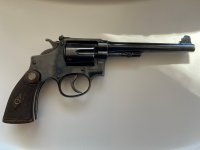
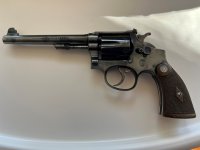
I have revolver that belonged to my grandfather when he was in the police auxiliary during World War II. Trying to identify what model it is and year of manufacture. I believe it to be a 38 M&P but I have not seen one with the same front sight.

Type: Hand ejector. No model number on the yoke.
S/N: 655XXX on the butt.
CTG: 38 S&W Special
Barrel length: 6 inches
Sights: Hand Ejector Pre-War Adjustable
Strain screw: Yes
Butt swivel/lanyard: No
Screws: 5
 

Attachments

  • IMG_3736.jpg
    IMG_3736.jpg
    246.7 KB
  • IMG_3735.jpg
    IMG_3735.jpg
    257.7 KB
Last edited:
That is a thing of beauty, I would be thrilled to own that! I have a hole in my database where that serial number range is, I can only guess that it was possibly a 1936 production...?

I look forward to what the experts have to share. I think the finish looks awfully good -- this may not have been a revolver he actually carried on-person in a holster?
 
I think the finish looks awfully good -- this may not have been a revolver he actually carried on-person in a holster?

This revolver was what he carried. I have his complete kit (holster, belt, whistle, handcuffs, etc.) that he used. I have a suspicion that it is a target model based on the front sight. It has a very light trigger action as well. He may have purchased the revolver himself since he kept it after unit was disbanded.
 
What a nice M&P Target!!

I have one 653365 Shipped 8-19-1936

It's my first prewar gun I ever bought. It got me liking the older guns.

Could we see a closeup of the front sight?
 
Last edited:
It is the Target model of the .38 M&P. The major distinction is the presence of adjustable target sights, and they usually had 6" barrels. There were several variants of front sights available from the factory. The design of the rear sight was somewhat different from the Micro style used from 1940 onward. Yours would likely have been shipped around the mid-1930s. Target M&Ps were also available chambered in .32-20, and there were small numbers chambered in .32 S&W Long. At the time yours was made, S&W did not offer target stocks. Late in the 1930s one style of target hammer was available as an option, usually called "Humpback." It was intended for single action target shooting use.
 
Last edited:
Welcome to the Forum. You have a 38 Military & Police, 4th Change Target revolver that shipped around 1935-1936. There are no front sights found in a Bob Neal study of front sights that match that one. There were, however, many made by companies like Lyman and Marbles. There were also specials made by the S&W factory and a letter should identify it if done at S&W. Of course, anyone can make their own style front sight with the proper tools.

I doubt that gun was carried in a holster and certainly not on active duty as the walnut stocks will wear quickly on the strong arm side of the gun.
 
I doubt that gun was carried in a holster and certainly not on active duty as the walnut stocks will wear quickly on the strong arm side of the gun.

I appreciate the information. The gun was carried by my grandfather in his role in the police auxiliary during WWII. I know this as fact because I shot the gun with him and we talked about it. He wasn't in uniform much in that capacity. They were only a unit that was used as necessary due to the manpower constraints on the regular police force because of the war, and he was an officer in that unit. Once the war was over, the unit was disbanded so he only served in that capacity for a short time, which may be why you don't see the wear you would be expected from a normal service revolver.
 
Last edited:
I have a suspicion that it is a target model based on the front sight. It has a very light trigger action as well.

Yes a beautiful early Target, very nice. I want my triggers to hold the weight of the revolver. Cock the hammer, point the muzzle down and let the trigger hang the weight of the gun on your finger (does it trip?). Just a quick and simple way to get an idea of trigger pull, I like to be able to bounce it around a little on my finger.

And there is something special about those stocks, ??
 
. . . I want my triggers to hold the weight of the revolver. Cock the hammer, point the muzzle down and let the trigger hang the weight of the gun on your finger (does it trip?). Just a quick and simple way to get an idea of trigger pull, I like to be able to bounce it around a little on my finger.

. . . just make sure the chambers are empty!:D
 
Under the heading of "Close, but no cigar!", #659118 was shipped December 23, 1936-----to a railroad police officer. It, as this one, was a 6" target--single unit, special order. That which was special is a Marble Ivory Bead front sight---and it letters with that sight. It too looks like it came out of the box today-----never mind that makes no sense at all!!

My best knee-jerk SWAG says this one may very well also turn out to be a single unit, special order shipped to your grandfather. It's for damn sure worth the price of the letter to find out. (And besides that, the letter may very well shine some light on that front sight---and it could do with some light shined on it!!

Ralph Tremaine

If (IF!) the front sight is original----AND IF it cost extra, it will almost certainly be treated in the letter. Another IF you send off for a letter, send along a picture of the sight, and ask for their best guess as to what it is.

I don't expect such from you, but if that one lived here, that sight would have been off in about two seconds flat to see if was original (numbered to the gun).

It's all such as this that makes our little fetish so much fun-----or so maddeningly frustratingly anguishing!!
 
Last edited:
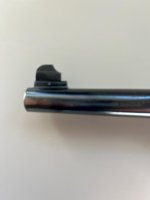
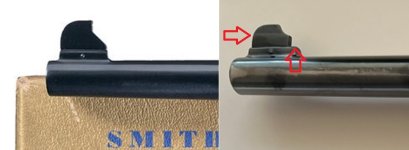
Here is a closeup of the front sight.

Thanks! As you are reading by now the front sight appears different than what we normally see. It may have came that way or its possible sometime later in life he had it changed and maybe had some trigger work done.

Did he ever shoot bullseye back in the day?

Does the gun fit in the holster very well at the tip? If not that might be a hint it was a later install.

Either way its a great gun and am happy for you that your grandfather felt you would be a worthy caretaker of something that was so personnel to him.
 
Welcome to the Forum.

If the OP's granddaddy joined the auxiliary in January 1942 and worked twice a week until VJ day, that wouldn't be that many shifts. I have a couple of blued handguns that I carried on duty for several years, each, and they still look pretty good.
 
Does the gun fit in the holster very well at the tip? If not that might be a hint it was a later install.

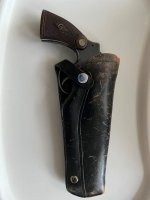
Attached is a photo of the gun in the holster he used for his auxiliary police work. It goes in easily and is secure. Unfortunately, the 80-year-old holster has not faired as well as the pistol. The belt I have with the holster is a shoulder strap belt typical of the time period.
 

Attachments

  • IMG_3739.jpg
    IMG_3739.jpg
    35.2 KB
Definitely worth a letter, especially if you think he special ordered the gun. Agree that it probably didn't see a lot of hard use.
 
Here is the link to the webpage for requesting the letter of authenticity (first one listed on the page):

swhistoricalfoundation.com/letter-process/

Regarding the front sight, it is very similar to the part fitted to an early post-war .38 M & P Target variation named the Mexican Model, so it might have been original to the gun. This image is from a closed auction in 2017.
 

Attachments

  • 1253-3653799639.jpg
    1253-3653799639.jpg
    110.9 KB
IT is an interesting sight, but I have never seen a factory sight in that configuration. Two things are odd. First is the stepped down sight blade and second having it not match the full length of the base??

attachment.php
 

Attachments

  • 1253-3653799639.jpg
    1253-3653799639.jpg
    60.2 KB
LMD, you possess a great family heirloom. Knowing the history of such things adds so much more to the story. I noticed something when I looked at the pictures. Did your grandfather have large hands? Unless the light is playing tricks on my eyes, it looks like his gun has some inserts (white) placed between the grips and the frame. That would make the grip feel larger in his hand. I would love to see pictures of the grips on the gun from the front, back, and bottom if possible.:)
Larry
 
The sight in post #19 is another not treated in Neal's article. Most all of the sights not treated are fronts. The only known rear not treated is the so-called "Large Screw Spring Up" item I stumbled upon 20 some odd years ago.

I've noted this before, but the factory kept no records on sights except for three that were patented---and only one of those (the Micrometer Click) was ever used. The research for the article was done by "observation". In plain English, if Neal or one of his legion of helpers didn't see any particular sight on a gun, it isn't in the article. (I have Neal's entire file on the article, and it was a prodigious undertaking!!)

The only weird sight I ever had was on a Triple Lock Target---a great tall sail with a full length gold bead on top-----NUMBERED to the gun. It looked for all the world like a Sheard, possibly a King, but there was no name on it. I had the gun over at Southern Precision for some work, and one of their folks said "It's a King!!" This was a crusty old guy, and he said it in a tone and with emphasis which told you he didn't expect any back talk---so he didn't get any!!

Ralph Tremaine
 
I have a M&P Target #648366 with a gold bead front sight. It has the slickest DA trigger of all the Smiths I have owned or shot, including a couple Performance Center guns. You’ve got a real peach there.
 
I have a M&P Target #648366 with a gold bead front sight. It has the slickest DA trigger of all the Smiths I have owned or shot, including a couple Performance Center guns. You’ve got a real peach there.

The slickest trigger of all you have owned MAY have been the result of the TLC afforded all S&W targets of the time----never mind this TLC was focused on single action use----or least seemed to be that way to me. I don't know when this TLC started---nor when it ended---if it ended, but I checked the S.A. trigger pull on the 14 M&P targets in my collection of target guns. These guns ranged from two 1902 versions to the last (from 1936). As an aside, the specification for S.A. trigger pull on targets was 3 to 4 lbs. (5 to 7 on fixed sight guns). At any rate, the S.A. pull on these 14 guns was 3.5 Lbs.----right down the line---from 1902 to 1936---at least.

Here's what's what from the 1925 Catalog (This from the M&P Target page.): "-------a special type of trigger pull is desirable-----not by any means simply a very light pull, but one having the peculiar quality termed "short and crisp" by shooters. This not only requires a special type of notch and trigger point, but requires a different adjustment of the working parts of the action as well." (They neglect to tell us which working parts of the action---or what sort of different adjustment, but that's understandable seeing as how anybody could be reading this catalog---and very likely were reading it!) I'd for damn sure be reading it if my paycheck came from Colt!!

Ralph Tremaine

Speaking of Colt (and I've told at least part of this story before), I had what we came to call "a Roper Colt". It was an Officers Model 38. It'd been to Roper's shop, where his lads had their way with it----grips/sights/action job---and some cosmetic alterations (polishing the leads into the cylinder stop notch leads, and left them "in the white" such that there'd be no visible turn line)---very sneaky!!

At any rate, part of the action job consisted of the use of a hammer, the likes of which bore no resemblance whatsoever to the stock Colt hammer. Needless to say, the geometry was the same, but the profile wasn't even close to the same!

I took this gun to my gunsmith to show off. He sat there on his three legged stool, wearing his leather apron, and puffing on his pipe; and said, "You know, I hate these effing Colts, but whoever did that action job REALLY knew what they were doing!!" High praise from a very sharp guy!!

I wondered who in the world could have made that hammer without it costing a gazillion dollars. It took awhile, but I finally came to the only realization that made any sense: Colt made it---only they made it to Roper's specifications---which involved a trip to their milling machine where it got a new shape----and lost A LOT of weight!!

A belated thought: If you want the slickest trigger of all you've ever owned, break loose of $20-$30, and get yourself a Miculek spring kit. Stuff it in----EXACTLY as you're told in the instructions, and you'll have it. If ANYBODY knows what's what with the innards of a S&W hand ejector, it's Jerry Miculek! And with this spring kit you'll have any D.A. trigger pull weight you want! Note he tells you to not go below 7 lbs. lest your toy won't go bang.

Now the reason to install it EXACTLY as you're told is because I didn't---the first time around. I've been in and out of 200 and some odd S&W hand ejectors in my time, and I for damn sure don't need any instructions to tell me how to swap out a couple of springs!! Well, maybe---and then again, maybe not. NOTHING would move when I finished---the first time around! Okay, maybe I better have a look at those instructions. Everything worked just fine---the second time around. Again, note you can have any weight D.A. trigger pull you want!
 
Last edited:
Factory front target sights were placed in a half moon cut in the top of the sight base on target revolvers. It extend to just short of the front and back, so a target sight will fit in the slot and come end to end on the sight base. All pre-WWII guns I have seen and read about had the same feature. Just a little extra care taken to assure a perfect fit and appearance. Lots of alterations found post-factory would have just cut a straight slot through the sight base, leaving the ends of the slot visible, or sometimes the sight blade did not match the length of the sight base leaving part of the top sight base showing. As far as the OP's gun, it is not original and neither is the base?? If you look at the image of the front sight, you will see a solder line that does not fill all the voids under the base. Sight base on factory guns were forged with the barrel.

attachment.php


As I noted in an earlier post, Robert Neal's references to sights for S&Ws shows the standard line of front sights available at the factory. There are actually about a half-dozen sight that were available at the time of the OP's revolver. Sights like Lyman, Call, Paine, Patridge, and Marbles were standard offerings for hand ejectors in the pre-1930s guns. The factory also did some special work, altering or making custom blades, but I do not see many that letter. Have one target M&P that had an odd front sight and had conversations with Roy who stated it was an early factory ramped front sight for a shooter or law enforcement officer. It is not pretty, but would not catch a holster when drawn. It is understood that he found that information on the invoice from 1910 that stated Lewis E Petry, New York. The factory letter stated the type of front sight, and that he paid $30.38 for the gun. The sight has the entire serial number stamped on the bottom half moon insert. Pictures below.

attachment.php

attachment.php
 

Attachments

  • P1010001.jpg
    P1010001.jpg
    120.1 KB
  • 38 M&P 154974 Letter.jpg
    38 M&P 154974 Letter.jpg
    70.2 KB
  • IMG_3735.jpg
    IMG_3735.jpg
    24.4 KB
Last edited:
Factory front target sights were placed in a half moon cut in the top of the sight base on target revolvers. It extend to just short of the front and back, so a target sight will fit in the slot and come end to end on the sight base. All pre-WWII guns I have seen and read about had the same feature.
Gary,
I'll agree with you on the early 20th century guns you collect.
However, I'll disagree with you on guns from the very late 20s and through the 30s.
By then, the Patridge blades almost never come to the rear edge of the base.
This is true on 38 M&P Targets, K-22 ODs, K-22/40s, K-32s, 38 ODs, 44 Targets, and 357 Mags.


38 M&P-
attachment.php


38 M&P-
attachment.php


44 Target-

attachment.php


38OD-
attachment.php


22 OD-

attachment.php
 

Attachments

  • IMG_0173.jpg
    IMG_0173.jpg
    73.4 KB
  • IMG_6169.JPG
    IMG_6169.JPG
    89.9 KB
  • IMG_6111.JPG
    IMG_6111.JPG
    80.7 KB
  • IMG_3316.JPG
    IMG_3316.JPG
    87.7 KB
  • IMG_2849.JPG
    IMG_2849.JPG
    75 KB
Last edited:
Thanks for the clarification. I have some 30s guns with the short sights, should have looked. Even have a McGivern shipped gun and the McGivern sight blade is also short.

Even though the OPs sight base was soldered on, I guess it could still be an altered Patridge blade.

attachment.php
 

Attachments

  • P1010006.jpg
    P1010006.jpg
    124.6 KB
As far as the OP's gun, it is not original and neither is the base?? If you look at the image of the front sight, you will see a solder line that does not fill all the voids under the base. Sight base on factory guns were forged with the barrel.

attachment.php
Ha!!!!!!!!!
I missed that!
However, we know his gun almost certainly shipped as a Target because of the grooved tangs.
My guess is someone (Grandpa??) wanted a different front sight, maybe to draw easier, or possibly just a cobbled up job of repairing a damaged sight.
 
M&P Targets are my favorite prewar guns. The front sight pin looks to have been out and the base looks odd, but could be lighting I suppose.
I marked this pic.
64-FE5-B64-4-CBF-4-BDF-866-C-1-EFB3788-B835.jpg


Also looks like the stocks are shimmed out. Nice to have a gun with family history.
 
Back
Top