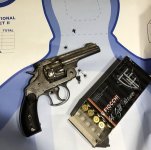
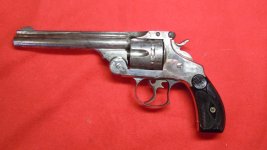
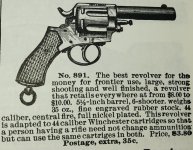
.44 DA Frontier

From friendly British Columbia , relish your indecision and bring home your hearts desire
 
How you folks deciphered a rather cryptic message, is simply amazing.
 
What's cryptic about it?
I have a 44/40 .44 DA I would like to shoot.
Should I stick to Black Powder or can I get away with some Smokeless Cowboy loads as long as I keep them reasonably soft??
The gun is in excellent condition, but not minty....
:confused:;):p
 
I do not shoot factory smokeless in any of my antiques. I assume they are mild, but I trust my chronograph and hand loads much more. All I can tell you is that I shot both a 44 Russian DA and a 44-40 DA over 20 years off and on with absolutely no problems with 5g Trail Boss and a 200g RNFP. Loading for 44-40 ran 650 to 700 fps which was around 7000 psi pressure. That is only 75% of BP loads. You can load 160g bullets that will produce even lower pressures.

Can a part break on a 120-140 year old gun while shooting? Absolutely! Will it blow up with mild smokeless loading? Absolutely not! Is loading a full casing of BP a good idea, your choice, but facts do not lie. Rumors however are often lies!

Comments like "Black powder only is the only viable option" with no support, facts, comparisons, or research is simply an old wives tale perpetuated!!!!!
 
Last edited:
This supports the theory that black powder should be used in these early revolvers. It’s the pressure spike with smokeless powder.

Will this particular revolver blow up? Probably not. But why take the chance?
 

Attachments

  • 2B66A1D5-779C-4A42-A0FE-E888897D0482.jpeg
    2B66A1D5-779C-4A42-A0FE-E888897D0482.jpeg
    33.9 KB
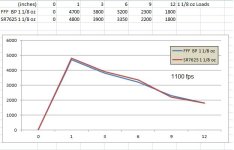
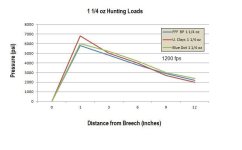
These charts just pick a random smokeless load and compare it to BP. It is done to prove their point. I have many such charts that compare smokeless to BP in shotguns from the Sherman Bell from Doublegun Journal research. The point is you match the pressures to BP, just don't pick some random smokeless load. Bell did that and matched pressure curves exactly to BP. (see charts) Velocity is tied to pressure, especially in short barreled handguns and the lower the velocity with the same bullet, the lower the pressure.

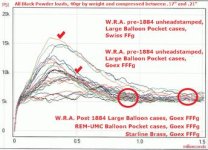
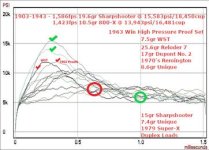
Specific to 44-40, you can find another study below that designs several smokeless loads to match BP. It can be done and if you do not need full power loads, you can load with smokeless to lower pressures than BP.

Below is the text from the author on the 44-40 loadings.

[Bryan E Austin
sixguns.com
SavvyJackBryan E Austinsixguns.com

For the smokeless powder gif, I took the best shot, the best that matched the average pressures from a ten shot group. The curves prove, for this cartridge, that there are no “pressure spikes” unless one uses fast burning pistol powders at higher than published loads, or for loads that require the use of stronger action rifles.

For the (first chart) black powder gif, I combined what I could that gave a clear distinction between the years of manufactures…pre-1884, post 1884 and modern. These are years of which the cases gradually lost the deep balloon pocket which appears to aid in higher pressures in black powder loads.
This screen shot shows the fast vs slower powders, the length of time it takes to complete the burn.

The second screen shot of the black powder gif shows just how much pressures original loads produced compared to today’s loads. It also shows the length of time it takes to complete a burn. The hotter load retained higher pressures through the duration of the burn.
 

Attachments

  • 1 18 Loads.jpg
    1 18 Loads.jpg
    50.4 KB
  • 1 14 oz Hunting Loads.jpg
    1 14 oz Hunting Loads.jpg
    46.1 KB
  • 44-40 BP Pressure Curves.jpg
    44-40 BP Pressure Curves.jpg
    20.8 KB
  • 44-40 Smokeless Pressure Curves.jpg
    44-40 Smokeless Pressure Curves.jpg
    20.6 KB
Last edited:
My old beater is in .44 Russian, but I shoot whatever factory loads I can find.

It might be different with .44/40 as there are plenty of modern guns chambering it.
 

Attachments

  • 9C825609-9CAD-4F90-B358-7336E2FA5058.jpg
    9C825609-9CAD-4F90-B358-7336E2FA5058.jpg
    74.1 KB
Responsible Reloading

Using generic charts to compare powder burns between Smokeless and black powder is not applicable to specific loadings for specific firearms.

Reloading is a science that applies to a “specific” firearm using powder, bullet type, bullet seating depth, overall case length, and primer selection.

***Every firearm is different. Pressure obtained between a rifle and pistol platform is dramatically different.

Using rifle scales for pistols is also not applicable. Nor is it responsible reloading!

All, smokeless reloading manuals clearly separate “Pistol” loads from “Rifle” loads. This is especially true with the 44 Winchester “Rifle” round being shot from a pistol platform using smokeless powder.

Reloading smokeless rifle rounds for a pistol that is 122 years old is not for a novice. Making it sound simple is not responsible reloading.


Murph
 
Over 100 years of Reloading manuals

This actually says it better.

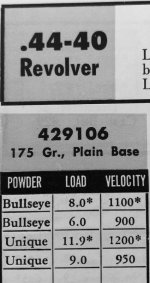
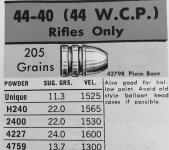
Over 100 years of reloading manuals beginning with early "Smokeless" Era does not adjust powder loads for antique firearms. They were considered "obsolete weapons". All powder loads listed was for modern smokeless guaranteed firearms.

Both photo's posted are smokeless loads that are "STANDARD" loads for the 44 Winchester for both Rifle and Pistol platforms. Both are Way too hot for Antique firearms! Yet these same loadings are documented for over 100 years in various reloading manuals beginning in about 1908.

Also, Cowboy action shooting loads are not "designed" specifically for Antique firearms. They are "Specifically" designed for Modern firearms with reduced loads for competition shooting with low recoil. Somewhere along the line the "Smokeless Squad" plugged them into Antiques without the Company's permission. I challenge anyone from the "Squad" to gain written authorization from those powder/cartridge companies to use smokeless in Antiques and I guarantee they will be silent!!!

Or they will clearly state that those loads are NOT designed for antique firearms, nor are they guaranteed safe to be used in antiques. Any other answer invites liability. Which is understandable and respected by me personally. Others will claim different but will not put themselves on the line if something goes wrong!

If you use the photo'd smokeless loads in an antique pistol, you will damage and likely destroy the gun.

Modern cartridges are NOT loaded down for antiques. That is also another fallacy. Antiques are "obsolete weapons". Loading cartridges for them requires extreme care.

Murph
 

Attachments

  • EEE3BBC5-480E-4A79-A783-702EBCBE6C49.jpg
    EEE3BBC5-480E-4A79-A783-702EBCBE6C49.jpg
    47.9 KB
  • C9C7194A-5F8E-459E-8523-A30EE5BFBA55.jpg
    C9C7194A-5F8E-459E-8523-A30EE5BFBA55.jpg
    88.5 KB
Last edited:
How much more specific can you get than comparing 44-40 smokeless loads directly to black powder????? As you know, the 44-40 case held 40 grains of black powder and was used universally in rifles and pistols. There was no reduced revolver load back then. That meant, depending on the manufacturer, one could get as high as 15,000 psi or as low as 5,000 psi. The smokeless loads tested the same, 15,000 down to just over 5,000 depending on the load. The charts prove that the proper smokeless powder will match the pressure curve of BP. Does not matter if it is rifle, shotgun, or pistol. Go to a site like Hodgdons and you can find loads for handguns that are at of below 7,000 psi pressure, 30% lower than the 11,000 psi limit and easily 25% lower than BP.
 
Specifics

You're still using generalities. NOT specifics.

Specifics is applicable to each and every platform that discharges a specific load.

Example: The original 44WCF was 40 grains of FFG black powder for many years. It was NOT 40 grains of FFFG. That was a result of reloaders using a hotter powder to achieve a better result on a pistol platform.

The 15,000 rating was the maximum PSI designed for that specific cartridge. That does not mean that 15,000 PSI was achieved when used in a 4"-barrel antique pistol. The FFG powder and shorter barrel length barely achieved 7,000 PSI maximum on a pistol platform. That is documented in old black powder manuals that I have.

That would be a maximum pressure rating measured at the muzzle, not the forcing cone like smokeless. Black powder is measured at a maximum "gradual" pressure achieved.

Smokeless generally spikes to maximum pressure as engineered and will spike even higher if your bore is dirty, lead fouled, undersized, wrong size bullet, wrong hardness of bullet, lack of lubrication, etc..... Black powder won't. That is where they differ greatly and the large safety margin that Black powder provides for antique firearms. It won't spike if the case is loaded correctly.

The 44WCF was more commonly used on a rifle platform. You can't compare total pressure achieved on a rifle platform with a pistol. Apples and Oranges. Totally different. Much lower pressures are achieved on antique pistol platforms. Even with large volumes of FFG Black powder. The barrel length is too short to achieve an efficient powder burn for the 44WCF Rifle round.

That kick or recoil that you feel from a black powder pistol is the result of the excessive powder load still burning when the bullet leaves the muzzle. It's a very poor burn with too much powder load for a short barrel pistol.

Murph
 
Last edited:
Smokeless powder use

Also,
I'm not saying that smokeless powder can't be used. I'm only saying that it is not for the novice reloader and there are no safe loads listed in copyrighted reloading manuals.

Cartridge and powder companies will not back up smokeless use as well. Their position is always to use their cartridges in "Modern Firearms in good working order".


So, the reloader is left to fend for themselves. In other words. You're on your own with shooting antiques. Nobody to blame but yourself if something goes wrong.


Murph
 
Reduced black powder loads were and are available. You reduce the volume of FFg and FFFg. By using a filler. I use Cream of Wheat.
 
I've shot them both and feel comfortable with the weapons ability to handle "cowboy action" type smokeless loads. In my hand smokeless loads regardless how soft are still more abrupt than black powder. My standard 44-40 black powder load is 30grs. of Old Eynesford 3F and the gap is taken up with a .060 vegetable fiber wad. This load gives me a great buck and roar with all the smokey goodness only available with holy black. On the face of it the black powder load is more spectacular while the smokeless load from Black Hills factory is sharper without the attending buck and roar. It doesn't feel right, in the same way the standard black powder load in a Ruger Old Army feels much more "correct" than the conversion cylinder load of Black Hills .45 Colt. With the current difficult availability of black powder I can understand someone looking for an alternative, stay safe. Buffalo Arms has received a shipment of Schuetzen 2 and 3F, it is available with a price break at 10lbs.
 
Reduced black powder loads were and are available. You reduce the volume of FFg and FFFg. By using a filler. I use Cream of Wheat.

Not in the 1880s when these revolvers were introduced. The point is that for the first 20 years or more there was nothing but a close to 40 grain loading. Of course you can reduce the BP loadings, but if you believe Bmur, you need to be some sort of reloading expert to do that or pick a low pressure smokeless load from a reloading manual and load it! Believe me, you only have to follow standard reloading protocol to come up with a great box of light loads. Smokeless works, smokeless can be loaded at substantially lower pressures than BP, and smokeless will allow you to shoot way more than 12 rounds before the gun gums up and stops working!

Still looking for all those stories of blown up 44 Winchester DAs, but no one can come up with one instance yet as far as I know.
 
I have a hard time believing the old timey owner of a .44 DA would get a new gun to shoot the new smokeless powder cartridges, or even bother to keep buying blackpowder loads when the smokeless ones were on the shelf.

I bet most of the BP cartridge guns just soldiered on with smokeless loads as they became available.

I once posted on another forum a picture of a BP framed Colt single action that my boss owned. He’d inherited it from his Uncle. I mentioned we were going to shoot it with some cowboy loads at our next firearms quals, and the caterwauling began in earnest. I would destroy a good gun. I would risk dismemberment. Disco would return.

It turns out the Uncle had shot the gun monthly for the last 50 years with factory smokeless ammunition. It was still in great shape.
 
As a practical matter, ammo manufacturers weren't stupid. When smokeless ammo was introduced, the significant majority of their customers were using black powder guns. Were they going to provide a product that would destroy the gun and potentially harm the user? That's really a good way to destroy your business.
 
What's cryptic about it?

I have a 44/40 .44 DA I would like to shoot.

Should I stick to Black Powder or can I get away with some Smokeless Cowboy loads as long as I keep them reasonably soft??

The gun is in excellent condition, but not minty....

:confused:;):p


Well in that case, go with cowboy loads……Since you put it in terms I can understand…..[emoji23] your post completely resonated with me. I use cowboy loads since I don’t reload.
700c6239d9d1e2900c69d145c5158501.jpg
 
Last edited:
Factory Winchester Ammo

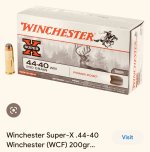
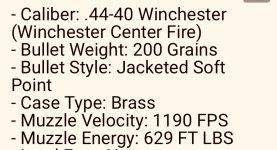
How about this “Factory loaded ammo”. Semi-Jacketed?
I don’t think Winchester was considering the Smokeless use in Antique Pistols when they produced this box.


Murph
 

Attachments

  • 7F2EF29D-2DAF-4335-B8B9-8AB472338FCE.jpeg
    7F2EF29D-2DAF-4335-B8B9-8AB472338FCE.jpeg
    143.8 KB
  • B8CB8E35-4651-470B-A852-8CAC114A9417.jpeg
    B8CB8E35-4651-470B-A852-8CAC114A9417.jpeg
    105.2 KB
Food for thought

Food for thought.

Murph
 

Attachments

  • CD5A7AEE-320A-4EB1-9ADE-9E65BF8D2D9A.jpeg
    CD5A7AEE-320A-4EB1-9ADE-9E65BF8D2D9A.jpeg
    61.8 KB
Definitely a BP cast load for the first one. Maybe a Cowboy cast load for the second, but I'm leaning BP for both....
 

Attachments

  • DSC00610.jpg
    DSC00610.jpg
    77.5 KB
  • DSC00612.jpg
    DSC00612.jpg
    63.4 KB
Bulldog

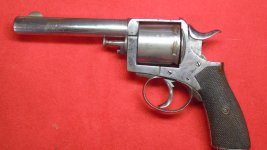
I like the Frontier Army Bulldog.
That’s a late model by grip design not introduced until the late 1890’s.
The way to determine antique or modern are the proof marks found on the cylinder and right side frame. If it’s nitro proofed it’s post 1905. If it’s black powder proofed having the oval with E L G then it’s only proofed for black powder.

I have late bulldogs nitro proofed that qualify for smokeless and they are noticeably heavier. Higher carbon steel with thicker chamber walls (more overall tempered steel) to handle smokeless loads. They are very impressive to shoot.

Murph
 

Attachments

  • 1725B38F-9D4F-4B3F-8693-E257F39A1573.jpg
    1725B38F-9D4F-4B3F-8693-E257F39A1573.jpg
    101.1 KB
Last edited:
Reloading for Antique pistols

I just wanted to post this for those who are considering shooting their antique revolver. It's my experience that we should always reload our own cartridges when shooting antiques. There are many hazards that you can run into when purchasing smokeless loads for antiques. Even black powder reloads. You basically don't know what you're getting.


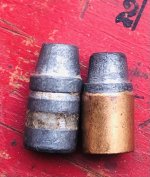
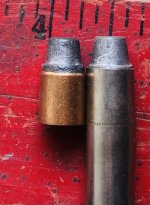
You can see in the photo's, once you load a case with a semi-jacketed round there is absolutely no way to tell the difference between a solid lead bullet and a hardened/copper semi-jacketed bullet that is designed for higher pressures and velocities. Even when buying a full box at say a gun show? The seller might have filled the box with some reloads to obtain maximum price. NO WAY to tell until you pull the trigger.

With a modern firearm there is no harm done since modern guns can handle the semi-jacketed round. The Antique will suffer the significant increase in pressure.

Murph
 

Attachments

  • 3E9A6172-EE4C-446A-8603-F8AC9CDFF0D6.jpg
    3E9A6172-EE4C-446A-8603-F8AC9CDFF0D6.jpg
    95 KB
  • E045FE32-B0A0-4D19-83D3-B4C9438923FE.jpg
    E045FE32-B0A0-4D19-83D3-B4C9438923FE.jpg
    80.6 KB
Last edited:
In the end it comes down to what your personally comfortable with after trying both loads. Personally I just don't like the way smokeless works, it is more abrupt or sharp. In the same way I don't like the way a 12 volt starter drive smacks the flywheel on a 6 volt starter equipped car, it doesn't sound right...too abrupt or harsh. Does it work? Yeah just fine, I just flinch every time I hear one used that way.
 
Murph,
Know what you mean!!

I just finished pulling down about 600 rounds of 45ACP reloads a guy gave me. Looked like a reasonable load of Red Dot, but who knows??
The only problem was they were all SWC's and my collet puller couldn't get a purchase on them, so it was inertia puller time..... (I now have a sore hand..)

Also pulled a box of 43 Spanish reloads. I have no idea just what the powder was in them. It kind of looked like cannon powder (Fg) but it was brown (~73 grains). I lit off a small amount and it just didn't smell right.
All now nicely recharged with 73 grs of FFg
 
Cream of Wheat?

LOL,
That's hilarious. I suspect the brown powder from the 43 Spanish loads are from a duplex of Black and Mikes Cream of wheat. Festering up for about 10 years. I'd imagine it would put off a foul odor. Probably not too healthy to breath too.

We do get spoiled with the collet tools. My crimpers are a joy.

Murph
 
Murph,
Know what you mean!!

I just finished pulling down about 600 rounds of 45ACP reloads a guy gave me. Looked like a reasonable load of Red Dot, but who knows??
The only problem was they were all SWC's and my collet puller couldn't get a purchase on them, so it was inertia puller time..... (I now have a sore hand..)

Also pulled a box of 43 Spanish reloads. I have no idea just what the powder was in them. It kind of looked like cannon powder (Fg) but it was brown (~73 grains). I lit off a small amount and it just didn't smell right.
All now nicely recharged with 73 grs of FFg

You are much more ambitious than I, I can't imagine hammering out that many rounds, especially from something as common as 45ACP. I just got into 218 Bee and have been having fun finding decent reloadable or fresh Bee brass. I just pulled a few over 100 that were previously loaded and thought that was a pita, can't imagine six times that. I know I can and have manufactured 218 Bee from both 25-20 and 32-20 but they come up quite a bit short of full length in the process, after firing they don't stretch enough to satisfy me.
 
Back
Top