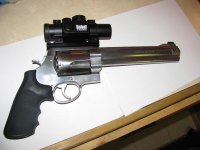
The one for jacketed bullets has holes (ports) on top along with the larger slots on the sides, the one for lead is slotted only for easier cleaning.
They are mighty nice revolvers. I was shooting mine today along with my 454 Casull (BFR). The XVR is hands down easier on the shooter. I haven't scoped it yet and as well as I was able to do with the factory sights I'm in no rush to put one on it.
Sure go through the powder loading for it though. It takes more than double the amount of my 44mag rounds.
Best wishes and congrats on your nice find.
thanks everybody, I will be owning the other comp. real soon, I appreciate the replies. I may have one of the first guns, the serial # is CJJ0800, let me know if anyone has a "born on date" for this gun. Yeah the reloading uses up the powder on this caliber (42-47 grns. for a 240grn bullet, will get you about 150 bullets/lb.) but, you gotta pay to play!
Is that really the main reason for having to change compensators for ease of cleaning? They really only explain how to change them in the manual not the reason for having to. Is there any loss of accuracy or other dangers if you were to shoot a lead bullet through the jacketed compensator?
I am really puzzled by mention of shooting lead in this gun. I guess that has been settled by the 454 Casull people, but there is probably considerable science there that just gets glossed over. Safe to say that conventional load sources probably make no mention of lead for this cartridge. Do they even make gas checks this big, what .454?
Gas checked are readily available for .45 caliber.
<snip>
The real question is whether these bare bullets, no gas checks, should properly be fired up using hot H110 loads. I am always nervous and skeptical about load data coming from an informal culture, wherein one guy goes off the res and then gets to reassure others that the load "works".
I agree with being skeptical and cautious with load data from questionable sources. Most powder and bullet manufactures will answer emails with good data.
Most lead are heavy or greater than 300 grain bullets so H110 won't be a best choice for powder.
I would suggest few hand loaders are interested in hot rodding lead but are interested in reducing loading cost.
If you are driving your hard cast under 1400 fps you don't need gas checks.
With powder coating you will be able to even do away with gas checks even when shooting lighter bullet up to about 2200 fps. I plan to do some testing this coming summer.
And will post results.
Good luck and be safe
Ruggy
I'm pretty sure the differences in comp's is about fouling problems using lead with the jacketed type brake. (I could be wrong.)
I'm using a touch over 50grains of H110 behind 200 grain jacketed bullets, they sure are zippy.
The muzzle brakes are great, it my first gun that has one and I am impressed with how well they work.
.............
So I remain perplexed by the two breaks on the 460 xvr. It seems like there surely is a reason other than ease of maintenance/cleaning. Can anyone tell me the difference. Surely SW wouldn't engineer two for the sole purpose of cleaning........Thoughts
I'm pretty sure the differences in comp's is about fouling problems using lead with the jacketed type brake. (I could be wrong.)
I'm using a touch over 50grains of H110 behind 200 grain jacketed bullets, they sure are zippy.
The muzzle brakes are great, it my first gun that has one and I am impressed with how well they work.
.............
So I remain perplexed by the two breaks on the 460 xvr. It seems like there surely is a reason other than ease of maintenance/cleaning. Can anyone tell me the difference. Surely SW wouldn't engineer two for the sole purpose of cleaning........Thoughts
The jacketed comp has holes projecting up and which go out the comp and the shroud.
The lead comp does not have these and is extended with two addition side ports.
If you use the jacketed comp port shooting lead and lead accumulates in the top ports it makes extracting the comp extremely difficult and occasionally next to impossible.
Some find the lead comp reduces muzzle flip better than the jacketed comp.
Be safe
Ruggy
The jacketed comp has holes projecting up and which go out the comp and the shroud.
The lead comp does not have these and is extended with two addition side ports.
If you use the jacketed comp port shooting lead and lead accumulates in the top ports it makes extracting the comp extremely difficult and occasionally next to impossible.
Some find the lead comp reduces muzzle flip better than the jacketed comp.
Be safe
Ruggy

I need to compare the two. Thanks for the info.