Another hand ejector identification needed

Joined
Nov 21, 2018
Messages
1
Reaction score
1
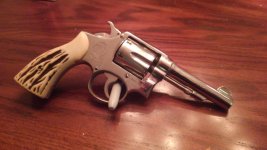
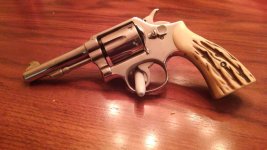
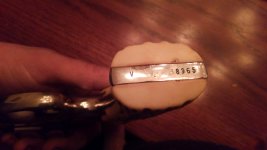
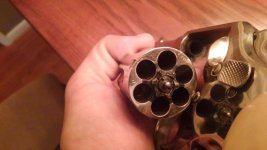
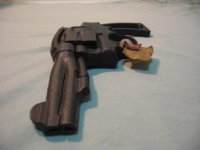
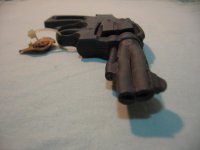
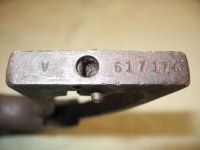
I inherited this gun from my grandfather over a decade ago. The story that I had always heard was this was his service revolver when he was with Seattle PD back in the late 50s/early 60s. I know it is a 5-screw K frame in .38 SP, s/n V638965 (the first "6" is very lightly stamped in the butt but clearly readable on the cylinder). This gun has a 4" barrel, fixed sights, pinned barrel. There is a "P" on the left top of the frame next to the cylinder opening, and before the serial number on the back of the cylinder. There is no lanyard loop or threads for one. Sadly, I do not have the original grips. The grips on the gun for the photos are the "GRIPWELL" faux staghorns that were on it when I inherited it. I'm a little confused, as the "V" prefix on the serial would denote a Victory model, but this is the wrong finish for a Victory and there is no lanyard ring. Any information you could give me would be great!
 

Attachments

  • KIMG2176.jpg
    KIMG2176.jpg
    64 KB
  • KIMG2177.jpg
    KIMG2177.jpg
    77.3 KB
  • KIMG2178.jpg
    KIMG2178.jpg
    35.9 KB
  • KIMG2179.jpg
    KIMG2179.jpg
    52.4 KB
Can you post a few more pics for us? Like a pic of the top of the frame right above the cylinder, especially the right hand side of the top of the frame?


Also can you remove the stocks(grips) and take good detailed pics of any stampings/markings on the metal grip frame, especially the left hand side, but all markings might help.


Definitely a Victory that's eventually had the lanyard ring removed, the hole filled in.....and then refinished/nickeled. (And most likely in .38 Special if the 4" barrel length is any indication) Just curious as if there may be anything stamped on it to determine if it was sent back to S&W for the work. More pics will help, especially with regards to any stampings/markings you may find such as date codes, shapes/symbols, etc.


I'm no nickel finish expert but I've seen where S&W did not nickel the star extractor (left them in the blue), and your example appears to be that way as well. That doesn't mean that a knowledgeable person with regards to S&W finishes could not have duplicated a S&W nickel style finish though. Although the thinning of the butt's serial number's first few digits does have me a little leary of thinking S&W would have left it that way. One of the guys that knows more about S&W nickel finishes will most likely assist.


More pics would definitely help with attempting to determine anything more. It does make for a nice looking revolver though. Have you put a few rounds through it yet in honor of dear 'ole Grandad?


Dale
 
Last edited:
The plugged swivel hole is obvious in picture #3. As tenntex32 has stated, this is a refinished Victory Model with replacement stocks.

That does not mean it wasn't used as a LEO gun in the period you mentioned. Lots of surplus WWII guns were so used. Of course, I don't know about the Seattle PD and whether they would have sanctioned such. I'll leave that to the experts on that topic.

The P is a proof mark.

Incidentally, the swivel holes were not threaded. The shaft of the swivel was simply slid into the hole and pinned in place with a cross pin through the bottom of the grip frame under the stocks. If you remove the stocks, you should be able to see the hole where the pin used to be.
 
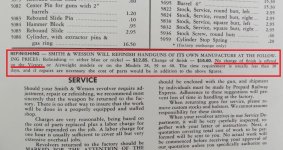
Smith & Wesson actually had a policy post-war not to do finish changes on Victory models (see attached), so no guess work as to the refinish is necessary: This is a private/gunsmith-applied nickel job.

The gun was originally manufactured in mid-1944, and the triple-P proof was standard at that time for all Victorys (frame, cylinder face, and it should also be next to the underbarrel serial).

Many PD's got Victorys during the war and continued using them for decades after since they were perfectly servicable M&P's. Frugal departments also acquired them surplus post-war.

Only a history letter could tell you where this gun shipped originally. The refinish could have happened any time during or after the gun's active duty.
 

Attachments

  • Victory no fact refinish.JPG
    Victory no fact refinish.JPG
    135.5 KB
Welcome! Good information above. The hammer and trigger are nickel plated, common with aftermarket refinishing.

You probably know these came with smooth walnut service stocks, inexpensive and easily found. These would be "correct" for your grandfather's gun but historically these are the real ones, just as the current nickel finish is :).

I would guess the "6" on the bottom of the grip frame SN was polished heavily at the time the butt swivel plug was installed. And by the way, it appears perfectly safe to fire (hint, hint :)). Enjoy!
 
Smith & Wesson actually had a policy post-war not to do finish changes on Victory models (see attached), so no guess work as to the refinish is necessary: This is a private/gunsmith-applied nickel job.

The gun was originally manufactured in mid-1944, and the triple-P proof was standard at that time for all Victorys (frame, cylinder face, and it should also be next to the underbarrel serial).

Many PD's got Victorys during the war and continued using them for decades after since they were perfectly servicable M&P's. Frugal departments also acquired them surplus post-war.

Only a history letter could tell you where this gun shipped originally. The refinish could have happened any time during or after the gun's active duty.

When was that document dated? I'm just curious as to if it's a wartime dated document, or later as I could understand not wanting to refinish them when the war was on, but after the war you would think money is money with regards to S&W and possible work. (To be clear I'm not disputing what the nickel experts feel about this example, I'm just curious as to whether or not S&W ever loosened up on their "no Victory refinish" policy.)


Now I will say this, I have read where S&W made it part of their contract with the U.S. Government for the Government to destroy/deactivate all Victory model revolver examples and to not surplus them out onto the civilian market. (This was due to them losing commercial sales after WWI due to all the M1917 revolvers suddenly available to the public, "however" they got there.)


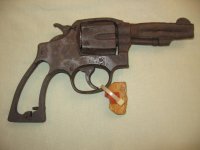
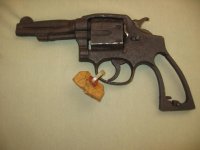
Well obviously, and thankfully complete Victory deactivation didn't happen. Just so happens though that I do own a U.S. military deactivated Victory though. Maybe I should ship it to S&W and see what they say about a possible nickel job on it!


(Coincidentally my deactivated Victory is in the same 600,000 s/n range as the OP's example.)


Dale
 

Attachments

  • Deactivated Victory 1.jpg
    Deactivated Victory 1.jpg
    77.5 KB
  • Deactivated Victory 2.jpg
    Deactivated Victory 2.jpg
    69.2 KB
  • Deactivated Victory 4.jpg
    Deactivated Victory 4.jpg
    41 KB
  • Deactivated Victory 5.jpg
    Deactivated Victory 5.jpg
    42.7 KB
  • Deactivated Victory 3.jpg
    Deactivated Victory 3.jpg
    64.2 KB
When was that document dated? I'm just curious as to if it's a wartime dated document, or later as I could understand not wanting to refinish them when the war was on, but after the war you would think money is money with regards to S&W and possible work. (To be clear I'm not disputing what the nickel experts feel about this example, I'm just curious as to whether or not S&W ever loosened up on their "no Victory refinish" policy.)
...

I don’t have a date on the document; Lee posted this some years ago, which means it came from God :D

It can’t be wartime, since no civilians would have had Victorys on which to individually order finish changes. In fact, it must be post-1957 since it mentions model numbers.

And it is my understanding that the reason was work required and therefore cost: the whole point of Victory production was saving steps in the production process, and all the labor-intensive pre-finish polishing of parts was omitted; that’s why so many even pristine Victorys show tool marks all over.

Prepping a Victory for a factory-quality polished re-finish, blue or nickel, was likely not cost-effective as a service, also given the condition many Victories were in.
 
Last edited:
It can’t be wartime, since no civilians would have had Victorys on which to individually order finish changes. In fact, it must be post-1957 since it mentions model numbers.

Well civilians that worked for a company/department the DSC may have sold them to might have been be so inclined as to have one shined up! (If they thought they cold get away with it anyways.)

Just wonder how many times S&W told folks "Thanks but no thanks" with regards to Victory refinishes?

Dale
 
Last edited:
Welcome to the forums from the Wiregrass, gregman! You are gonna get more info than you likely wanted. ;)


@dale: LOL!


Well obviously, and thankfully complete Victory deactivation didn't happen. Just so happens though that I do own a U.S. military deactivated Victory though. Maybe I should ship it to S&W and see what they say about a possible nickel job on it!


But, seriously, S&W will not work on older, obsolete models. They sent my model marked K32 back with a flat refusal to do any work on it.
 
After WW2 and up to the late 1950s, imported surplus Victory models were available in US sporting goods stores, & dealer catalogs, for as low as $10. It would cost you more than the gun, to refinish one, so the few nickel guns you see may have been ego jobs by owners with fat wallets. Ed.
 
Back
Top