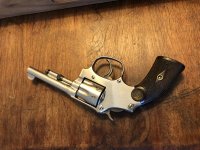
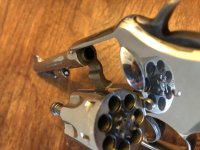
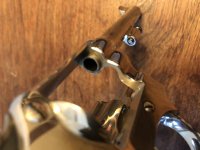
Another one

Joined
Jul 8, 2020
Messages
11
Reaction score
59
Using the mountain of awesome info of this forum and older threads, I took a stab at identifying this other acquisition of mine- Am I on the right track with this one?

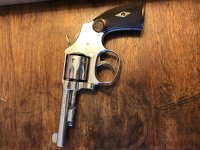
Ladysmith .22
3rd model?
Nickel, great finish
Little to zero wear. I don’t think ever fired a round or if it did, not many
Serial 26xxx

How do I figure out year?
 

Attachments
  • 68C6699C-E136-4469-A32B-1BABD87C322A.jpg
    68C6699C-E136-4469-A32B-1BABD87C322A.jpg
    96.7 KB
  • 2CED8188-82DF-45B3-8B1D-F5114724CCBE.jpg
    2CED8188-82DF-45B3-8B1D-F5114724CCBE.jpg
    85.5 KB
  • 09626A78-575C-485A-BA3D-D7D883F5ABE5.jpg
    09626A78-575C-485A-BA3D-D7D883F5ABE5.jpg
    51.8 KB
  • 01AAEC75-D4EA-42E8-B5EE-895F31A5101B.jpg
    01AAEC75-D4EA-42E8-B5EE-895F31A5101B.jpg
    48 KB
Last edited:
I hope you read about the forcing cones. They cannot be fired with modern ammo. They were designed for the 22 Long, NOT Long Rifle. Modern high speed ammo will split the cone. I would not even recommend modern 22 shorts.
Others say they shoot CB caps OK.
 
Yes read about the cone and ammo. This place is a trove of awesome knowledge! I have no intention of firing this one, or any I’m collecting. I’m just weird that way.
 
.22 Ladysmith 1st model: serial # 1 - 4575 Mfg. 1902 - 1906
2nd model: serial # 4576 - 13950 Mfg. 1906 - 1910
3rd model: serial # 13951 - 26154 Mfg. 1911 - 1921
You have one of the last ones produced. S&W called the 3rd model the "Perfected 22 Hand Ejector".

That is a dandy. Congratulations!
 
I hope you read about the forcing cones. They cannot be fired with modern ammo. They were designed for the 22 Long, NOT Long Rifle. Modern high speed ammo will split the cone. I would not even recommend modern 22 shorts.
Others say they shoot CB caps OK.

The forcing cone on the OP's example looks to be fairly thick. Are the darn things made out of soft lead?

Surely with this being a later production example that wouldn't still be an issue.......would it?

Not trying to be argumentative, just genuinely curious.
 
Could have something to do with the HV .22 LR having both a heavier bullet and a higher velocity than the .22 Longs of that time (all of which would be of the "standard velocity" type, as HV .22s did not come onto the market until the early 1930s). .22 smokeless powder loadings existed before the Ladysmith did, so it must have been anticipated that they would have been satisfactory to shoot in a Ladysmith. I wouldn't have any fear that today's .22 Short standard velocity ammunition would cause any damage to the forcing cone area, but for those who do, then the .22 CB should be the choice. But if I owned a Ladysmith, I probably would not shoot it at all for fear of breaking something in the lockwork.
 
Doubledown, you are amazing! First you jump into the forum with a Triplelock (possibly factory converted and special factory rear sights installed). Next you show up with an absolutely gorgeous example of a Ladysmith which are usually well worn or damaged in some fashion so the examples in pristine condition are far and few in between and if found quite expensive. I am holding my breath for your next show, possibly a Registered Magnum? No maybe a 5 screw 44 magnum? Well it is going to get tough to outdo yourself quickly with these first 2 great showings. Thanks for sharing with us.
 
That's got to be one of the finest I've ever seen. Even the checkered stocks are a rare option and seldom seen.

The barrels are all the same throughout production and made from S&W's standard barrel alloy steel of the time. The problem is not the gun. It was designed for low velocity S&W .22 Long cartridges, not .22 Long Rifle and especially not .22 Hi Velocity. With the right ammo, they'll last forever, that's the bottom line.

Most owners are very conservative with these because of their current value, therefore many if not all know to shoot only low pressure ammo, .22 CB caps or Agiula subsonic loads. Even today's 22 shorts are higher pressure than the 22 Longs of yesteryear.

If you've never shot one, you have to experience it at least once. Keep a note with it for future family owners to know what to shoot in it for its safety.
 
Beautiful 22 Hand Ejector, 3rd Model. I say that because members here have stated that the company never used the term Ladysmith to describe this gun, only 22 Hand Ejector.

Original 22 Long ammo was about half the speed of 22LR, around 600 fps and a much lighter bullet, under 30g. LR rounds typically have a bullet weight of 50g or more. Remember that a standard 22LR round is higher chamber pressure than 45 Colt or even 45ACP, so damage can and will happen in barrels not designed for the round. Numbers around 25,000 psi are often quoted.
 
I saw where the .22 Long ammo from that era was a 29gr lead bullet at just over 1000fps.

Seems fairly respectable, but I would expect less actual velocity from a revolver versus a rifle/carbine.

It is a gorgeous example.
 
All modern era ammo aside I have read where early .22Long ammo was just slightly slower, by about 50fps, than it's .22Long Rifle contemporary of that time. The .22Long used a 29gr bullet and the .22Long Rifle used a 40gr bullet.

Say a 29gr .22Long bullet doing 1030'ish fps versus a 40gr .22Long Rifle bullet doing 1080'ish fps. (And once again I would expect much lower velocities from a revolver.)
 
Sadly, like a lot of stories, some great pieces were gained because of the loss of someone great. But, I’m more than excited to share with you, and learn about these great pieces and history behind them so I can share with my son some day. He’s not even old enough for a Red Ryder yet but you bet I’m counting down the days for that.

I wish I did, but I don’t have anything behind a door #3 to share.

Yet.
 
I have shot Aguila CB caps in mine...very infrequently... mine is a reblued first model and I'd love to put set together but prices are crazy for good ones. Thank you for sharing this one.

Robert
 
I saw where the .22 Long ammo from that era was a 29gr lead bullet at just over 1000fps . . .

Here is the problem with ammunition velocities we read about and see. None of them identify the gun used or barrel length, including manufactured ammo. A rifle might get a 22 Long to 1000 fps, but out of a short barreled revolver, no way. Shooting CCI heavy bullets (40g) will increase velocities and pressures, but were not around when the 22 HE was being manufactured.

My numbers are shooting ammunition in the guns that we are discussing. My chronographed rounds mentioned above were shot out of a 3 1/2" 22 HE, 2nd. Vintage 22 Long ammo that I have encountered used 29 grain bullets.
 
That's the situation. The MVs listed in the old ammunition catalogs don't specify the barrel length used, and a good assumption is that they are all derived from rifle barrels of maybe 20"-24". Therefore, from a short barreled handgun, muzzle velocities would be substantially lower. This is MV information taken from the Remington 1933 ammunition catalog. At that time, Remington had apparently ceased loading .22 ammunition with black powder, as no information is shown about any BP .22 loads.

22 Short, SV 29 grain - 950 ft/sec
22 Short, HV 29 grain - 1100
22 Long, SV 29 grain - 1025
22 Long, HV 29 grain - 1375
22 LR, SV 40 grain - 1070
22 LR, HV 40 grain - 1350

Based only on that information, it seems likely that firing .22 Short SV in a Ladysmith should be OK. .22 HV loadings (which Remington calls Hi-Speed) were newly on the scene in 1932-33.
 
Last edited:
Back
Top