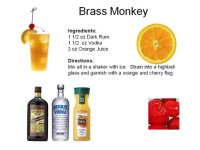

Brass Monkey

Joined
Oct 3, 2014
Messages
2,531
Reaction score
4,330
City & State/Province
Central VA
I have heard that saying "It's so cold it would freeze the balls off a brass monkey" refers to old war ships. The plate with holes they piled cannon balls on the deck is called a "monkey". If made of brass or bronze they would contract more in the cold than the iron cannon balls causing some to pop off. Anybody know if this is true or not?
 
I have heard that saying "It's so cold it would freeze the balls off a brass monkey" refers to old war ships. The plate with holes they piled cannon balls on the deck is called a "monkey". If made of brass or bronze they would contract more in the cold than the iron cannon balls causing some to pop off. Anybody know if this is true or not?

With Brass Monkey's you also have Powder Monkey's--basically a kid who fetcches powder for cannon crews.

From a post I copied and made years ago:
In the heyday of sailing ships, all war ships and many freighters carried iron cannons. Those cannons fired round iron cannon balls. It was necessary to keep a good supply near the cannon. However, how to prevent them from rolling about the deck? The best storage method devised was a square-based pyramid with one ball on top, resting on four resting on nine, which rested on sixteen. Thus, a supply of 30 cannon balls could be stacked in a small area right next to the cannon. There was only one problem....how to prevent the bottom layer from sliding or rolling from under the others. The solution was a metal plate called a 'Monkey' with 16 round indentations. However, if this plate were made of iron, the iron balls would quickly rust to it. The solution to the rusting problem was to make 'Brass Monkeys.' Few landlubbers realize that brass contracts much more and much faster than iron when chilled.. Consequently, when the temperature dropped too far, the brass indentations would shrink so much that the iron cannonballs would come right off the monkey; Thus, it was quite literally, 'Cold enough to freeze the balls off a brass monkey.' (All this time, you thought that was an improper expression, didn't you.)
greybearer1.gif
greybearer1.gif
 
Last edited:
Pulled this link from Bekeart's post made regarding this
very subject on 12/21. Hope it helps, good story though.
Brass Monkeys : snopes.com

snopes is NOT a good reliable source. According to a few radio hosts and somewhat in their own words but--those who created snopes are basically two over-weight couch-potatoes in California who are libs who TRY to convince one and all-that only they know what's real and what aint.
 
Last edited:
Okay, how about "Colder than a witch's," ah, um, "chest.. in a brass bra?!"

Is it true that it originated in a pizza parlor run by two old ladies in downtown Duluth on a winter morn when the famous lumberjack Paul Bunyan walked in, icicles dripping from his ample beard, and asked for a slice of Sicilian, over easy? (Hey, don't ask me! I don't have a clue. Better Snopes it!)
 
Last edited:
"Cold enough to freeze the nuts off a bridge" came from the tragic occurance in Latvia when an insane asylum was accidentally bombed in WWII. The inmates fled, but they were trapped on a bridge over the Daugava when ends of the bridge were simultaneously destroyed by artillery and as night fell, the temperature dropped to 20 below zero. The inmates were consequently forced to jump from the bridge. They then walked on the ice to the nearest pub, spent the remainder of the war there, and then formed the United Nations.
 
"Cold enough to freeze the nuts off a bridge" came from the tragic occurance in Latvia when an insane asylum was accidentally bombed in WWII. The inmates fled, but they were trapped on a bridge over the Daugava when ends of the bridge were simultaneously destroyed by artillery and as night fell, the temperature dropped to 20 below zero. The inmates were consequently forced to jump from the bridge. They then walked on the ice to the nearest pub, spent the remainder of the war there, and then formed the United Nations.

According to snopes, that is entirely correct.
 
This is all playing havoc with my long-standing mental image of the "brass monkey," which involves a simian figure similar to the "see no evil" trio, but with said simian having his hands over a different portion of his anatomy.

Sorry, but I like my imagery better...
 
most if not all of the cannons and gun ports on men of war ships I've seen are below the main deck....with doors that could lifted when it was time to fire the cannons... only a few cannon and swivel guns were seen on the main deck of those ships...

so there was no need to have cannon balls on the main deck... they were needed to be kept by every cannon.. though I'm sure the black powder was kept in a water proof magazine.. and brought out as needed. Tell me if I'm wrong on my memory guys. It's been too long since I've seen
" Master and Commander " or Hornblower.
 
Here we see Major General E.J. Milford RAAC (CB CBE DSO) in Borneo, after accepting the surrender of the Imperial Japanese forces there.
After the Major General was re-assigned to the Northern Islands of Japan (in December 1946) where the bald monkey was undoubtedly frozen off the brass. ;)
 
Last edited:
I also seriously doubt the cannonball stacking theory. While brass has a greater coefficient of thermal expansion than iron or steel, there is no possible way that a hole in a brass plate of any significant diameter (say at least 10% of the cannonball diameter) could shrink enough as a result of extreme cold to force the ball out to roll around. It's a totally made-up BS story. Snopes has to be right on this one, regardless of their political leanings.

Additionally, I seem to remember that round cannonballs on the old sailing ships weren't stored stacked in a pyramid, but on linear racks, sort of like bowling balls in a bowling alley.
 
Last edited:
According to the United States Navy Historical Center, this is a legend of the sea without historical justification. The center has researched this because of the questions it gets and says the term “brass monkey” and a vulgar reference to the effect of cold on the monkey’s extremities, appears to have originated in the book “Before the Mast” by C.A. Abbey. It was said that it was so cold that it would “freeze the tail off a brass monkey.” The Navy says there is no evidence that the phrase had anything to do with ships or ships with cannon balls.

Anyway on a cold day I say it's cold enough to freeze the balls off a brass monkey.
 
Now I'm really surprised. The physics forum had this to offer:
Copper alloys, like most materials, actually increase in strength as the temperature drops. Hyo X provided a graph of temperature (x axis) versus strength (y axis) which shows how various alloys of copper (ie: brass) increase in strength as they get colder. That's fairly common for most metals and plastics as well. They tend to get stronger as they get colder. You've probably seen things like a flower or a tennis ball get dunked in liquid nitrogen (-320 F) and they become very brittle and can shatter like glass. But the fact is, they don't suddenly break just because they get cold.

Reference Freezing Temperature Of Brass | Physics Forums - The Fusion of Science and Community

My old Daddy had a better term for extreme cold:
"Colder than a foot up an eskimos igloo."
Now granted, an igloo should be warmer than the ambient temperature, but still, being made of ice/snow blocks, the entrance into an eskimos igloo would probably be pretty cool....or something...:confused:
 
Back
Top