Case vs Accuracy

  • Thread starter Thread starter AJ
  • Start date Start date

AJ

US Veteran
Joined
Apr 30, 2003
Messages
13,481
Reaction score
35,283
City & State/Province
East of Stick Marsh, Fla.
Been reloading a lot of years. I normally just police up my brass and any other brass that is laying around. I tumble it and reload it. Never really pay attention to the headstamps. Does it really make that much of a difference? My Colt original Series 70 Gold Cup seems to shoot well with what ever brass I use. What makes me wonder is I recently replaced my Colt Mid Range with a Model 52 S&W. Will using the same manufacturer brass make a difference?
 
If any handgun can tell the difference, it ought to be that Model 52.

I routinely sort my brass between plinking loads and serious loads. Generally I use Federal 38 Special brass and Starline 45 ACP brass for my serious shooting and use the mixed stuff for plinking or practice. Probably bullet quality is more of a concern for accuracy, but why gamble when a couple of 10 ring or X ring hits can spell the difference between being an also ran and being in the money.

Confidence in your ammo is part of the battle in shooting good scores.
 
Last edited:
Many hundred manuals give instruction on proper brass prep. To a benchrest shooter, the powder measurement is the element that least factors in in accuracy. If your method works for you be happy.
 
For maximum accuracy, you really want to use brass from the same manufacturer and even keep them separated by production lot number.
For practice and plinking, unless your loads are at or near maximum safe pressures, it makes little difference.
 
With the current shortage situation, many may have to use whatever they can find, but sorting brass certainly won't hurt. With handgun ammo, I much prefer buying a batch of 500 or 1,000 new or once-fired cases, all same headstamp. You know the history of the brass and there's no sorting and and no headaches (like thicker case walls) that come with using mixed and range pickup brass that you know nothing about.

When it comes to brass, "free" is seldom free.
 
LOADS

Consistency in reloading never ever makes poorer shooting ammo ...
The more consistent every aspect of the load , brass, bullets , powder charge , primer , case length and crimp ... The Better .
Gary

I agree Gary, and have always prescribed to this camp. As far ast lot number- that would be beyond my scope of consistingness .. I have a couple buckets of Winchester Match brass and same with some Federal stuff and lot numbers are up for grabs. I have no clue whatsoever. All I can say is they ALL work just fine in my Colt Commander, and did so in my Series 70 - which shoots so well I got rid of the Gold Cup I had and a dozen other 45's.I DID pick up another barrel and bushing somewhere along the way but these days the Series 70 wears a vintage Colt Conversion kit which works just fine with the prober ammo. No soft lead target stuff for her . :)
 
JMO. Pistol brass no, rifle brass, if you want consistency, yes. At 100 yds it's easy to see the difference with a precision bench rest rifle.

I sort my rifle brass. I only use Lake City brass. I don't sort my pistol brass.
 
Last edited:
Thanks for the replies. I am not shooting matches anymore. Do not feel a need to compete with anyone except myself. Was just curious as to what the folks here thought.

I have about 700 rounds of vintage Match .38 Special Wadcutter. If I shoot any of that I will keep the brass separate. Normally I just shoot 148 grain HBWC's out of the 52. It seems to do better with those than a solid wadcutter.

"Back in the day" when I shot in the Corps, I saved the Match cases. I have 33 pounds of cleaned and deprimed Winchester Match brass sitting in an ammo can. Maybe I ought to fire up my Gold Cup and do some serious reloading for it. I too, have a Colt Conversion Unit for my Gold Cup.

Since what I do nowadays is just considered "plinking". Will probably just concentrate on making stuff that goes bang when I pull the trigger.

I have heard that some of the really serious (read big-time) shooters that reload weigh their cases, bullets and powder charges. That all cases and bullets had to weigh within a grain of each other to make the grade. And it goes without saying their powder charges had to be exactly the same for each and every one no variation allowed.

Thanks again,
AJ
 
I sort mine...

... simply because brass is different depending on head stamp. You can feel a difference when you resize them. Some are thicker and harder to raise the ram. I load in batches of 50 with the same head stamp. I use them all, I just don't mix them in the same ammo box. I actually loaded up a bunch of ammo for a brass shootout with 5 different brands (9mm), but haven't shot them yet. I'm curious if one brand is more/less consistent and accurate than another.
 
Last edited:
I find a little bit of “ME” in a number of the replies!

Consistency in your operation will NEVER make poorer ammo, that was succinct and genius, and a great way to put it. And like was said in the very first reply, having confidence in your ammo will make you shoot better and it shows up on the target.

If a shooter tells me that he ignores all headstamps and treats them all the same and mixes them and it works for him, I back him 100% for his own use. But that is not how I make my ammo. I sort all my brass, typically in front of a movie on the TV with a beer or three.

It’s easier to tell the difference in different head stamps through the feel of the press lever if you are loading them single stage.

I take a lot of pride in the ammo that I make.
 
Stay with the same head stamp when trying to be accurate. Some 38 brass is about .003 thicker. Sometimes I look at the head stamps before I load the magazine. The .003 could make a difference in a 52 chamber but not so much in a wheel gun. That bullet 1'' out of the group could be thicker brass.:)
 
Last edited:
A different spin on brass. I have noticed that for a large caliber like 44 Special it does not matter very much, and not too much with 38 Special. But in my opinion when you get down to a smaller caliber like 32S&W Long it begins to get kind of finicky. Or maybe I am just reading too much into it. This weekend I loaded 50 rounds of 32S&W Long with my home cast 90 grain Lee swc's all with 1.9 grains of Bullseye, and exclusively with Starline brass. I will see if that helps in accuracy. With a mixed bag of brass my previous chrono results made me think about it - some Starline and Lord knows what else - 692, 641, 692, 690, and 665.
 
Depends on your purpose, caliber, firearm, brass, bullets and other loading characteristics. If your loading light 45 acp loads so bullet slightly jams into rifling, then no.

Another extreme is loading full power 185 gn jacketed loads in Rem 45 acp brass, than yes it is also a safety factor.

Used to prefer Rem 38 sp cases when using 148 hdy swaged hbwc's. The hdy's were smaller dia and rem brass was thinner making for a slip in fit without distorting the bullet.
 
For the average shooter, mixed brass is probably good enough. But as mentioned above, for the ultimate, best possible accuracy in a handload, consistency is the key. There may be enough variation between manufacturers' brass to make a difference, but for me, there's not enough to bother, being just an average shooter (but I do sort out European brass). I normally sort brass depending on the load, like my T-Rex Killer 44 Magnum loads use one kind of brass and I count reloadings, same with my "good" Garand loads...
 
Last edited:
With a mixed bag of brass my previous chrono results made me think about it - some Starline and Lord knows what else - 692, 641, 692, 690, and 665.
I'll start with I am not saying you are wrong, but I will suggest that you consider: the chrono results are not accuracy results.

I say this because technique sometimes has a lot to do with chrono accuracy.

I believe that a chrono can sometimes return results that don't necessarily reflect the accuracy performance of the load, and I also believe that different holds for each shot can throw off chrono results that may not have any affect on accuracy. And there are other anomalies that can affect bullet speed as we measure them. There is also that BIG mathematical and scientific thing that seems to often get lost when folks chrono loads and then come to fast conclusions, and that is called sample size. The affect of sample size doesn't get nearly enough thought when it comes to making fast conclusions from chrono results.

A chrono can be an exceptionally valuable tool, especially for rifle shooters who need to calculate drop over distance. For handgun shooters, it's also valuable for competitors who must make a velocity or "power factor" floor for ammo that they will compete with to stay legal within the rules of that event.

But my (often unpopular opinion) is that chrono results are misinterpreted and over valued in a lot of situations, especially for handgun shooters.

We can make phenomenally accurate handgun ammo even when we may see some less than thrilling chrono results. And in the context of this conversation, your post seems to suggest that different headstamps are the cause of your different chrono results and I'm simply saying that we definitely don't know that for certain. It could be variances in the weight or diameter of your bullets, it could be a slight variation in one or two of the chambers of your revolver, or an inconsistent powder drop on your handloads or if the bullet crossed the chrono in a different place or in changing light/cloud conditions.

When we chrono one HUNDRED rounds, we can better see a pattern of results that might be more trustworthy.

I'm not trying to pick on your post, I'm just adding some food for thought -- the answers we seek are not so easy to find and the time-sucker-fun-sucker-speed-checker box doesn't give easy answers to complex things.

And if we have the choice between ten rounds from a solid rest in to a paper target at 25 yards --OR-- ten rounds through a chrono to decide if a load is decent or a load is questionable, I would answer that choice by driving over my fun-sucker chrono with a dump truck.
 
A top bullseye pistolsmith and bullseye shooter, Ed Masaki, used to used mixed brass in his .45 ACP reloads. He did a lot of 50 yard machine rest testing. He could always get a good pistol to group well with those loads. He even tested with cracked brass and found that it still shot well with low powered loads. I think the S&W model 52 is a horse of a different color. Gil Hebard spent a lot of time trying to match or exceed factory .38 SPL 148 gr. HBWC loads and never could. For fun (plinking) your loads in the Smith will probably do well enough to keep you happy. You might want to seat them flush or just below flush. Some prefer a slight roll crimp on the top. I've used a taper crimp only. Alliant Bullseye is a much used powder with 2.7-2.8 grains being standard under the swaged hollow base wadcutter bullet. Don't try to push those bullets very fast or the "skirts" will separate from the rest of the bullet. The model 52 isn't designed for anything but mild target loads. It's a terrific target pistol!
 
I'll start with I am not saying you are wrong, but I will suggest that you consider: the chrono results are not accuracy results.

I say this because technique sometimes has a lot to do with chrono accuracy.

I believe that a chrono can sometimes return results that don't necessarily reflect the accuracy performance of the load, and I also believe that different holds for each shot can throw off chrono results that may not have any affect on accuracy. And there are other anomalies that can affect bullet speed as we measure them. There is also that BIG mathematical and scientific thing that seems to often get lost when folks chrono loads and then come to fast conclusions, and that is called sample size. The affect of sample size doesn't get nearly enough thought when it comes to making fast conclusions from chrono results.

A chrono can be an exceptionally valuable tool, especially for rifle shooters who need to calculate drop over distance. For handgun shooters, it's also valuable for competitors who must make a velocity or "power factor" floor for ammo that they will compete with to stay legal within the rules of that event.

But my (often unpopular opinion) is that chrono results are misinterpreted and over valued in a lot of situations, especially for handgun shooters.

We can make phenomenally accurate handgun ammo even when we may see some less than thrilling chrono results. And in the context of this conversation, your post seems to suggest that different headstamps are the cause of your different chrono results and I'm simply saying that we definitely don't know that for certain. It could be variances in the weight or diameter of your bullets, it could be a slight variation in one or two of the chambers of your revolver, or an inconsistent powder drop on your handloads or if the bullet crossed the chrono in a different place or in changing light/cloud conditions.

When we chrono one HUNDRED rounds, we can better see a pattern of results that might be more trustworthy.

I'm not trying to pick on your post, I'm just adding some food for thought -- the answers we seek are not so easy to find and the time-sucker-fun-sucker-speed-checker box doesn't give easy answers to complex things.

And if we have the choice between ten rounds from a solid rest in to a paper target at 25 yards --OR-- ten rounds through a chrono to decide if a load is decent or a load is questionable, I would answer that choice by driving over my fun-sucker chrono with a dump truck.


To many folks are wrapped up in speed. Fast bullets are neat, but not necessarily accurate. A group of bullets that group well slower are better than a group that looks like a shotgun blast but moving quicker.
 
A different spin on brass. I have noticed that for a large caliber like 44 Special it does not matter very much, and not too much with 38 Special. But in my opinion when you get down to a smaller caliber like 32S&W Long it begins to get kind of finicky. Or maybe I am just reading too much into it. This weekend I loaded 50 rounds of 32S&W Long with my home cast 90 grain Lee swc's all with 1.9 grains of Bullseye, and exclusively with Starline brass. I will see if that helps in accuracy. With a mixed bag of brass my previous chrono results made me think about it - some Starline and Lord knows what else - 692, 641, 692, 690, and 665.

It appears you're speaking of extreme spread and/ or standard deviation here. These numbers have become very popular nowadays with so many handloaders having chronographs. The general thought seems to be that the smaller the discrepancies are, the more accurate the load will be. The numbers have little to do with accuracy. They are an indication of consistency only, not accuracy. There are lots of other factors that contribute to accuracy.

If your load is accurate, there is no need to even consider the numbers. If the numbers are really wild, say a variance of 100 between readings, the load probably is not shooting well anyway.

Go for the results you get with ten-shot groups (with a handgun) and do your testing using good technique from a solid benchrest setup at 25 yards. Shooting closer will boost your ego, but won't tell you what you need to know. And don't put much emphasis on those spread and deviation numbers. I can't remember the last time I even looked at them when chronographing. Good luck-
 
  • Like
Reactions: AJ
A top bullseye pistolsmith and bullseye shooter, Ed Masaki, used to used mixed brass in his .45 ACP reloads. He did a lot of 50 yard machine rest testing. He could always get a good pistol to group well with those loads. He even tested with cracked brass and found that it still shot well with low powered loads. I think the S&W model 52 is a horse of a different color. Gil Hebard spent a lot of time trying to match or exceed factory .38 SPL 148 gr. HBWC loads and never could. For fun (plinking) your loads in the Smith will probably do well enough to keep you happy. You might want to seat them flush or just below flush. Some prefer a slight roll crimp on the top. I've used a taper crimp only. Alliant Bullseye is a much used powder with 2.7-2.8 grains being standard under the swaged hollow base wadcutter bullet. Don't try to push those bullets very fast or the "skirts" will separate from the rest of the bullet. The model 52 isn't designed for anything but mild target loads. It's a terrific target pistol!


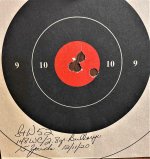
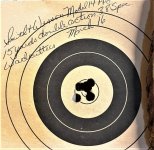
I use 2.8 grains of Bullseye with a 148 gr. HBWC for all my reloading for my 52. And even using it in my Model 14 PPC revolver built by A.F.Behlert.
 

Attachments

  • 52 Target.jpg
    52 Target.jpg
    106.4 KB
  • PPC Target.jpg
    PPC Target.jpg
    121.2 KB
It appears you're speaking of extreme spread and/ or standard deviation here. These numbers have become very popular nowadays with so many handloaders having chronographs. The general thought seems to be that the smaller the discrepancies are, the more accurate the load will be. The numbers have little to do with accuracy. They are an indication of consistency only, not accuracy. There are lots of other factors that contribute to accuracy.

If your load is accurate, there is no need to even consider the numbers. If the numbers are really wild, say a variance of 100 between readings, the load probably is not shooting well anyway.

Go for the results you get with ten-shot groups (with a handgun) and do your testing using good technique from a solid benchrest setup at 25 yards. Shooting closer will boost your ego, but won't tell you what you need to know. And don't put much emphasis on those spread and deviation numbers. I can't remember the last time I even looked at them when chronographing. Good luck-

Much prefer the old method of actually shooting at a target to find out what load shoots best. Once that load was narrowed down then trying to tweak the power charge up or down a 0.1 of a grain to see if that helped. Was way more fun than reading numbers.
 
I'll start with I am not saying you are wrong, but I will suggest that you consider: the chrono results are not accuracy results.

I say this because technique sometimes has a lot to do with chrono accuracy.

I believe that a chrono can sometimes return results that don't necessarily reflect the accuracy performance of the load, and I also believe that different holds for each shot can throw off chrono results that may not have any affect on accuracy. And there are other anomalies that can affect bullet speed as we measure them. There is also that BIG mathematical and scientific thing that seems to often get lost when folks chrono loads and then come to fast conclusions, and that is called sample size. The affect of sample size doesn't get nearly enough thought when it comes to making fast conclusions from chrono results.

A chrono can be an exceptionally valuable tool, especially for rifle shooters who need to calculate drop over distance. For handgun shooters, it's also valuable for competitors who must make a velocity or "power factor" floor for ammo that they will compete with to stay legal within the rules of that event.

But my (often unpopular opinion) is that chrono results are misinterpreted and over valued in a lot of situations, especially for handgun shooters.

We can make phenomenally accurate handgun ammo even when we may see some less than thrilling chrono results. And in the context of this conversation, your post seems to suggest that different headstamps are the cause of your different chrono results and I'm simply saying that we definitely don't know that for certain. It could be variances in the weight or diameter of your bullets, it could be a slight variation in one or two of the chambers of your revolver, or an inconsistent powder drop on your handloads or if the bullet crossed the chrono in a different place or in changing light/cloud conditions.

When we chrono one HUNDRED rounds, we can better see a pattern of results that might be more trustworthy.

I'm not trying to pick on your post, I'm just adding some food for thought -- the answers we seek are not so easy to find and the time-sucker-fun-sucker-speed-checker box doesn't give easy answers to complex things.

And if we have the choice between ten rounds from a solid rest in to a paper target at 25 yards --OR-- ten rounds through a chrono to decide if a load is decent or a load is questionable, I would answer that choice by driving over my fun-sucker chrono with a dump truck.

All that could be true, or some of all that might be true. Sorry for even mentioning it, for sure. I am quite abashed for daring to intrude. But due to the monstrous stampede on primers, I am a bit frugal on how many I load or shoot. That particular load had proven to be very accurate off a rest at 15 yards, and I was curious about consistency and velocity. I will continue to make my own decisions. Once again I apologize for intruding in your forum.
 
Hahaha :D you took that wrong way for certain and the internet may not be for you. There wasn’t half a breath of offense intended, but you managed to find it.

I’m sorry that you won’t enjoy the internet and I wish you well.
 
I load pistol, revolver, rifle and shotgun.............

and have noticed that for the best accuracy or patterns, I do best with brass or cases thatare new factory or only loaded 2-3 times.

Shotgun crimps start to go bad after the third crimp and loose fps, while
rifle cases will strat to strech and get brittle, if at factory speeds.
Pistol and revolver brass will hold up a lot longer if used for target loads
but will start to loose their "Set" when seating and reducing the belling.

I beleave in using the same lot, case length, OAL and crimp pressur on a load as the first step to a accurate load.

Powders and primers can be off a little, that can change the fps 10-20fps
which might cause a small flyer but thats something I just have to live with.

Some times my 100 box of ammo is great and on some days I get flyers.
At my age, I just accept that is is all me but 40 years ago, I knew it was the ammo or weapons fault!!
 
Handloader #225 had a pretty thorough test comparing new brass -vs- used brass accuracy tests as well as several other tests comparing variables like same brass/load but different primers tests.

45 Hardball Accuracy Test - Handloader #225
--------------------------------------------------
The load was 6.8 grains of Alliant Power Pistol with CCI primers and 230 grain Remington FMJ bulk packed bullets.

In the Ransom Rest it was obvious my experiment wasn’t going to turn out the way I wanted it to.

The load using new brass averaged 1.08 inches for five, 10-shot groups.

The mixed brass averaged 1.38 inches with a standard deviation almost twice as large.


.
 
I’ve had the pleasure of knowing and shooting with some of the best Bullseye shooters in the country in the 70’s and 80’s. All were very picky about the 22LR ammo even to the point of buying cases of certain lot numbers when possible. One of the best 45 shooters I knew told me bullet diameter and weight was the most important thing to him. I did learn that all of the good shooters had little ‘quirks’ they didn’t discuss, so maybe he had other things he didn’t tell me, but I do remember he bought oversized H&G style SWC in 185gr that he sized and lubed to his preference and loaded over 3.2gr of Bullseye. It’s a load I shoot regularly but today I use coated lead. One thing that does still stand out in my memory is he did not own a chronograph.
 
I’ve had the pleasure of knowing and shooting with some of the best Bullseye shooters in the country in the 70’s and 80’s. All were very picky about the 22LR ammo even to the point of buying cases of certain lot numbers when possible. One of the best 45 shooters I knew told me bullet diameter and weight was the most important thing to him. I did learn that all of the good shooters had little ‘quirks’ they didn’t discuss, so maybe he had other things he didn’t tell me, but I do remember he bought oversized H&G style SWC in 185gr that he sized and lubed to his preference and loaded over 3.2gr of Bullseye. It’s a load I shoot regularly but today I use coated lead. One thing that does still stand out in my memory is he did not own a chronograph.


You are correct about what you call "quirks". Most Bullseye/IPSC shooters, who are really good will be glad to teach you some of the finer points of their craft. But most will hold back a little something, this is what gives them their edge to win. The one thing most of the really good guys do is practice, practice and more practice. When I was stationed (I was a Guard Chief and the Chief weapons instructor) in Calif., I was a pretty fair hand with a handgun. I was shooting about 1000 rounds a week on average....so I got practice, practice and more practice. Once I went back to the real world of aviation maintenance, shot maybe a few hundred rounds a month.
 
Last edited:
I agree Gary, and have always prescribed to this camp. As far ast lot number- that would be beyond my scope of consistingness .. I have a couple buckets of Winchester Match brass and same with some Federal stuff and lot numbers are up for grabs. I have no clue whatsoever. All I can say is they ALL work just fine in my Colt Commander, and did so in my Series 70 - which shoots so well I got rid of the Gold Cup I had and a dozen other 45's.I DID pick up another barrel and bushing somewhere along the way but these days the Series 70 wears a vintage Colt Conversion kit which works just fine with the prober ammo. No soft lead target stuff for her . :)
No way to do lot number with range pick ups ... for 99% of us headstamp sorting is about the best we can do ...
Keep on Keeping on with your 1911 they rock .
Gary
 
Seems like very few shooters could hold well enough to see the difference between all the same and mixed brass....Just MY thoughts.

Randy
 
Back
Top