
DA Frontier Value

otteray

Member
Joined
Sep 11, 2005
Messages
51
Reaction score
43
City & State/Province
Santa Cruz CA
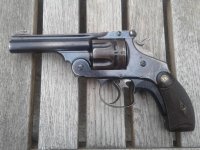
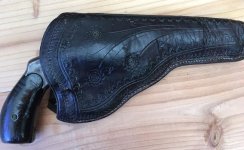
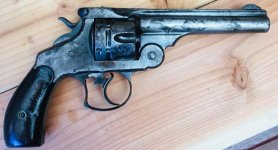
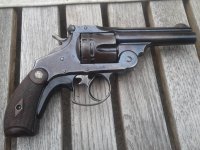
I just don't enjoy shooting this old gun, like I do enjoy shooting many other old ones. I dunno, just doesn't fit my hand comfortably.
So I think I should find a good value and let someone else have fun with it.
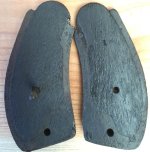
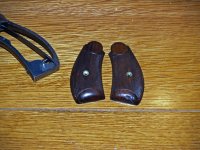
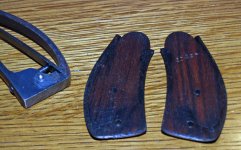
The Hershon grip adapter had been glued onto the frame, sometime in the past.
Based on my copy of the Standard Catalog (2006) I see this as somewhere between 'Fine' and 'Excellent.'
Am I off on my evaluation?
 

Attachments
  • 20190819_113414.jpg
    20190819_113414.jpg
    147.2 KB
  • 20190819_113431.jpg
    20190819_113431.jpg
    145.1 KB
  • 20190819_114527.jpg
    20190819_114527.jpg
    151.5 KB
  • 20190819_113300.jpg
    20190819_113300.jpg
    56 KB
Last edited:
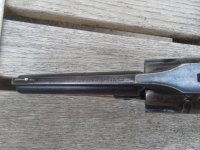
Depends on what you call plum patina? Nice and interesting 44 DA in 44-40. Only 15.000 were made from 1886 to 1913. The short barrel target sights, if original, make the gun even more uncommon. Problem is that both a target latch and front sight can be placed on a standard 44 DA Frontier. If there is a matching serial number stamped on the bottom of the rear sight/latch, your chances are good that it is a very uncommon short barreled target gun.

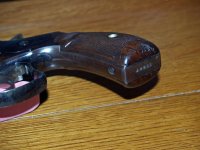
Looking for value is a tough thing with a gun that is not standard configuration. A factory letter is the only way to tell if the walnut stocks are original or not, but I have never seen a set of 1910s medallion stocks on a 44 DA? Without the letter it is tough to sell the gun as totally "original" and that has a large affect on value. Original hard rubber stocks are very hard to find for the 44 DAs since they were different than any other model.

Not many collectors would be thrilled with a glued on grip adaptor. Without the letter, there would always be a question of the authenticity of the target sights as well. As for condition, it is very difficult to determine exactly how much original bluing exists without an in-hand inspection. In order for a 44 DA that shipped around 1900 to be in Fine to Excellent condition, it would need to have at least 70% to be Fine and 90% to be Excellent as far as Supica/Nahas grading system is concerned. Remember that you have to look at the age of the particular gun, not when the model was introduced. It is only my guess, but I see about 50% to 60% bluing and the rest plum brown. The gun is very nice and appears to have been well cared for.

Next thing to be certain of is that the gun is a 44-40 and not a 44 Russian since both models serial numbering started with "1".

last thing is the fact that these guns have never rose in value as much as many other antique S&W models and value is low compared to a 44 New Model 3, American, Russian, etc.
 
Last edited:
Thank you, Gary, for your well laid out answer. I will check the rear sight and grips. Messing with the front sight is something I will not attempt, as pointed out to me here to avoid, in the past, with a New Model No.3.
The grip adapter should be easy to remove since they only contact the metal frame, not the wood grips.
And yes, the longer length of its cylinder is that of the 44-40.
 
Okay, the grip adapter popped of easily.
I checked the rear sight, and it is a match.
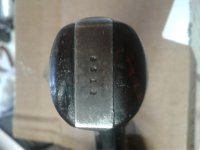
So the question remains about the grips.
Looks like a letter may be in order.
 
I like it just as it is without the grip adapter. New to this antique Smith and Wesson game I find the early D.A. 44's to be the neatest revolvers in the field. For the years they were built and the purpose intended I find them ideal.
 
Not too sure how much stock I put into the 'Gun Values by Gun Digest' website for accuracy as a comparison to Supica's grading; but for this model:
Poor - $400
Fair -$750
Good - $1200
Excellent -$4000
Assuming that the stocks are not original, and based on what has been shown; what would be a fair value for sale?
 
Sorry, but I never use Gun Values by Gun Digest for pricing on anything. Your best bet is to search the Internet gun sites for completed auctions of your model revolver that actually sold. It is the only place where you can find what people are actually paying for these guns. Sites like Gunbroker, GunsAmerica, GunsInternational, Proxibid, etc. can offer sold pricing on guns of all makes. Asking prices are just that anc cannot be used as value.

The SCSW4 shows that nickel S&Ws from 1890 to 1920 era are considered Fine if they are at least 80% original nickel. Very Good drops off substantially to 40% for blued guns, so it can be estimated that a nickel gun would have to be around 50% to be Very Good. Stated values are $1200 for VG and $1800 for Fine. Personally, I do not see this model selling for that value in similar condition as yours and yet this is from one of the most credible sources on S&W in the industry.

If you can find original hard rubber stocks, you might expect $800 - $1000 in my opinion, but at the same time I would not buy that gun for $800 - $1000, so . . . ??

K frame black hard rubber stocks fit OK, although they are not a perfect match, but could be an option. You could sell those K frame gold medallion stocks for near $100 today. And, yes the letter would help verify the non-standard features that gun has and help with a sale to a collector. Who knows, maybe somebody wanted a short barrel target 44-40 DA with gold medallion stocks in the 1910s and there were a few laying around the factory.
 
Last edited:
The front sight looks "weird". Is it my monitor or is the front sight a modified Lyman?
 
Original wood grips?

I have a 44 Russian D/A with original factory smooth wood grips just like the wood grips found on the 38 cf Model 1 Baby Russian when blued. My gun has A matching stamped number underneath on the right side grip.
Check inside the grips for a stamped number ( should be there) and if there please post a photo so we can see the Dies?

Murph
 
IMHO
The condition is at the lower end of "fine"
 
I'll speak for myself but I'd rate that a number 1 Shooter Grade. Its collectible value is questionable without a letter which may reveal more than you want to know which put it right in the ballpark for us shooters. I enjoy shooting black powder loads in these fine old revolvers and consider it almost an honor to get to fire a few cylinders through each and every one of the ones I own. I shoot them along with the rest of the few non muzzle loading firearms I enjoy. I just got started fooling around with a .44 D.A. and enjoy it, they certainly were not developed for accuracy but for their intended purpose of self defense at close range they are very effective. I have a box full of smoke less loads I built to approximate black powder charge and find them fun to shoot in my .44 specials, great teaching load for someone wanted to move up from them to .44 magnum. A third step in the .44 family, their may be others but they are more obscure like .44 American which may not work because of the possibility it may have a heeled bullet.
 
Grips

This is a .44 DA which letters as having been shipped 6/5/1884 with walnut grips. The grips are numbered to the gun. As you can see, there are no medallions. I paid $1,000 for the gun about eight years ago. Probably too much, but I liked it.
 

Attachments

  • 44DA3.jpg
    44DA3.jpg
    185.9 KB
Last edited:
Dos
If you have buyer's remorse, I will be glad to give you your $1000 back.
 
This is a .44 DA which letters as having been shipped 6/5/1884 with walnut grips. The grips are numbered to the gun . . .

Those stocks pictured were made from 1900 to 1910 and are K frames round butts, not 44 DA stocks in my opinion. The front toe of a set of 44 DA stocks are square and the front toe of the K frame round butt stocks are rounded. Many 44 DAs were shipped in the early years of the 1900s with that style stocks, but that design did not appear in the 1880s. Serial numbers are sadly faked all the time and one cannot simply rely on number stamps to validate originality.

Original period walnut stocks for a NM3 are shown below, but will not fit a 44 DA. The 44DA had stocks that did not properly fit any other S&W model.
 

Attachments

  • Untitled.jpg
    Untitled.jpg
    240.7 KB
  • 44 NM3.jpg
    44 NM3.jpg
    105 KB
Last edited:
Dies

That’s exactly why I requested to see a photo of the Dies on the OP gun. Way too much of that going on now. Good catch! I’ll have to dig mine out to post a photo of original wood grips that are correctly numbered to the gun. Mine are smooth wood and match.
 
Last edited:
Ok so I dug out my old Smith D/A 44 Russian.( one of my first S&W's purchased in the late 1980's)
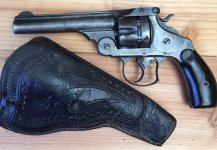
I know it's not much to look at but it's all untouched original in as "Found" condition and in this original period holster. I actually looked up the holster and it is seen in a Major Distributor catalog from the 1880's. The drawing in the catalog is "Identical" to the design and pattern seen in the below photo's. The holster was obviously designed for the large frame S&W double action. It fits perfectly in both width and barrel length with a capped off holster tip. If anyone is interested in seeing the Distributor drawing let me know and I'll look it up and post a photo.
The gun is all matching. Action is very good. I have shot it and it shoots very well with black powder loads. It was originally blued which is somewhat scarce. With patches of original finish here and there. The smooth wood grips are numbered to the gun and I am certain that they are original but I don't think I have a letter for this one...I'll have to check my files. If you look closely at the dies? They are identical to the dies stamped on the frame. This is correct from my research of blued Smiths of this period that includes Baby Russian 38's. The dies are identical to those that were used to stamp the frame number.
You can see the holster damage on the right-side. I was very close to removing it but I couldn't do it. I believe this gun/holster were together for a very long time. If not original, close to it. So I decided to leave it alone for now. I like it as it was found. I also like the 3 hashes on the right grip....It's got a story to tell that's for sure.

Murph
 

Attachments

  • 884DAC22-3D49-4D08-B78A-790B74064C0A.jpg
    884DAC22-3D49-4D08-B78A-790B74064C0A.jpg
    85.2 KB
  • 744277D7-0156-4633-847B-97799B9D2D4C.jpg
    744277D7-0156-4633-847B-97799B9D2D4C.jpg
    36.6 KB
  • DC7DFC38-B8CE-4F7C-AC8E-C4E640EB8D44.jpg
    DC7DFC38-B8CE-4F7C-AC8E-C4E640EB8D44.jpg
    100.6 KB
  • 3771337F-668A-4F23-804C-0D3C54588F24.jpg
    3771337F-668A-4F23-804C-0D3C54588F24.jpg
    62.4 KB
  • 9A826F0E-296B-4BDC-A916-4FD66374B880.jpg
    9A826F0E-296B-4BDC-A916-4FD66374B880.jpg
    56.1 KB
Last edited:
Those stocks pictured were made from 1900 to 1910 and are K frames round butts, not 44 DA stocks in my opinion. The front toe of a set of 44 DA stocks are square and the front toe of the K frame round butt stocks are rounded. Many 44 DAs were shipped in the early years of the 1900s with that style stocks, but that design did not appear in the 1880s. Serial numbers are sadly faked all the time and one cannot simply rely on number stamps to validate originality.

Original period walnut stocks for a NM3 are shown below, but will not fit a 44 DA. The 44DA had stocks that did not properly fit any other S&W model.

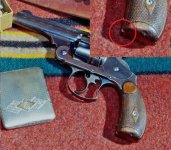
Gary - What you have circled in the photo is a chip in stocks, which fit perfectly. When I have a minute I'll take a better picture, and one with the stocksoff the gun.
 
Please take a picture of the other side with the right stock installed as well. What is the serial number? I am sure that Roy's letter is correct, so yhe question is how can stocks that were not yet designed or manufactured be installed in 1884? I would be thrilled if they were original, but it does not seem possible???
 
The dies should be identical to mine as seen in my post. They should also be in the same location. If faked it will show for sure.

Murph
 
Those stocks pictured were made from 1900 to 1910 and are K frames round butts, not 44 DA stocks in my opinion. The front toe of a set of 44 DA stocks are square and the front toe of the K frame round butt stocks are rounded. Many 44 DAs were shipped in the early years of the 1900s with that style stocks, but that design did not appear in the 1880s. Serial numbers are sadly faked all the time and one cannot simply rely on number stamps to validate originality.

Original period walnut stocks for a NM3 are shown below, but will not fit a 44 DA. The 44DA had stocks that did not properly fit any other S&W model.

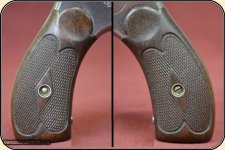
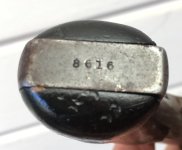
Attached are pics of the stocks on my 44DA. What Gary circled is actually a chip in the stock, not a section which does not fit the frame. Also shown is the stamping of the serial number. The numbers look period correct, though the "3" is different than the one on the grip frame. On the gun the "3" has a straight line on top, while the stamping on the grip is curved at the top. I would imagine that different dies were used for the grip frame and the stocks. The factory letter states "This handgun was shipped with a 4 inch barrel, blue finish, and checkered walnut grips."
 

Attachments

  • 44DA 1.jpg
    44DA 1.jpg
    124.9 KB
  • 44DA 2.jpg
    44DA 2.jpg
    204 KB
  • 44DA 4.jpg
    44DA 4.jpg
    156.8 KB
Last edited:
Unmolested Smiths

I agree Mike.
It’s near impossible to find them now. Most have seen the bluing bottle or a re-nickel bath. It seems the collecting circuit has changed dramatically over the years.

Murph
 
Those grips look right to me Peter. The numbers are stamped in the correct location, Dies are correct as well. The different 3 is not unusual. Let me clarify my statement of “ same Dies”? My study of dies proves the same size and Style of font would match the frame Dies. NOT necessarily the exact same individual die that was used to stamp the frame number.
Just the same size and style of font! I think the OP’s gun with the S&W medallions are the ones in question. He must have gone on vacation?

I just noticed he is from Santa Cruz, Ca. He must be Salmon fishing or hanging out at the Boardwalk.

Murph
 
Last edited:
Agree. The medallion stocks are not original to the revolver but they do make a nice upgrade to a DA .44.
 
Murph,

Just FYI: there are no dies on any guns. There are roll stamps on guns made by roll dies. The dies for rolling on the various letter stamping are back at the factory.

Hope that helps,
 
• The recessed gold plated over brass S&W medallion pearl stocks became standard after first being used for the 1893 World's Columbian Exposition in Chicago where S&W had a very large display of their revolvers. Before that, pearl stocks did not have medallions.

Target walnut extended two screw, introduced beginning with the Model 1891 single shot, and in 1904 on the .32 Model 1903-1st Change along with standard size Walnut stocks, which were optional plain and checkered, with ‘dished’ stock circle; gold medallions beginning only after 1910.

Gustave Young is the S&W engraver that designed the S&W monogram logo that we all know and love today.
 
Roll dies for serial numbers?

Jim,
My studies regarding various Dies are specific to Serial numbers . I did assist another author in a survey for the Colt Pocket 49 and Baby Dragoon in which they documented roll Dies for cylinder scene, barrel address, patent stamps, etc.
Serial numbers however were proven to be stamped individually.
Simple observation can see human error in both distance between numbers and a wavering line stamp because it is very difficult to achieve a straight line with individual number dies.

Are you saving that Smith & Wesson used a roll die for “ Every” Serial Number? Including grip numbers, barrel, cylinder, and latch number?
If so they sure didn’t spare any expense. I’m also finding that hard to comprehend since a roll die would make no error in number spacing, arrangement in a straight line, or depth of stamp. So all the numbers should be stamped basically at the same depth from one strike and in a perfect line.
I’m not seeing that on my Smiths.


Murph
 
Last edited:
Hi Murph,

No, I'm saying you can't do this:

.....I requested to see a photo of the Dies on the OP gun.

You can only see the roll stamping on the gun, made with the dies.

Every serial # is different, no roll dies made up to roll stamp those.
 
So now we get to what I believe is the reason why those stocks are on your revolver. The ship date you have is most likely incorrect (and yes it happens). I cannot find any 44DA in the SWCA database in the 40,000 range that was made before 1901. Since there were only 54,000 made up to 1913, your gun would be much later than 1884. Lastly, most 44 (Russian) DAs were within a year of chronological serial number order from start to finish in those examples documented.

Depending on how old the letter is, you can probably have it researched for any correction needed, but I think it is impossible for stocks that did not exist in 1884 to be found on your gun. The database also shows that any 44 DA made in 1884 would have been well below 10,000 serial number. To further detail what I found was that the latest serial number made in the 1890s was 35,XXX. The first of that style stocks that I have found were found on K frame revolvers ordered by the US Army & Navy Model 1899s starting in 1900 with the order of 1000 Navy guns.
 
Last edited:
So now we get to what I believe is the reason why those stocks are on your revolver. The ship date you have is most likely incorrect (and yes it happens). I cannot find any 44DA in the SWCA database in the 40,000 range that was made before 1901. Since there were only 54,000 made up to 1913, your gun would be much later than 1884. Lastly, most 44 (Russian) DAs were within a year of chronological serial number order from start to finish in those examples documented.

Depending on how old the letter is, you can probably have it researched for any correction needed, but I think it is impossible for stocks that did not exist in 1884 to be found on your gun. The database also shows that any 44 DA made in 1884 would have been well below 10,000 serial number. To further detail what I found was that the latest serial number made in the 1890s was 35,XXX. The first of that style stocks that I have found were found on K frame revolvers ordered by the US Army & Navy Model 1899s starting in 1900 with the order of 1000 Navy guns.

Gary - Now I'm really confused as we seem to be talking about two different guns. Mine (11237) letters as June 5, 1884.
 
Back
Top