
DA trigger pull on 686+ 2.5"

rjm6120

Member
Joined
May 4, 2015
Messages
1,317
Reaction score
3,087
City & State/Province
Xtrm Northern KY
I was finally able to take 3 recent acquisitions to the range yesterday to give them a workout. One of them, a 686+ snub, was a great shooting gun after I did a couple sight adjustments, and the single action pull was, to my mind, acceptable. However the DA pull was terrible---heavy and not at all smooth. The biggest thing I noticed was, while pulling the trigger to fire a shot, the cylinder would advance and stop in position to fire the next shot, but the trigger still had to be pulled much farther that I am used to before the hammer would fall.
I am very happy with the gun, otherwise and have no plans to let it go. I am not sure how old this gun is, as it has MIM parts and the IL, but I am curious if anyone else has had similar trigger pull experiences with their newer smiths and if this kind of issue is solvable with changing the springs and a little bit of polishing here and there a la Jerry Miculek's you tube videos (which would be a new experience for me, as I have NEVER removed the side plate on any revolver).
Responses and guidance, as always, is appreciated!

Ray
 
I have a couple of the 7-shot L frames. I've noticed that the cylinder lock-up seems to be a bit earlier in the trigger pull. I have no objection to it as I have always preferred earlier lock up to later. It also allows me to more easily stage the trigger.

Both Apex and Wolff spring kits are available, as well as many other brands. A little judicious stoning (very little on MIM) to smooth up the contact points on the hammer and trigger journals, as well as the rebound slide, will smooth it up nicely in my experience. Just make sure to have it done by someone who has experience and knows the process as it pertains to MIM. The MIM surface hardness is said to be a bit more shallow than on the pre-MIM parts.
 
In DA, my 2 1/2" PC 686-6+ locks the cylinder with 3/16" gap to the trigger stop. The hammer falls with a 1/16" gap, so 1/8" travel from cylinder lock to hammer fall.
Hope that helps.

I checked my other non-PC 686-6's, and they all have the same post-lock trigger travel.
If your not eager to DIY, Smith & Wesson offers gunsmithing services like the Master Revolver Action Package ($165).

Precision Gunsmithing | Smith & Wesson
 
Last edited:
Even hand sanding with fine grit sand paper (1500+) can help your trigger feel. That way you don't really risk removing too much material or altering any angles. As another member already mentioned, focus on the rebound slide. Lighter power springs will also help. But for me, I don't change springs if the gun is meant to save my life.

Sent from my LGLS991 using Tapatalk
 
In DA, my 2 1/2" PC 686-6+ locks the cylinder with 3/16" gap to the trigger stop. The hammer falls with a 1/16" gap, so 1/8" travel from cylinder lock to hammer fall.
Hope that helps.

I checked my other non-PC 686-6's, and they all have the same post-lock trigger travel.
If your not eager to DIY, Smith & Wesson offers gunsmithing services like the Master Revolver Action Package ($165).

Precision Gunsmithing | Smith & Wesson
That is about the amount of additional travel I am getting as well from cylinder lock to hammer fall...~1/8", maybe a hair more. During this additional amount of pull, it gets a little rough, like there is a little bit of drag in the pull is about the best way I can describe it, plus it gets a scosh heavier.
To both responders, I think I will venture into changing the springs and get a Wolff kit. The procedure doesn't look too scary. I'd say if I can handle tearing down my wife's SP101 to change out the springs, I can handle this. I will probably also invest the $5 or so to get a trigger rebound spring tool from Midway. As far as stoning/smoothing surfaces, I will pass on that, but will take the time to give the innards a cleaning and light oiling.
 
IA little judicious stoning (very little on MIM) to smooth up the contact points on the hammer and trigger journals, as well as the rebound slide, will smooth it up nicely in my experience. Just make sure to have it done by someone who has experience and knows the process as it pertains to MIM. The MIM surface hardness is said to be a bit more shallow than on the pre-MIM parts.


MIM parts do not require the polishing that forged ones do. MIM parts are manufactured with a greater degree of precision and consistency to begin with. A couple hundred rounds fired, will smooth them out just fine.
 
That is just not true.

Sent from my LGLS991 using Tapatalk
What ever "That" is????????????????????

The first step is the springs, at least the trigger return spring. While you have the rebound slide removed, polish it by lapping on a hard Arkansas stone or with lapping compound on a lapping plate. Do not touch the DA and/or SA sears with any type of abrasive materials!!!!!!!!!! After assembling the gun do not leave the main spring screw out a turn or two. This will lighten the trigger pull but more important it will cause light hammer strikes and failure to fire rounds!
jcelect
 
That is just not true.

Sent from my LGLS991 using Tapatalk

Can you explain? It is a fact they're made more precise. It's documented everywhere, not just with gun parts, but automotive, aerospace, and countless other industries.

If you look at the sides of hammers, and triggers, in the older S&W revolvers, you'll usally see the sides are scuffed up to some degree. This is not necessarly because they'be been shot a lot. It's because they rub against the side of the frame, and the side plates. You do not see that nearly as much in the revolvers with MIM hammers, and triggers.

The sear surfaces are aligned better, and will burnish themselves smooth after use.

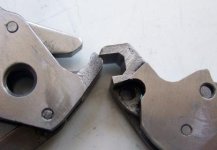
Below are forged parts, showing side rubbing:
 

Attachments

  • Selection_005.jpg
    Selection_005.jpg
    14.1 KB
  • Selection_006.jpg
    Selection_006.jpg
    12.2 KB
Last edited:
What ever "That" is????????????????????

The first step is the springs, at least the trigger return spring. While you have the rebound slide removed, polish it by lapping on a hard Arkansas stone or with lapping compound on a lapping plate. Do not touch the DA and/or SA sears with any type of abrasive materials!!!!!!!!!! After assembling the gun do not leave the main spring screw out a turn or two. This will lighten the trigger pull but more important it will cause light hammer strikes and failure to fire rounds!
jcelect

This man is leading you right. Get a rebound slide spring in the 11-13 lb range from Wolff (or buy a 5 pack assorted strengths at a discount) and while you have the rebound slide out, polish the sides of it carefully. The rebound slide that came in my wife's 60-15 had a sharp edge that was actually cutting a very shallow groove in the frame and I polished the sides of the rebound slide and swapped in a 12 lb rebound slide spring. Double action on it now is less than 10 lbs and single action is about 2 1/4 lbs. And if you want to try it, get a regular strength v-rib mainspring from Wolff and swap that in. The v-rib springs seem to lighten up the double action pull without compromising the hit strength on the primer.

I polished my rebound slide up on a polish stone in my Lansky knife sharpening kit. That stone is ultra fine and just polishes, not sharpens.
 
I have a 1972 vintage 19-3 that was nearly unfired when I purchased in a bit more than a year ago. The reason it was nearly unfired was because the factory put in a short hammer nose, so it would misfire 60% of the time with 38 special and 100% of the time with 357 Magnums when used in double action. Trigger pull on that revolver was 9.0 lbs. BTW, shimming the strain screw to increase the DA trigger pull to 12 lbs had NO effect on the misfire rate.

I also have a model 620 purchased brand new in 2008 and the DA trigger pull on that revolvr,e my 625 JM, and my 610-3 all checked at 12.5 lbs. or a bit more. IMO the difference is 100% due to concerns about liability between 1972 and today.

Good news is that if you install a Cylinder & Slide Extended Travel firing pin, a 14 lbs rebound spring, and do a bit of tuning on the length of the strain screw you can have 100% reliable ignition with a DA trigger weight of 8 lbs. for Speer and Federal ammunition and 9 lbs. if you want to use Remington UMC. Yeah, unlike what is portrayed on the Net I've found that Remington's current primers seem to be the "hardest" primers typically available. BTW, I like Remington cases for reloading so I've tuned all my revolvers to feature a 9 lbs. DA trigger and a single action pull just a bit over 3 lbs.
 
Horrible Trigger Pull

I was finally able to take 3 recent acquisitions to the range yesterday to give them a workout. One of them, a 686+ snub, was a great shooting gun after I did a couple sight adjustments, and the single action pull was, to my mind, acceptable. However the DA pull was terrible---heavy and not at all smooth. The biggest thing I noticed was, while pulling the trigger to fire a shot, the cylinder would advance and stop in position to fire the next shot, but the trigger still had to be pulled much farther that I am used to before the hammer would fall.
I am very happy with the gun, otherwise and have no plans to let it go. I am not sure how old this gun is, as it has MIM parts and the IL, but I am curious if anyone else has had similar trigger pull experiences with their newer smiths and if this kind of issue is solvable with changing the springs and a little bit of polishing here and there a la Jerry Miculek's you tube videos (which would be a new experience for me, as I have NEVER removed the side plate on any revolver).
Responses and guidance, as always, is appreciated!

Ray
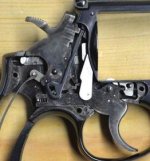
My wife's new 642-2 (W/ Crimson Trace Grip) must have a 25 lb. trigger! Had our armorer install Wolf springs that helped somewhat. I hadn't pulled a S&W trigger on a revolver for sixty years and remember those being butter smooth and an easy pull.
I realize a SD handgun shouldn't have a 2 lb. trigger pull but these are ridiculous.
Poli Viejo
 
The carry-up in a new revolver is faster than in one that's been broken in. This is due to the way the star if fitted to the hand. You may notice a few light shavings on the star if you dry fire to get the breaking process going. A few hundred rounds (or trigger pulls) will make a big difference.

Based on my limited sample (not as limited as my wife would prefer), a standard 686 or 686+ has a 13.5# DA pull out of the box, and about 3.5# SA with 1/16" overtravel. A PRO or PC model typically has a 9.5-10# DA pull and 2.5-3# SA. A PC revolver has a fixed trigger stop, so the overtravel is almost unnoticeable (< 1/32").

The first thing you notice in a PRO/PC revolver is that the DA pull is very smooth, with none of the lumps you feel in a stock trigger.

All this gives you a warm, fuzzy feeling with the revolver, but I'm not convinced it translates into a superior self-defense weapon. On a target range you notice the difference. I can (mostly) keep rounds on a 10" paper plate at 30' with either, but my PC groups are half the size, this with a 2.5" or 3" barrel. However, both will get the job done with room to spare.

There is very little to dislike about a 686 of any flavor.
 
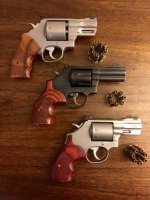
My 686+ was the roughest action of the three revolvers below but very acceptable. The other L frame, the 586 L-Comp was superior at delivery. Sent the top two to TK Custom for defensive action jobs, sold the 3rd.
 

Attachments

  • 627586686Wood.jpg
    627586686Wood.jpg
    70.8 KB
Although I'm not a gunsmith, I've worked on S&W revolvers since I bought my first one in 1971. The MIM parts are an improvement over their counterparts in the area of their finish. They are much smoother and require little to no work as far as honing or stoning. What hasn't changed though is the finish on the inside of the frame, and you will still find rough machining surfaces and even burrs in spots. These can be helped with the appropriate stones, or in the case of burrs, files. Springs will also help, but stick with brand names and even then be aware that they can effect reliability if too light.
 
Back
Top