Digital scales

quneur

Member
Joined
Jun 9, 2011
Messages
1,856
Reaction score
792
City & State/Province
Mukilteo, Washington
I have a question; some reloading manufacturers import their products from overseas. The actual manufacturer will also re-brand them for sale. Specifically, the Hornady GS-1500 and AWS-100. The pictures are here:

Cabela's: Hornady® GS-1500 Electronic Scale

American Weigh Scales - Digital Scales Wholesale

Note: the AWS is listed in the gun powder scale category.

I order the AWS on ebay for a third less than listed on the company website but still waiting to receive it. Anyone used it? I got the Lee safety scale from the kit but wanted something to re-check after charging and before seating.
 
Digital scales can be iffy. Some claim that fluorescent lights cause erratic readings. I have an old, old, Hornady, and it is pretty bomb proof. I still check most of my loads with a balance beam scale first, not always, but....and my digital scale has been pretty true. I calibrate from time to time just to make sure. I also have a set of Lyman scale test weights, something that is mandatory for using a scale to dispense gun powder! ;)

As to the logic of "same looks must be the same", not always. Sometimes, a company will buy a product from a supplier with their stipulations as to the design inside. I don't know about this one but, with a set of check weights, you will be able to find out right away how reliable yours is. ;)
 
I have a feeling that I will catch flak for this post, but here goes:
I am a robotics engineer. I was in R&D for an instrumentation company that made pressure transducers and weight scales for emergency equipment. I own two digital scales, a Lyman topof theline and the MidwayUSA cheapie. They have their uses, but to verify load weights I use an RCBS model 1010. The potential problems with digital are many: fluoresence, AC power supply ripple voltage (A REALLY under reported problem), weak or damaged batteries, load cell signal wander, on and on. I would dearly love to have oneof the electronic load stations, but I have not found one that I would consider 1000% (A thousand per cent) reliable. That is my standard for powder charges and mechanical scales are what Itrust at this point. I don't believe that the technology adequately supports the concept at this time and I have been researching the situation for 16 years. I have heard people swear by, and at, digital scales, and at this time they are all porkers in a poke
_______________________
Boxers or briefs? At my age, Depends.
 
I use a Hornady Auto Charge that I check every tenth or so charge with my RCBS 505 scale and in the last two years it has never been off. That still won't stop me from checking though as someday it will fail due to the electronics and the RCBS will tell me when that day happens. But until then OMG is it nice.
 
I've been in the high tech business for 35 years and I want to add one more thing. Electronics typically fail without warning whereas good old balance beams don't. I used to mix my own chemicals for photo processing and still have my dial-o-gram triple beam. For things that go "boom", I'm not sure I'd trust a digital device unless there was built in redundancy to create automatic detection of failure and I'd guess those would be expensive. I'd be worried that something would fail and before being caught, I'd be committed to a significant amount of work/effort/product that may be suspect. Guess my old school is showing :)

I haven't even gotten to the reloading as part of my hobby but when I do, I'll probably rely on mechanical devices and the laws of physics!!!

I have a feeling that I will catch flak for this post, but here goes:
I am a robotics engineer. I was in R&D for an instrumentation company that made pressure transducers and weight scales for emergency equipment. I own two digital scales, a Lyman topof theline and the MidwayUSA cheapie. They have their uses, but to verify load weights I use an RCBS model 1010. The potential problems with digital are many: fluoresence, AC power supply ripple voltage (A REALLY under reported problem), weak or damaged batteries, load cell signal wander, on and on. I would dearly love to have oneof the electronic load stations, but I have not found one that I would consider 1000% (A thousand per cent) reliable. That is my standard for powder charges and mechanical scales are what Itrust at this point. I don't believe that the technology adequately supports the concept at this time and I have been researching the situation for 16 years. I have heard people swear by, and at, digital scales, and at this time they are all porkers in a poke
_______________________
Boxers or briefs? At my age, Depends.
 
I dunno, fellas...

Triple beams are fine. They do work reliably every time. No argument.

I've been conducting product safety audits since 1981 and (among other things) verifying calibrations and formulations of things ranging from coatings and adhesives to flow rates of enteral feeding pumps used in hospital applications. My work includes production line tests as well as lab verification and product verification to International as well as U.S. Standards.

And I haven't seen a triple beam used for any of this in over 20 years.
 
I dunno, fellas...

Triple beams are fine. They do work reliably every time. No argument.

I've been conducting product safety audits since 1981 and (among other things) verifying calibrations and formulations of things ranging from coatings and adhesives to flow rates of enteral feeding pumps used in hospital applications. My work includes production line tests as well as lab verification and product verification to International as well as U.S. Standards.

And I haven't seen a triple beam used for any of this in over 20 years.

So how much do the scales cost that are used for these applications?

To the OP...
At that price they are most likely the same so for a couple of bucks I'd rather deal with Hornady for any warrantee issues. Also at that price point I wouldn't trust it to hold weight consistently - otherwise the acclaimed RCBS digital scale that many rely on wouldn't cost $100 more. I don't trust my $80 PACT for powder charges, after several checks against my RCBS 502 & 1010 so I sure wouldn't rely on a cheaper scale. If I were you, I'd also try to replace the Lee with something better.
 
Last edited:
As a side note you will find that all the big name companies with the lifetime warranty coverages will quickly point out that the electronic stuff is not covered by said warranty and is usually only covered for a few years at best.
 
Thanks for all the replies. I just wanted it to do a redundancy check on charged cases. Make sure the first case is fully and correctly charged then zero the scale on it. Then if a subsequent case weight changes significantly away from zero, I know something's wrong.
 
Wait -

You are using the scale to weigh a charged case? You will find that it's not uncommon for cases and bullets both to vary in weight.
 
  • Like
Reactions: PDL
As mentioned in other posts, even with sorted brass, there can be up to 10 grains variance on loaded pistol rounds, so it is not a good way to weigh your loaded rounds for error checking.
 
I don't have the years of experience you guys have but I'll jump in with what I do have. It was said that if you can't spend a minimum of $100 on a digital scale don't get one. Well I spent more than the $100 as suggested. There is a part of me that wishes I had gotten a beam scale instead. There is no questioning a beam scale accuracy and it would have been less expensive. I will pick one up before too long to just check now and again. I will say I haven't had any problems with mine and I load mostly in the middle of the road so a tenth or two one way or the other won't matter.
 
I also have some pretty extensive experience with different scales. I was involved in biochemical research for the first 20 years of my career and have seen, used, and calibrated just about every type and brand of scale made.

I agree with the poster that said he has not seen a triple beam balance in 20 years - I haven't seen one either.

The one thing that I haven't seen brought up in this thread is the need to calibrate ANY scale with good quality calibration weights.

Triple beams or any mechanical scale can be off quite a bit when the knife edge they balance on gets worn down. The beam depends on a sharp edged, fixed position blade to balance the arm. When the blade becomes worn and slightly flat the beam will balance at something less or more than the actual weight and gives no indication of a problem.

The only way to detect an error with any scale is by using good quality calibration weights. I use a small digital scale and am absolutely blown away by how accurate, stable, fast, and reliable it is. But I also check it several times during each reloading session with NBS certified weights.
 
There are no good cheap dig scales. That Hornady works, sort of, but drifts & won't hold zero. It is the issue w/ all of them under $100. So buy the Dillon, RCBS or larger Hornady, they work, the rest, not for improtant weighing of powder charges.
BTW, weighing loaded pistol rounds will tell you nothing. It's almsot impossible to spot variations in powder charges less than 5-6gr. Case & bullet variation can easily be 3-4gr so weiging them, a waste of time. Just pay attention when you reload, there is NO substitute.
 
Last edited:
...
The one thing that I haven't seen brought up in this thread is the need to calibrate ANY scale with good quality calibration weights.

....

Completely agree and thank you for bringing this up.:cool:


And the 50 gram check weight provided with most scales, even if it is accurate to within 1%, it is so far out of the range of use as to be well, no use at all.
50 grams is 771 grains. Even if it were within 1% of accuracy, that could be an error of +/- 7.7 grains!

We hand gunners typically weigh in the range of 3 to 15 grains and need check weights in that same magnitude. There are sets available from Lyman and others for about $35.

Since I am essentially formulating explosives, I take it seriously and the investment is minimal.
 
We hand gunners typically weigh in the range of 3 to 15 grains

Since I am essentially formulating explosives, I take it seriously and the investment is minimal.


Speak for yourself! hahahahahaha

You are right but, I didn't want to let it get out that I make anything other than 25gr H110/W296 loads! ;)
 
After checking randomly about 20 empty brass w/o primers, I get a variation of about 2 grains; most being between 67-66 grains with one case at a lower 68. If I digital weight it before seating then a variation amount of power would signal a possible problem, ie. if it calls for 7 gns then if the weighted shell is over/under 7 gns then I'll take a closer look.

I will replace the Lee beam scale and eventually the powder measure.
 
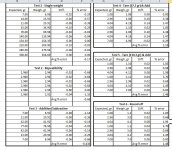
Here are the test results I did using a cheap ($50.00) digital scale. I've been using the scale about 4 months and I am very impressed by its performance.

I have a set of National Bureau of Standards certified weights that were used in this test and I use them every time I reload.

The scale is more accurate in the upper part of its range - as most scales are. So when I check powder weights I put a ten gram weight on the scale before I tare the case and add powder. This improves accuracy from about 3 - 4 % to 1%.

Anyway the test results are pretty amazing to me. Ten or twenty years ago those kind of results could only be had with a top loading Mettler or Taylor balance that would cost about $1,500 and require a dedicated marble table that would weigh about 300 lb.
 

Attachments

  • scale calibration.jpg
    scale calibration.jpg
    232.5 KB
I have a question; some reloading manufacturers import their products from overseas. The actual manufacturer will also re-brand them for sale. Specifically, the Hornady GS-1500 and AWS-100. The pictures are here:

Cabela's: Hornady® GS-1500 Electronic Scale

American Weigh Scales - Digital Scales Wholesale

Note: the AWS is listed in the gun powder scale category.

I order the AWS on ebay for a third less than listed on the company website but still waiting to receive it. Anyone used it? I got the Lee safety scale from the kit but wanted something to re-check after charging and before seating.

I also saw what you said and with some research noticed this. I have the Hornady digital scale and below the readout it says Capacity: 100g and below that it says Graduation: 0.005g whereas the AWS digital scale that appears to look the same as the Horonady scale says Capacity :100g and Graduation: .01g, so it appears that the graduation is different. To compare them I looked at mine and then went to Amazon where I saw the AWS and you can see an expanded view of it and see .01g. Just an observstion. The Hornady digital scale came with my Hornady reloading kit and I use it to back up my GemPro 250 digital scale. The GemPro works great but the Hornady also seems to work pretty good. It is nice to have a backup.
 
Last edited:
Glad to others mentioning the use of check weights (other than the huge chunk of brass that came with the scale) to check its accuracy. The same goes for a balance beam scale....can't think of a reason why someone wouldn't want to check that either.

That being said, I've had excellent luck with my RCBS Combo. I verify operation before and after each session with a check weight that is typically within 5~10 grains of the weight I am loading. I've never found it to be other than dead nuts equal to the check weight. Love my RCBS! :D
 
Speaking of check weights, has anyone had any experience with these imported sets?

Amazon.com: American Weigh Scales Calibration Weight Kit WGHTKIT, Class M2: Kitchen & Dining@@AMEPARAM@@http://ecx.images-amazon.com/images/I/411Vciv7zLL.@@AMEPARAM@@411Vciv7zLL

I understand the Lyman/RCBS sets are marketed to our specific needs at a cost around $45.
I don't like chromes weights and would rather have naked brass but this looks to have a wider range of weights in the set at a much lower cost.

Are they certified and how would one check their accuracy? That is the main thing keeping me from ordering a set. (gotta spend that SS check wisely).

*****Never mind, I answered my own question with a little goole-foo ********
From what I read, M2 class weights are an international std. and are at the lower end of tolerance but are fine for student use and general lab work, but their tolerance might be out of our desired precision range and be difficult to convert grams to grains on our scales.

The main reason the above set is NOT very good for our use is that it is in grams and milligrams. If you are using a digital scale that lets you change the weight mode to grams, then these would work as a cheap check. It would be difficult to check our grain only calibrated balance and digital scales as some quick calcs show these approximate conversions:
1gram = 15.434 grains, 100mg= 1.543 grains 200mg=3.086 grains etc
so adding them together would give odd fractions of grains plus their metric tolerances would combine to make a nightmare for us.

I see that Lyman makes a smaller set that seems like a good value and it is a direct read in grains....

lyman-scale-weight-check-sets.html
 
Last edited:
Note that those are gram weights, not grains. Looks like they go down far enough, but do you want to deal with the math every time you use them? Myself, I wouldn't....
 
Back
Top