
Drag Line

brokenprism

US Veteran
Joined
Sep 24, 2007
Messages
883
Reaction score
302
City & State/Province
Oregon
Is it mechanically possible to time (right word?) the gun so that the bolt drops right into the notch and doesn't fall early? Considering that the parts involved are fairly standardized within models, there should be a 'sweet spot' angle or whatever that would eliminate the line as nearly as is possible. The question is, why do so many guns have the damn line?
 
I don't know of any way to make that possible in a S&W revolver, short of re-engineering the internal lockworks. The bolt is activated by the trigger and unlocks just long enough to clear the slot in the cylinder. The only way to avoid a turn line is to never use the gun.
 
Take the sideplate off a S&W revolver and then cycle it, either SA or DA, and watch how the cylinder stop works. The only way to prevent a turn line would be a teflon insert or coating on the stop where it rides against the cylinder.
 
Everytime you open and close the cylinder, you're helping to create a "turn line".
 
Please check under the FAQ section of the Smithing section of this forum. http://smith-wessonforum.com/s-w-smithing/94072-faqs.html

Way and I mean WAY down in the post is a discussion on this and a methodology to help reduce this issue. Likewise I imagine RenWaxing the cylinder may help this as well. I've pondered just using scotch tape between the cylinder stops if I had something truly pristine to try out.
 
Everytime you open and close the cylinder, you're helping to create a "turn line".

I've considered that too. When I first get a Smith, I polish the bolt to eliminate any truly egregious burrs, and then hope for the best. I smile when I see engravers deal with this -- you'll always find a 'decorative' line around the cylinder there.
 
Is it mechanically possible to time (right word?) the gun so that the bolt drops right into the notch and doesn't fall early? Considering that the parts involved are fairly standardized within models, there should be a 'sweet spot' angle or whatever that would eliminate the line as nearly as is possible. The question is, why do so many guns have the damn line?

The problem is the speed at which the cylinder turns, and the need to have the stop rise into the notch really fast so as to prevent cylinder over-run.

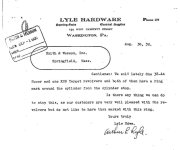
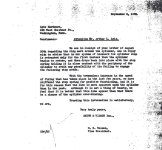
Doug Wesson himself addressed this in a letter.
 

Attachments

  • S&W drag line inquiry.jpg
    S&W drag line inquiry.jpg
    52.4 KB
  • S&W drag line S&W response.jpg
    S&W drag line S&W response.jpg
    92.1 KB
I remember when I bought my first handgun. Just turned 21 and knew everything about guns. Heck, I read G&A and a few others.
It was a model 19-3 six inch, which I still have.
When I noticed the drag line beginning to form I told a older friend about it and said I was going to send it back to the factory.
I won't repeat what he told me.
 
I remember when I bought my first handgun. Just turned 21 and knew everything about guns. Heck, I read G&A and a few others.
It was a model 19-3 six inch, which I still have.
When I noticed the drag line beginning to form I told a older friend about it and said I was going to send it back to the factory.
I won't repeat what he told me.

You cannot tell only half of that story!!!!!
 
I was in a gun shop when an older 'gentleman', for lack of a better term on this civilized forum, tried to negotiated the price down on a 98 percent Model 29-3. He said "Obviously that gun is seriously out of time! Look at that ring starting on the cylinder." The counter man told him to look at every single (expletive!!) revolver in the (expletive!!) store, even the new ones, and see if they didn't have a line too. The older gent left muttering. I ended up buying a very nice Ruger Blackhawk .45 LC/.45ACP out of the same case. Yep, it has a turn line.
 
That letter is awesome. Those fellas could write a letter.

I never intended to whine about the line, and no one seems to have mistaken my intent in askign the question, but I was curious about the engineering. I thought it might be theoretically possible to drop the bolt in the approach, but I don't understand the function of the parts so I can't visualize it.

I liked the idea about tape. There must be a non-glossy tape that would disappear on the cylinder. But then why bother to protect the cylinder 'waist' if you're just going to burn the cylinder face?

Thanks for the replies.
 
Last edited:
Don't open the cylinder and don't cycle the action and there will be no turn ring.

My revolvers are for enjoyment. I don't worry over the small stuff.
 
One LGS here has a model something or other and the tag reads "DONT TURN THE CYLINDER"

Sent from my DROIDX using Tapatalk 2
 
I believe an application of wax (Renaissance Wax) on the cylinder will "lessen" the turn line, but it would have to be reapplied frequently. The beauty of a nice used S&W can be in the various marks that come with use and well cared for.
 
When I was looking to purchase a model 19 Texas. Ranger commemorative, the lgs would not let me cycle the gun because it was like new in box. After I purchased the gun I dry fired the gun and created a drag line. The lgs owner almost cried. I planned on using the gun so it was going to get the line sooner or later.
 
The answer to "Can I eliminate the turn line on a S&W?" is the same as the one to, "Can I put 7 rounds in my Model 10?" It is -- no. They are made the way they are made.
 
One LGS here has a model something or other and the tag reads "DONT TURN THE CYLINDER"

Sent from my DROIDX using Tapatalk 2

Yeah, I've encountered quite a few dealers that get their panties all in a bunch if you turn a cylinder. At the Nations Gun Show in Chantilly, VA, near NRA headquarters, most all the dealers fix the cylinders with zip ties so you can't swing them out of the frame or turn them. I've walked away from interesting guns when the sellers refused to cut the zip ties so I could examine the star and cylinder face, and test the lock-up. Too bad, too, because I've consistently seen more nice revolvers at that show than anywhere else.

I've got a M-19 I've shot quite a bit that for some reason has hardly any turn line. It seems to vary somewhat from gun to gun.
 
Just consider the cylinder turn line as part of the gun, 'cause it really is.
 
Yeah, I've encountered quite a few dealers that get their panties all in a bunch if you turn a cylinder. At the Nations Gun Show in Chantilly, VA, near NRA headquarters, most all the dealers fix the cylinders with zip ties so you can't swing them out of the frame or turn them. I've walked away from interesting guns when the sellers refused to cut the zip ties so I could examine the star and cylinder face, and test the lock-up. Too bad, too, because I've consistently seen more nice revolvers at that show than anywhere else.

I've got a M-19 I've shot quite a bit that for some reason has hardly any turn line. It seems to vary somewhat from gun to gun.

This was in an old S&W that i guess had never been fired or even opened so i guess it was a collectible and they wanted top dollar for it in its current state. This i can understand although im not into collecting someone out there is and is looking for a revolver just like this.

On the other hand the bozos who zip tie ALL their guns so you cant inspect can keep em

Sent from my DROIDX using Tapatalk 2
 
Don't open the cylinder and don't cycle the action and there will be no turn ring.

My revolvers are for enjoyment. I don't worry over the small stuff.

Most revolvers are for enjoyment and use, but some are preserved -- for whatever reason -- in a collectable state of non-use. Nothing wrong with that either. I've seen some that were faint suggestions of a line, and some that were deeply engraved by the bolt. There's a middle ground, and for some of us, it's worth finding.

I've known some rough and tumble guys who were happy to proclaim their manly blindness to 'character' marks on their guns who would nevertheless detail and preen their new or collectable cars. People are funny.
 
Most revolvers are for enjoyment and use, but some are preserved -- for whatever reason -- in a collectable state of non-use. Nothing wrong with that either. I've seen some that were faint suggestions of a line, and some that were deeply engraved by the bolt. There's a middle ground, and for some of us, it's worth finding.

I've known some rough and tumble guys who were happy to proclaim their manly blindness to 'character' marks on their guns who would nevertheless detail and preen their new or collectable cars. People are funny.
I've done that, I've had a car that I constantly picked at, a little dust and the entire car had to be cleaned and polished. Forget about driving it on a gravel road. Got to be a pain in the rear after a while. Now I drive a 4wd truck with dings, dents and rust spots.
I've got scars, my truck has scars and my guns have turn lines and holster wear. All that's just fine with me.
 
This was in an old S&W that i guess had never been fired or even opened so i guess it was a collectible and they wanted top dollar for it in its current state. This i can understand although im not into collecting someone out there is and is looking for a revolver just like this.

On the other hand the bozos who zip tie ALL their guns so you cant inspect can keep em

Sent from my DROIDX using Tapatalk 2

All of the gun show promoters where I set up at require ALL guns to be tied. It's for safety purposes. If someone wants to inspect a gun, I will cut the tie and retie it afterwards.
 
All of the revolvers I have ever owned had a turn line on the cylinder. However, the degree of that line has varied. I have two late 70's 28-2 revolvers. Both of these revolvers have been fired extensively with live ammunition as well as in dry-fire practice, both SA and DA. The six inch revolver has a turn line that is exceedingly light and that only begins about half way between each notch. On the couch beside me as I type this is my four inch 28-2. It has virtually no visible turn line at all except for a small mark slightly longer than the blue band in which this reply is being typed, that precedes the shallow lead to each cylinder notch. When purchased, it gave every appearance of being unfired. It is remarkably well fitted. It is atypical in that it is the only S&W revolver I've ever had where the cylinder line was so very minimal.
 
I wonder if a little high tech wonder grease was applied to the area where the drag line occurs prior to firing would help?
 
The turn line doesn't bother me. It's just normal wear.

One could design a revolver that does not have one - but it would require an entire redesign of the gun, and would also require disengagement of the stop when the latch is pressed to open the cylinder, and then probably a cam in the yoke arm to keep the latch down until the cylinder is almost fully closed. Also, the gun would need to be designed so that the cylinder exactly aligns when closed so that there is no rotation necessary to lock it after the stop comes up.

That would likely cost hundreds of thousands of dollars to design it and get it working, then many more to ramp up production.

The result would be a revolver that is more expensive but keeps a pristine cylinder.

And then many here would complain that the the revolver doesn't have a damn turn line like it should.
 
I was told that the German Korth revolver, if timed properly, would have practically no drag line...
 
If you want to try the trigger on any S&W Hand Ejector you can open the cylinder then hold the cylinder release slide to the rear and cycle the action. 95% of the clerks in the stores don't know this. You can cycle single action, double action and test for push off, etc.
 
Back
Top