
You are using an out of date browser. It may not display this or other websites correctly.
You should upgrade or use an alternative browser.
You should upgrade or use an alternative browser.
GERMAN MAUSER
- Thread starter pberendsen
- Start date

LVSteve
Member
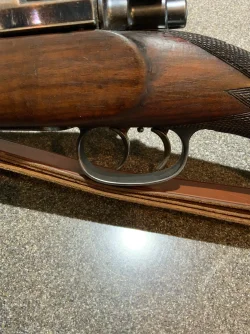
Sporterized Gew98 of some type with set triggers. From the looks of it, the original bolt was heated and bent.
There usually stamped but there were two bullet dia varations in those one was bigger then the other. I wanna say a JS and JR msybe. One was a .318 one was a .312 i think. In early guns. Lot i have seen were converted. Usually stamped around tge front site or under the front site.
erikpolcrack
US Veteran
I believe the bullet diameter conversion for the military began in 1905: .318 to .323. Commercial changeover took much longer and was kind of sporatic for a while. From the few pictures shown, that rifle could be an original Mauser factory sporter or an early high-quality build by a gunsmith or other commercial firm. Can't really determine caliber. Love to see more photos. Looks really first-class to me.

LoboGunLeather
US Veteran
Difficult to be sure from the photos, but it could be a commercially produced rifle rather than a converted military specimen. The Mauser-designed bolt action rifles were well known and in demand all over the world.
Yes, more pictures would be nice. Not being a knowledgeable Mauseraholic, I’m waiting until someone with more smarts jumps in. Where’s 2512hq?
Looks like it may be a Mauser commercial sporter from what I can see in the pics.
But there are some questions
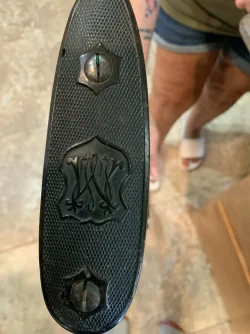
The butt plate is a Mauser marked (MW intertwined for Mauser Waffenfabrik ).
That style with the 'stars' around the screw heads is I believe the eralier style of the hard rubber/or horn butt plates. The other (later?) did not have the star borders around the screw heads.
IMO the butt plate is correct for an early Mauser mfg sporter.
What little of the stock I see shows the slim sided stock with the raised 'panels' for reinforcement around the action.
Those 'raised panel stocks' were standard on the Mauser sporters.
....BUT the style was also widely copied by those gunsmiths making sporters from x-military actions and bbl'd actions.
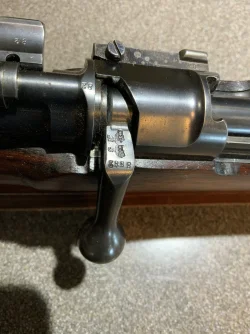
I don't think the bolt handle is aftermarket heated and bent/turned down.
Proof marks & ser# are clear and undisturbed on the shank at the bolt body.
Forging a bolt handle down usually ends up damaging the proof marks there and then the area is filed and polished up clean afterwards.
Forging a straight bolt handle down generally leaves the entire bolt handle and shank a bit short of what a standard sported bolt handle is. This one looks like the right length,,but pics can be deceiving.
The proofs and ser# are on the shank,,BUT I see 2 sets of proof marks on the bolt handle.
One is Crown/B and Crown/U.
That's fine and are Pre-WW2 commercial proofs.
The second set of bolt proofs are NAZI ERA proofs of Eagle N (nitro proof) and Eagle/J.
The Eagle/ J I'm not sure of the meaning. I think it was an inspection mark indicating a sporting (Hunting) firearm.
The bolt extractor collar has a WW1 German military acceptance proof mark on it.
A Crown/over a German Fraktur alphabet letter.
Maybe it is an x Military bolt,,or parts on it.
Some questions, some answers.
Need more pics. Markings underside of bbl would be a great help. Any on the sides of the recv'r ring as well. Pics of the bbl contour style and sights.
My first thought is the rifle is a pre-WW1 Mauser sporter that was re=proofed during the Nazi era.
Maybe some work done on it, a re'bbl , new bolt fitted or otherwise.
But there are some questions
The butt plate is a Mauser marked (MW intertwined for Mauser Waffenfabrik ).
That style with the 'stars' around the screw heads is I believe the eralier style of the hard rubber/or horn butt plates. The other (later?) did not have the star borders around the screw heads.
IMO the butt plate is correct for an early Mauser mfg sporter.
What little of the stock I see shows the slim sided stock with the raised 'panels' for reinforcement around the action.
Those 'raised panel stocks' were standard on the Mauser sporters.
....BUT the style was also widely copied by those gunsmiths making sporters from x-military actions and bbl'd actions.
I don't think the bolt handle is aftermarket heated and bent/turned down.
Proof marks & ser# are clear and undisturbed on the shank at the bolt body.
Forging a bolt handle down usually ends up damaging the proof marks there and then the area is filed and polished up clean afterwards.
Forging a straight bolt handle down generally leaves the entire bolt handle and shank a bit short of what a standard sported bolt handle is. This one looks like the right length,,but pics can be deceiving.
The proofs and ser# are on the shank,,BUT I see 2 sets of proof marks on the bolt handle.
One is Crown/B and Crown/U.
That's fine and are Pre-WW2 commercial proofs.
The second set of bolt proofs are NAZI ERA proofs of Eagle N (nitro proof) and Eagle/J.
The Eagle/ J I'm not sure of the meaning. I think it was an inspection mark indicating a sporting (Hunting) firearm.
The bolt extractor collar has a WW1 German military acceptance proof mark on it.
A Crown/over a German Fraktur alphabet letter.
Maybe it is an x Military bolt,,or parts on it.
Some questions, some answers.
Need more pics. Markings underside of bbl would be a great help. Any on the sides of the recv'r ring as well. Pics of the bbl contour style and sights.
My first thought is the rifle is a pre-WW1 Mauser sporter that was re=proofed during the Nazi era.
Maybe some work done on it, a re'bbl , new bolt fitted or otherwise.

LittleCooner
Member
Appears to be a Pre War commercial Oberndorf Sporter Mauser, Type B. An excellent article from 25 years ago in the American Rifleman is attached. Some of these years ago would bring excellent money from a collector of these commercial grade hunting rifles, as the workmanship in construction was way above the military grade guns.
https://www.americanrifleman.org/content/the-original-mauser-98-sporters/
https://www.americanrifleman.org/content/the-original-mauser-98-sporters/
The Preacher
Member
- Joined
- Dec 6, 2003
- Messages
- 263
- Reaction score
- 702
By the picture with the triggers, in looking at the stock work, I'd say it's an early 98 Mauser that has been modified. They are called Guild Rifles I believe. Put together by un-named German gunsmiths in the "Gun Makers Guild". I have one in 7x64 Brenneke that is possibly my most accurate rifle.
Ds J
Member
Please be very careful with ammo?!
The correct calibre should be stamped beneath the barrel - either .318 (7.9mm) or .323 (8.1mm).
Some help with ID'ing Mausers:
https://www.buffalorifles.org/blog/how-to-identify-a-mauser-rifle/
https://www.americanrifleman.org/content/identifying-mauser-markings/
The correct calibre should be stamped beneath the barrel - either .318 (7.9mm) or .323 (8.1mm).
Some help with ID'ing Mausers:
https://www.buffalorifles.org/blog/how-to-identify-a-mauser-rifle/
https://www.americanrifleman.org/content/identifying-mauser-markings/
OP
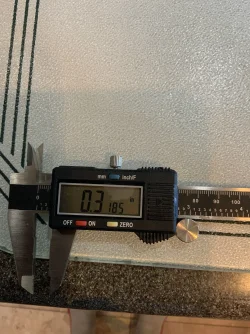
You all are the best, and I thank each and everyone of you. In the next hour or two will take more pictures to post and will take it out of the stock for the first time. I think it’s an unmolested early commercial Sporter , and will bet it’s.318, 8x57. Let’s see. Phil
- Joined
- Oct 21, 2021
- Messages
- 846
- Reaction score
- 1,614
I suspect that firing a Spitzer .323 in a .318 early 98K barrel isn't going to blow it up, but that is the reason that 8mm Mauser ammunition made in the US was down loaded so much. The German war time 7.92x57 is a very powerful round with a 198 gr projectile @2500+fps. The early .318 Commision rifles were not Model 98s and they could be a problem with the Spitzer bullet.Please be very careful with ammo?!
The correct calibre should be stamped beneath the barrel - either .318 (7.9mm) or .323 (8.1mm).
Some help with ID'ing Mausers:
https://www.buffalorifles.org/blog/how-to-identify-a-mauser-rifle/
https://www.americanrifleman.org/content/identifying-mauser-markings/
OP
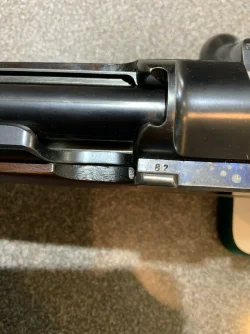
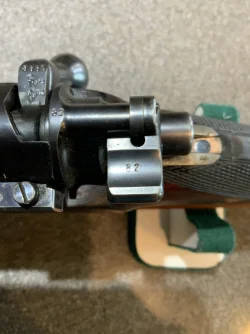
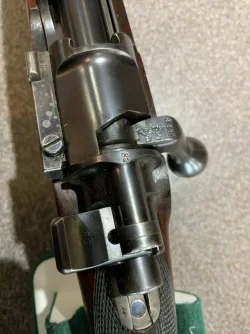
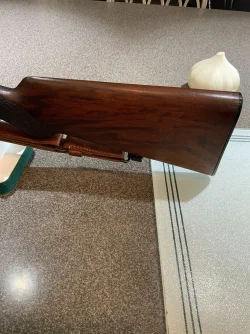
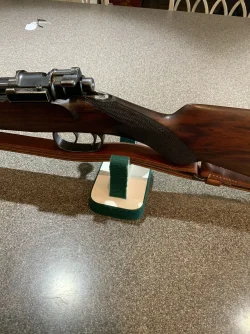
OP
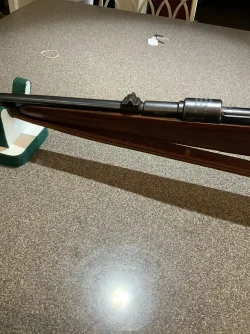
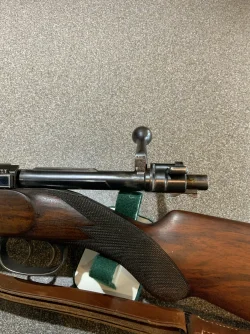
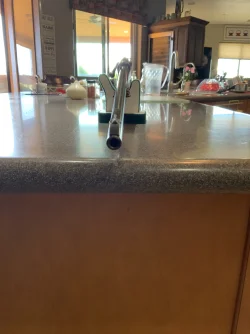
erikpolcrack
US Veteran
I have several older German 8mm rifles that have the .318 bore. I have proper ammo for them - got a bunch from Old Western Scrounger years ago. When the German Army made the change to the lighter, spitzer .323 bullet, they were looking for a little more power and better accuracy. We did something similar when we changed from the 30-03 to the 30-06 in our Springfields. We changed bullet shape and weight, but not diameter. That is why it is perfectly safe to use 30-06 ammo in a 30-03 rifle, like some Win '95s. Since the Germans did increase bullet diameter, they obviously had to modify existing rifles to use the new ammo safely. The way they did that reflects their desire to inprove accuracy. They re-cut the rifling in the old barrels using special reamers that only cut the grooves deeper, leaving the lands the same. This made the new bullets obdurate in the rifling very deeply, optimizing their spin to take full advantage of the new spitzer shape. Leading up to WWI, some of their arsenals were very busy doing this to early 98s and many '88 Commission rifles still in use by many reserve and support troops. Rifles so modified had an S stamped on the top of the breech end of their barrels, just forward of their receiver ring. In most cases, you can look down the bore of military 8mm rifles and see the difference in the rifling. The difference between the lands and grooves in the .318 rifles is much less distinct than in the .323 rifles. It almost reminds me of Marlin Microgroove or some of the modern polygonal bores. The .323 bores show a visibly much greater difference between the very distinct lands and grooves. Couple of caveats here. Only a bore slugging can safely tell you for sure which bore diameter you are dealing with. Well-worn or corroded barrels can make the distinction hard to see. I also have no experience with commercial barrel rifling of either diameter. There may be little apparent difference in some cases with those rifles. I do know that German gunsmiths and commercial firms continued to produce .318 bore rifles for years and years after the military changeover to the .323 bore. One other caveat that would be appropriate in rare cases. During the later course of WWI, some '88 Commission rifles were converted using a questionable, possibly unsafe short-cut. Instead of re-cutting the barrel grooves, some arsenals cut a much longer freebore at the front of the chamber. This was supposed to make using the new ammo OK by lowering the chamber pressure.
Last edited:
Is the caliber known?
A great many were built in 8x57 (sporters).
The earlier bullet dia was .318 and is commonly known as the 'J' bore size.
The J is actually an 'I' for Infantrie (German spelling sp?).
The J and the I appear the same in the older German alphabet font. The difference betw them is sorted out by looking at the letter and if it sits on the 'guide line of the text,,it's an 'I'
If the same appearing letter dips slightly below the text line,,it's a 'J'
Standing all by itself printed on a piece of paper or lable,,it appears as a J to most anyone looking at it.
So the 'I' in 8x57I got to be called 8x57J instead. The 'J' bore of .318 dia 8mm bullet.
The later slightly larger 8mm bullet is the 'S' bore size of .323.
There are a number of other 8mm sporting cartridges. Most are/were available in either the J or S bullet dia. The rifle chambered for them was carried the appropriate J or S rifling bore specs.
Many say that 8x57mm S (.323d) rounds can be safely fired in a rife chambered and rifled for the J cartridge (.318d).
It can be, depending on the particular firearm, the actual load, the particular bullet (cast or a thin jacketed bullet. A blanket statement that it is safe I don't agree with.
But it is done and has been probably millions of times over.
Maybe the rifle isn't 8x57 anyway, but that's the story.
A 7x57 cal would be a nice option!
A great many were built in 8x57 (sporters).
The earlier bullet dia was .318 and is commonly known as the 'J' bore size.
The J is actually an 'I' for Infantrie (German spelling sp?).
The J and the I appear the same in the older German alphabet font. The difference betw them is sorted out by looking at the letter and if it sits on the 'guide line of the text,,it's an 'I'
If the same appearing letter dips slightly below the text line,,it's a 'J'
Standing all by itself printed on a piece of paper or lable,,it appears as a J to most anyone looking at it.
So the 'I' in 8x57I got to be called 8x57J instead. The 'J' bore of .318 dia 8mm bullet.
The later slightly larger 8mm bullet is the 'S' bore size of .323.
There are a number of other 8mm sporting cartridges. Most are/were available in either the J or S bullet dia. The rifle chambered for them was carried the appropriate J or S rifling bore specs.
Many say that 8x57mm S (.323d) rounds can be safely fired in a rife chambered and rifled for the J cartridge (.318d).
It can be, depending on the particular firearm, the actual load, the particular bullet (cast or a thin jacketed bullet. A blanket statement that it is safe I don't agree with.
But it is done and has been probably millions of times over.
Maybe the rifle isn't 8x57 anyway, but that's the story.
A 7x57 cal would be a nice option!
OP
OP
Both the JR and JRS were rimmed??
erikpolcrack
US Veteran
Yes, both the JR and JRS were rimmed versions of the two 8x57 cartridges. They were popular chamberings in German multi-barrelled break-open guns like Drillings and Vierlings. After WWI, there was a period during which it was illegal for Germans to own rifles which chambered military ammo. Gunsmiths soon popularized a simple rechambering to a cartridge called the 8x60 Mauser. Met the legal requirement as OK for private use. It even came in .318 and .323 versions.
With the extra pics, I see a couple of more things.
I think I see the rifles ser# as 5583 on the LH side of the recv'r.
I see 5583 on the bbl LH side as well but can't make out what 2 digits/letters are after that.
Matching numbers on bolt body and the bolt parts I can see.
(The bottom metal (the trigger guard magazine box) should be #'d the same on the outside back wall of the mag box. You have to take the bbl'd action out of the wood to see it of course.
Mauser Sporting rifles were ser#'d in their own series separate from the military production.
Starting w/ #1 in 1898.
A four digit ser# in the 5000 range would be a in the 1902/early 1903 production time.
So that seems to match up with what info I have.
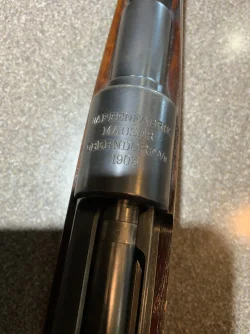
The roll die impression on the recv'r ring is consistent with with production up to 1922. The Mauser name was changed that yr to Mauser-Werke, AG. from the previous used WaffenFabrik Mauser, AG.
The latter marking is on the OP's rifle along with the yr/mfg/proofing which would be correct.
The commonly seen Mauser 'Banner' marking wasn't used til 1909. But it wasn't used on Mauser rifles till after WW1, around 1924/25.
It was used pre-WW1 on pocket pistols and a few other offerings.
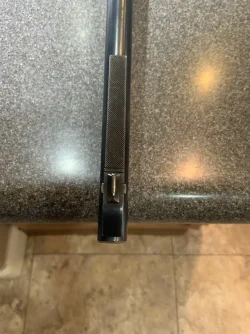
The front sight is called a 'Block Sight' and was one of the 3 types avail on the sporter(s).
The base 'block' is soft soldered to the bbl and dovetailed for the sight insert.
Some bases were slotted for a sight hood.
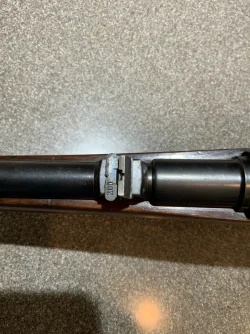
Rear sight 2 leaf blade was an available option as well at the time.
A block base soldered to either the bbl right in front of the chamber profile. Or onto a sleeve extension placed on the bbl to lengthen the look of the chamber profile and act as a riser for the rear sight.
DST was a common option chosen. Though plain Military pull single trigger and a Single Set trigger were also avail.
Most of the parts to these will be ser#'d with the last 2 digits of the rifles number.
The Bottom metal with it's floor plate release inside the guard is one of the 3 option types.
One was a plain military style where you need a pointed instrument (loaded rd) to push in and release the plate.
The other was the well liked by collectors lever release on the floor plate.
Normally there should not be any small Lock Screws in the trigger guard to lock the action screws in place as on a Military rifle. I believe that feature could be ordered, but not completely sure.
Check the magazine ser# for a match to the rifle and it will tell you if it's orig or not.
h
It looks like it has the Pear Shaped bolt knob and that was pretty much the standard on sporters, though again,,order what you like.
The shape is called an Oberndorf style bolt knob oddly enough.
Caliber, if not imprinted on the bbl LH side at the breech along with the ser#, should be on the bottom of the bbl up near the breech.
It will be in BORE dia M/M's, not groove dia.
Case length usually along with it. Sometimes rifling twist in 1 turn in so many M/M's.
Early guns like this can sometimes have bore dia expressed in a gauge size and caliber in a number system God only knows how it works. But there are websites like the German Gun Collectors Assn that explain and have charts.
Mauser had their own Gov't sanctioned Proof facility in Oberndorf right across the river from the main factory.
Those added NAZI era proof marks (Eagle/N, Eagle/J) on the bolt handle (1937? to 1945) are one thing that is newer than the rest of the rifle that I can see,
The rounded grip knob of the stock was the standard style early on.
I think I have the following in the right order..,,forgive me if I'm wrong....
If the forend tip has a Horn or Ebony Schnable shaped tip attached, it;s a Mauser Type A sporter
A Schnable forend tip shaped of the stock wood itself, It's a Mauser Type B Sporter.
I reload and shoot a couple .318 'J' bore 8X57's
I load either cast or jacketed bullets intended for the 32Winchester Spcl. These are sized .320/.321.
I load very conservatibly for the rifles and have had no issues. Starting loads in the manual for 8x57 are my primary loads.
I use regular 8x57 'S' bore dies (common) but remove the .323 expander button from the decaper rod and sub a smaller caliber button to hold the decap pin in place. So it just decaps and does not expand..
The idea is to not open the neck back up on the return stroke of the press. The sized but not expanded neck of the operation provides a perfect seating tension for the smaller .318/.320 dia bullets.
I think I see the rifles ser# as 5583 on the LH side of the recv'r.
I see 5583 on the bbl LH side as well but can't make out what 2 digits/letters are after that.
Matching numbers on bolt body and the bolt parts I can see.
(The bottom metal (the trigger guard magazine box) should be #'d the same on the outside back wall of the mag box. You have to take the bbl'd action out of the wood to see it of course.
Mauser Sporting rifles were ser#'d in their own series separate from the military production.
Starting w/ #1 in 1898.
A four digit ser# in the 5000 range would be a in the 1902/early 1903 production time.
So that seems to match up with what info I have.
The roll die impression on the recv'r ring is consistent with with production up to 1922. The Mauser name was changed that yr to Mauser-Werke, AG. from the previous used WaffenFabrik Mauser, AG.
The latter marking is on the OP's rifle along with the yr/mfg/proofing which would be correct.
The commonly seen Mauser 'Banner' marking wasn't used til 1909. But it wasn't used on Mauser rifles till after WW1, around 1924/25.
It was used pre-WW1 on pocket pistols and a few other offerings.
The front sight is called a 'Block Sight' and was one of the 3 types avail on the sporter(s).
The base 'block' is soft soldered to the bbl and dovetailed for the sight insert.
Some bases were slotted for a sight hood.
Rear sight 2 leaf blade was an available option as well at the time.
A block base soldered to either the bbl right in front of the chamber profile. Or onto a sleeve extension placed on the bbl to lengthen the look of the chamber profile and act as a riser for the rear sight.
DST was a common option chosen. Though plain Military pull single trigger and a Single Set trigger were also avail.
Most of the parts to these will be ser#'d with the last 2 digits of the rifles number.
The Bottom metal with it's floor plate release inside the guard is one of the 3 option types.
One was a plain military style where you need a pointed instrument (loaded rd) to push in and release the plate.
The other was the well liked by collectors lever release on the floor plate.
Normally there should not be any small Lock Screws in the trigger guard to lock the action screws in place as on a Military rifle. I believe that feature could be ordered, but not completely sure.
Check the magazine ser# for a match to the rifle and it will tell you if it's orig or not.
h
It looks like it has the Pear Shaped bolt knob and that was pretty much the standard on sporters, though again,,order what you like.
The shape is called an Oberndorf style bolt knob oddly enough.
Caliber, if not imprinted on the bbl LH side at the breech along with the ser#, should be on the bottom of the bbl up near the breech.
It will be in BORE dia M/M's, not groove dia.
Case length usually along with it. Sometimes rifling twist in 1 turn in so many M/M's.
Early guns like this can sometimes have bore dia expressed in a gauge size and caliber in a number system God only knows how it works. But there are websites like the German Gun Collectors Assn that explain and have charts.
Mauser had their own Gov't sanctioned Proof facility in Oberndorf right across the river from the main factory.
Those added NAZI era proof marks (Eagle/N, Eagle/J) on the bolt handle (1937? to 1945) are one thing that is newer than the rest of the rifle that I can see,
The rounded grip knob of the stock was the standard style early on.
I think I have the following in the right order..,,forgive me if I'm wrong....
If the forend tip has a Horn or Ebony Schnable shaped tip attached, it;s a Mauser Type A sporter
A Schnable forend tip shaped of the stock wood itself, It's a Mauser Type B Sporter.
I reload and shoot a couple .318 'J' bore 8X57's
I load either cast or jacketed bullets intended for the 32Winchester Spcl. These are sized .320/.321.
I load very conservatibly for the rifles and have had no issues. Starting loads in the manual for 8x57 are my primary loads.
I use regular 8x57 'S' bore dies (common) but remove the .323 expander button from the decaper rod and sub a smaller caliber button to hold the decap pin in place. So it just decaps and does not expand..
The idea is to not open the neck back up on the return stroke of the press. The sized but not expanded neck of the operation provides a perfect seating tension for the smaller .318/.320 dia bullets.
OP
I have quite a bit of 8x57 JR ammo as I use it in a German combo for hunting
OP
Inside the magazine and floor plate have matching #s to the gun
30calflash
Member
- Joined
- Jan 26, 2013
- Messages
- 72
- Reaction score
- 80
How did you measure the bore at .318"?
The reason I ask is that your receiver is milled to take stripper clips and it's my understanding that 8x57 Mauser rifles set up that way are .323" diameter barrels. The .318 barreled rifles were earlier manufactured before stripper clips were used. Those early versions altered afterward to take stripper clips also had the barrel/chamber altered to take the larger diameter ammo.
The reason I ask is that your receiver is milled to take stripper clips and it's my understanding that 8x57 Mauser rifles set up that way are .323" diameter barrels. The .318 barreled rifles were earlier manufactured before stripper clips were used. Those early versions altered afterward to take stripper clips also had the barrel/chamber altered to take the larger diameter ammo.
OP
Now that I know what it is, what do I do with it?? lol 
oneeyedpete
Member
- Joined
- Jun 23, 2020
- Messages
- 316
- Reaction score
- 530
Yes, shoot it! This is a lovely commercial sporter version of the Model 98 and will be a joy to shoot. Light cast lead target loads are really nice to shoot at the range. CE Harris's "The Load" article will give you a lot of useful information on reloading options.

SGT ROCK 11B
Member
- Joined
- Mar 28, 2023
- Messages
- 3,636
- Reaction score
- 5,467
- City & State/Province
- American Legion Post 1
With the double triggers I would say Classic Hunting Rifle.
Germans are great outdoorsmen and hunting is a big pastime there. We tend to only think of WWI and WWII so military surplus.
Germans are great outdoorsmen and hunting is a big pastime there. We tend to only think of WWI and WWII so military surplus.

HuntFish918
Member
Bring it to Tulsa and sell it!Now that I know what it is, what do I do with it?? lol
bwickens
Member
Mauser DID make rifles for the commercial market, some very nice sporters. Reprints of the old catalogs have been available.Sporterized Gew98 of some type with set triggers. From the looks of it, the original bolt was heated and bent.
Similar threads
- Replies
- 0
- Views
- 217


- Replies
- 1
- Views
- 582
- Replies
- 12
- Views
- 569
Latest posts
-
 This morning was a good morning working GOALS 2026 in Des Moines, Iowa.
- Latest: DixieRanger
-

-

-

-
 PERFORMANCE CENTER M&P 10MM M2.0 Recommendations
- Latest: sparkyvega
-
-

-
-

-

-

