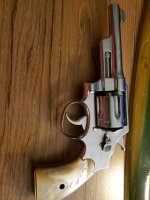
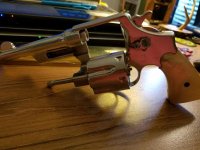
Since you did not add the city, HPD could mean one of many in the country (I assume Houston), so I read through the posts again and might have missed it, but where was the revolver used? As stated, the gun has been refinished and the pearl stocks are a post-factory addition as well, and both negatively affect value.
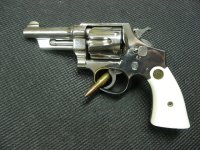
Original walnut stocks for this gun sell for over $200 now by themselves. Replacement originals can be found on ebay and other sites if originality is of interest to you. As for the plating, the biggest question has been asked by Ralph about original finish. Can you look for a B inside the ejector rod housing or under the stocks on the butt-frame which would indicate Blue? The reason I ask is that if the gun was originally nickel, the value would be different in my mind. The biggest drawback of the plating is that the trigger and hammer were plated and would have been color case hardened at the factory. This could be done to bring the gun back to original factory condition if interested, but other than that, since you will most likely never sell it, just leave it as is.
As is condition would rate Very Good with the non-factory refinish. Standard Catalog of Smith & Wesson 4th Edition states $1400 for VG. One could argue that the stocks would drop the value even further, but not to a big degree. Some would pay a premium for documented history, but others would not. Insurance value is almost always set higher than expected selling price by maybe 30%, so if you are insuring it, $1800 to $2000 would be appropriate.