Help with identidication

Joined
Apr 3, 2019
Messages
2
Reaction score
3
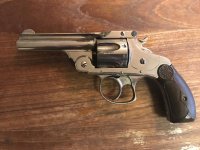
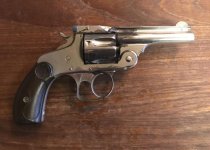
I was given this revolver that used to belong to my grandfather, serial number 205XXX. I’m looking for help with what model it is and when it was made. Thanks
 

Attachments

  • 93520E22-0879-4848-8C84-E182E6998E31.jpg
    93520E22-0879-4848-8C84-E182E6998E31.jpg
    67 KB
  • 4DE0EAC1-E6F4-46F2-874F-112196B9157C.jpg
    4DE0EAC1-E6F4-46F2-874F-112196B9157C.jpg
    58.5 KB
Welcome! This is a .38 Double Action from the late 1880 decade. Since the hammer and trigger appear plated it has probably been refinished. Hope this is helpful.
 
Welcome to the Forum. The specific model is 38 Double Action, Third Model. They were manufactured from 1884 to 1895, with around 204,000 made. Serial number 205XXX would have shipped in maybe 1888 or 1889. You might wonder why your serial number is higher than the number of this model made? To clarify, the serial number range started with "1" for the 38 Safety, 1st Model and the 3rd Model range was 119,001 to 322,700.

The comment on a refinish is supported by the fact that the hammer, trigger, and trigger guard were typically not nickel plated. Overall, the plating looks very well done, with even the pin holding the front sight not buffed flat. Also, looking at the hard rubber stocks, they look well worn, which does not match the current level of finish on the gun. Still a very nice and priceless family heirloom.
 
Last edited:
Thanks for the help. I know it has been shot in the last 50 years or so and it was give to me with a box of ammo. Would you advise shooting this with modern ammo or is this better just kept as a family heirloom?
 
Condition usually dictates whether any particular gun should be shot and as noted, your revolver is in excellent shape. I would not hesitate shooting it with standard manufacture factory ammo. Remington, Winchester, and European companies still manufacture 38 S&W and they are designed to be safe in top-break revolvers. The standard bullet is around 145 grain LRN in these brands, but don't try the WWII ammo that England used in their hand ejectors with a 200 grain bullet, since pressures can be higher.

Any old gun can break, and parts are hard to find, but currently manufactured ammo will not damage the gun. I regularly shoot my top-break 38 S&Ws as they are just plain fun to take to the range. Don't shoot that many rounds at an outing, since they are not the most accurate gun in my safe. I have an early 1880s 32 S&W Double Action that belonged to my great-grandfather and shoot it because I like having the feeling that I know 3 generations of family owners have done the same thing with the same gun.
 
I just want to offer an alternate view? Your "Antique" Smith was actually manufactured during the Black Powder Era. Before smokeless was invented? To experience the TRUE impact of what it was like to shoot this gun in the late 1880's early 1890's I'd recommend safely loading it with a black powder FFFG load of about 11grains or black powder substitute of 9 grains of Pyrodex or American Select black powder substitute. Or simply purchase a black powder load from some of the Cowboy action Shooting providers? You will have a much better experience shooting this Old Smith with the original load of black powder. I shoot my model 3 top break (shooter with no finish but excellent action) often with my personal favorite. 105 grain Semi-wad cutter 100% lead with 11 grains of black powder and heavy crimp. At 10 paces I can shoot the Spade clean out of an Ace playing card and If I can do it with my old eyes you certainly can! It's very accurate and a ton of fun to shoot.

Oh, one other tip. If you decide to use black powder, make sure you clean the gun right away. Black powder is very dirty. What I normally do is bring a spray or solvent with me to the range or outdoor shooting spot. When I'm finished shooting I spray the gun completely and wipe it down right away. Then leave it soaking in a zip lock bag until I get it home then completely clean it. After cleaning it completely store it in a film of oil. Often about two weeks later you will see some scum develop inside the bore. Clean it again and leave it in a film of oil. Guns love oil. Mine are always bathing in it so I don't have any issues.
 
Last edited:
Cleaning revolvers after shooting black powder is not an easy task to do right. The burnt powder gets everywhere including inside the mechanism. The major actors in the residue of firing BP are potassium salts and sulfur. Both are very hydroscopic and with moisture in the air are bad actors on most all metals. Quickly oxidizes brass and will rust steel/iron in a short time with only the relative humidity in the air.

Soap and water is the clean-up method and unless one is already experienced with partial disassembly of the gun, along with how to clean up BP, should steer clear of it in my mind. Having shot BP for near40 years, I avoid using it wherever possible mostly because of the clean-up issues. I shoot several cap & ball revolvers and flintlock rifles & fowlers, all with BP. The rifles are relatively easy to clean since the entire lock comes out and is washed in soap & water, then dried and oiled. The barrel is relatively easy to clean as well.

If you want, shoot BP, but the only difference in my mind is the smoke and the extensive cleaning required after the range. Also, you will be limited to a relatively few rounds compared with smokeless, since most revolvers will start to bind after a dozen or more shots.
 
Back
Top