HH HEISER info

andy52

US Veteran
Joined
Feb 20, 2017
Messages
2,788
Reaction score
6,717
City & State/Province
Missouri
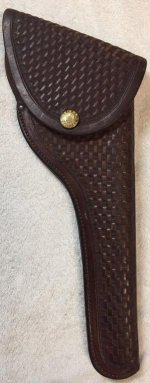
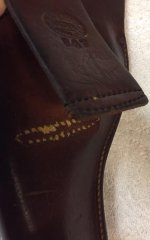
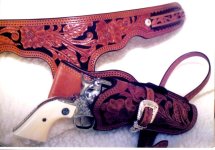
My newly acquired K22 needed some leather so I bought this one today. The holster is in fairly good shape with the exception of the stitching on the belt flap which I intend to repair.

What I need to know is the original thread used cotton or nylon.
I'd like to keep it as true to form as possible.

Thanks
 

Attachments

  • HH 1.jpg
    HH 1.jpg
    38.8 KB
  • HH2.jpg
    HH2.jpg
    30.8 KB
Touch a lighter or match to some of the bad thread. If it quickly melts, it's nylon. If it just smolders and turns black, it's linen or some other natural material. It's likely waxed linen or something similar on a holster that old.
 
Last edited:
Touch a lighter or match to some of the bad thread. If it quickly melts, it's nylon. If it just smolders and turns black, it's linen or some other natural material. It's likely waxed linen or something similar on a holster that old.

Very correct, yet it's even easier. No holster company used nylon except Chic Gaylord and Paris Theodore until the late 1970s. (P.S. Heiser was gone by then).

One wonders why Chic chose it so early on. Multifilament heavy cords like that likely were created for parachutes and the like and holsters weren't know to fail at the welt particularly. At Bianchi it was blowing out the welts whilst shaping the steel-reinforced Ojala type holsters, that forced us to come up with a solution. It worked and we changed over everything. The old stitching machines tended to wear out the parts that the thread ran through though. Chic and Paris did not use saddlery machines to likely it was their appearance from the rag trade that caused them to use synthetic threads.
 
Last edited:
I have not received the holster yet so there is no way for me to test the thread. I suspected it was a cotton/linen thread due to the failure, I doubt that nylon would have failed like that.
 
I'm glad you bought that holster. I had it on my watch list, and almost pulled the trigger on it. Then I got to looking at the pile of holsters I have and talked myself out of it. :D

If you can find a shoe repair shop, they should be able to restitch that in less time than you'd think. I've had a few older ones restitched by a young lady that works at a local farm supply store. She was going to charge me $10, but I gave her 20 because she did a real good job.

Mark
 
I'm glad you bought that holster. I had it on my watch list, and almost pulled the trigger on it. Then I got to looking at the pile of holsters I have and talked myself out of it. :D

If you can find a shoe repair shop, they should be able to restitch that in less time than you'd think. I've had a few older ones restitched by a young lady that works at a local farm supply store. She was going to charge me $10, but I gave her 20 because she did a real good job.

Mark

Thanks, I almost passed on it but the holster looked to be in pretty good shape with the exception of the belt flap. I've done a bit of leather work in the past and think I'll be able to repair it without to much difficultly.
When I get it done I'll post up some pics of the repair and the K22 that I bought from a member here. I've given the K22 some TLC and it turn out nice, I'm hoping the holster does the same.
 
I recently had this Heiser restitched by a very experienced shoe repairman. For $20 I was thrilled with the results!

b4daa7229b543601da3e6e9c6cd21591.jpg


3659a36e789c15e3a3a57d72113ad289.jpg


Sent from my iPhone using Tapatalk
 
OK, so its a full flap holster with the other side of the stitching concealed inside the holster. I'm trying to figure out how that can be fixed. Maybe using a short, curved needle and pliers to finish the stitch?
 
OK, so its a full flap holster with the other side of the stitching concealed inside the holster. I'm trying to figure out how that can be fixed. Maybe using a short, curved needle and pliers to finish the stitch?

While special needles for such tasks likely exist, when I've run into this problem, I had the wife remove the side seam stitching as well. I figured that thread likely isn't in the best shape, either, so we may as well replace it, too, while we're at it. Once the holster is opened up, stiching the belt loop is easy and done first.
 
OK, so its a full flap holster with the other side of the stitching concealed inside the holster. I'm trying to figure out how that can be fixed. Maybe using a short, curved needle and pliers to finish the stitch?

The side stitching was replaced any way so the belt strap was likely redone while it was open on Kalamazoo's rig; but the real comprehensive shoe shops, (that also repair cowboy boots), have some stitching machines that will sew to a blind side.

Redoing leather stitching and looking as original has a great deal to do with the "stitch-count" per inch; and many modern shops have machines that do not have the flexibility to adjust that count.
 
OK, so its a full flap holster with the other side of the stitching concealed inside the holster. I'm trying to figure out how that can be fixed. Maybe using a short, curved needle and pliers to finish the stitch?

If I don't have it done but a shoe repair shop ETC. and do it myself I'll use a S needle or a shortened harness needle and long needle nose plyers or forceps. The biggest advantage is the holes already exist and don't need to be punched.
 
I'll use a S needle or a shortened harness needle and long needle nose plyers or forceps.

Thanks, I can see how that would work. But how do you shorten a needle? Just for general knowledge. Of all the crazy things I've done in the past, especially to tools, it would be good to know. I've made wrenches by cutting and welding various wrenches. My best effort was making a short 9/16s out of an otherwise Craftsman box end. Oh, and it became an open end with the opening just big enough to allow it over a 3/8s clutch rod.

I can't imagine putting an new hole for the thread, so I assume you shorten it to use the now blunt end. Do you sharpen that end?

And I agree that using the current holes will make it much stronger than making all new ones and leaving the originals.
 
Thanks, I can see how that would work. But how do you shorten a needle? Just for general knowledge. Of all the crazy things I've done in the past, especially to tools, it would be good to know. I've made wrenches by cutting and welding various wrenches. My best effort was making a short 9/16s out of an otherwise Craftsman box end. Oh, and it became an open end with the opening just big enough to allow it over a 3/8s clutch rod.

I can't imagine putting an new hole for the thread, so I assume you shorten it to use the now blunt end. Do you sharpen that end?


And I agree that using the current holes will make it much stronger than making all new ones and leaving the originals.

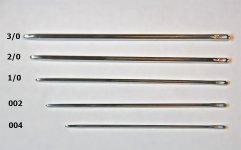
Harness needles really aren't that sharp to began with there meant to be used with existing holes. I'll just shorten one with a wire cutter and touch up the tip with a file.
 

Attachments

  • il_fullxfull_587950897_f29k.jpg
    il_fullxfull_587950897_f29k.jpg
    46.8 KB
Harness needles really aren't that sharp to began with there meant to be used with existing holes. I'll just shorten one with a wire cutter and touch up the tip with a file.

The ideal way to reconstruct your holster, is different and more difficult than anything mentioned so far; and yet you can get an 'original' result if you're willing.

Step one: run a (very) sharp knife down the centre of the leather welt that is inserted in the seam. Doing it this way, like breaking a china cup and regluing it with super glue, the irregular surfaces can be re-mated perfectly at reassembly. If instead you do the 'obvious', and run the knife blade down one side or the other of the welt, you're very likely to slice into the holster instead. This is very bad :-).

Step two: should be the hardest. Use needle-nosed pliers to remove the cut threads from both sides of the holster. If you're lucky, one side (usually the backside) will strip off in a complete set, spitting out bits of the looped thread that we call the 'knot' (though it's not really a knot, just a loop).

Step three: use the leather sewing needles, which are blunt-ended, and five cord linen/flax thread. Buy it either waxed from Tandy, or beeswax it yourself by drawing the thread through the lump of wax.

Step four: judging the length of the thread is no fun. There is a formula that I don't recall; it'll be somewhere on the web.

Step five: start the process with restitching the belt loop. Start at the point of the belt loop furthest from the line of sewing that forms the underside of the belt tunnel. The needles are on each end of the length of thread: one needle through the hole and pulled until both needles are rougnly equidistant from the hole. Both needles pass, one at a time, through the next hole; tighten; repeat. At the end, overlap the stitches.

Step six: for the welt, although glue may not have been used on the original, likely you'll want to use some. Personally I'd not get to hung up on using 'the' leather glue; a gel superglue will bond leather handsomely. Originally glue had to be used to prevent the moving surfaces from squeaking. I've had a few apart that used no glue anywhere, even for the linings.

Step seven: the sewing that you did for the belt loop: repeat for the welt. Begin at the muzzle end, ideally doubling that first stitch and continuing up the welt. Use needle nose pliers to grasp the needles and pull them through the original holes.

Not nearly as time consuming as it sounds; and a much more satisfactory result when you're done because -- no one will know until you tell them, that it's been restitched :-).
 
Oh yes, pics from a set I built for Joe Bowman yonks ago (he has passed away):

bowman jpegs (15).jpg It's new so the holes are drilled

bowman jpegs (3).jpg Closeup of the finished holster

bowman jpegs (2).jpg Joe in my backyard

The set, at his instructions, looks like a normal buscadero but the holster swivels; he did that (even built his own sets originally) so that he could tie the muzzle end down to his leg, but still walk and sit for interviews and demonstrations.
 
Last edited:
I'm a little confused Red are you suggesting that I split the holster open at the main seam sew the flap back in place and then re-sew it back together? The reason I'm confused is because there is no welt on the belt flap.
 
I'm a little confused Red are you suggesting that I split the holster open at the main seam sew the flap back in place and then re-sew it back together? The reason I'm confused is because there is no welt on the belt flap.

Sorry; yes, cut open the main seam's welt to get full access to the belt loop's end. Hand sew the belt loop's end, then glue and hand sew the main seam's welt afterwards :-).

To restore the luster to the welt after you've slit it and then restitched it, use a bit of fine sandpaper (not ultra fine wet n dry, just fine sandpaper) lightly; then dampen it with a sponge and use a Sharpie barrel or similar to rub along it briskly. The leather will gloss right back up again and conceal the cutting you did.
 
Sorry; yes, cut open the main seam's welt to get full access to the belt loop's end. Hand sew the belt loop's end, then glue and hand sew the main seam's welt afterwards :-).

To restore the luster to the welt after you've slit it and then restitched it, use a bit of fine sandpaper (not ultra fine wet n dry, just fine sandpaper) lightly; then dampen it with a sponge and use a Sharpie barrel or similar to rub along it briskly. The leather will gloss right back up again and conceal the cutting you did.

I think I'll take your advice Red I received the holster today and the main seam is a little weak also. Actually the holster doesn't have a welt at the main seam which will make it even easier. The only thing I haven't decided on is removing the rivet or not, I think I could do the flap work even with the rivet in place.
 
I think I'll take your advice Red I received the holster today and the main seam is a little weak also. Actually the holster doesn't have a welt at the main seam which will make it even easier. The only thing I haven't decided on is removing the rivet or not, I think I could do the flap work even with the rivet in place.

Of course no welt! I'd lost track of your particular holster (you're only the OP, after all and therefore the purpose of the entire thread) and had the 457 on the brain, when I said 'welt'. Heiser didn't use them before introducing the 457 in '39. Nor in everything afterwards.
 
The leather seems to be in very good shape and the holster looks like it hardly ever got used and just sat around for years it's almost dead flat without shaping like it would have if a revolver had been stored in it.
 
OK I've got all the old thread out and need to order some new. Technical question we already established that linen would be period correct, what size? 4, 5 or 6 size, right or left twist. Twist probably isn't that big of a deal but size certainly would be.
 
OK I've got all the old thread out and need to order some new. Technical question we already established that linen would be period correct, what size? 4, 5 or 6 size, right or left twist. Twist probably isn't that big of a deal but size certainly would be.

You can actually determine this yourself :-). The number is a 'size' only in the sense that it is the number of threads twisted together; so the more threads, the larger the twisted strand. Twist the old threads in the reverse direction, and count the threads.

I would expect 4 cord (the correct term) on an old Heiser; nothing wrong with using 5 cord anyway; and I doubt that 6 cord was used. The reason is less than obvious: less thread fits on the bobbin, though the bobbin on saddle machine is huge (usual diameter but very long).

Therefore it is common for the 'bobbin' side (the backside of the holster on all but Gaylord and Theodore) to be one 'size' smaller: to fit more on the bobbin.
 
You can actually determine this yourself :-). The number is a 'size' only in the sense that it is the number of threads twisted together; so the more threads, the larger the twisted strand. Twist the old threads in the reverse direction, and count the threads.

I would expect 4 cord (the correct term) on an old Heiser; nothing wrong with using 5 cord anyway; and I doubt that 6 cord was used. The reason is less than obvious: less thread fits on the bobbin, though the bobbin on saddle machine is huge (usual diameter but very long).

Therefore it is common for the 'bobbin' side (the backside of the holster on all but Gaylord and Theodore) to be one 'size' smaller: to fit more on the bobbin.

Thanks Red I hope you don't mind me picking your brain. You are absolutely correct about the back side of the stitching holes being smaller I noticed that when I was removing the thread.
All the leather work I have done has been by hand and the holes are larger mostly using 000 harness needles which are way to large for this holster I'll get some smaller needles when I order the thread, I really want to return this holster to as original condition as possible.
 
Sorry this is off-topic, but

Oh yes, pics from a set I built for Joe Bowman yonks ago (he has passed away):

View attachment 327293 It's new so the holes are drilled

View attachment 327294 Closeup of the finished holster

View attachment 327295 Joe in my backyard

The set, at his instructions, looks like a normal buscadero but the holster swivels; he did that (even built his own sets originally) so that he could tie the muzzle end down to his leg, but still walk and sit for interviews and demonstrations.

I've been doing leather work for about 45 years, and this is incredibly high quality work. Absolutely beautiful.
 
Back
Top