information assistance requested

JEBar

Member
Joined
Jan 3, 2015
Messages
7
Reaction score
3
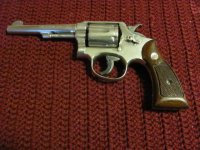
my compliments for the quality of the Sticky at the top of this thread which helps identify the pistol .... I learned more by reading it than I ever knew about a nickle plated S&W 38 Special (shown below) has been handed down in our family for many years .... it has fixed rear site with blade front .... 5 screw .... 5" barrel .... cylinder swings out to the left .... no model number on the frame where the cylinder is mounted .... no letter given with serial number .... serial number given 313291 .... as a side note, it was probably built/used in the corrosive primer days because the barrel does have some pitting

we would sincerely appreciate any info as to date of manufacture and/or any other info folks may care to share
 

Attachments

  • IMG_4389.JPG
    IMG_4389.JPG
    79.3 KB
Welcome to the Forum.
You have a Military and Police revolver. Millions were made since 1899, and it is still made. In 1957 all revolvers were given model numbers and this became the M10.
The Catalog gives a range for serial numbers of that era. I says #241,704 was from 1915 and #700,000 in 1942. It is ptobably from the early '20s.
Jim
 
That's a great gun, especially given its family history. I encourage you to shoot it often (assuming condition checks out OK) with any standard pressure 38 specials. It would love lead wadcutters or semi-wadcutters. A couple of notes: the stocks are from a much later period (1970s ?), it is possibly replated, and you may want to remove the trigger shoe (small allen wrench) to prevent any rust build up underneath. The trigger shoe was a popular add on in days gone by, but is now pretty much out of favor. Consider a careful scrubbing of the bore with a brass brush and gun oil.
 
Nice piece. Nobody else mentioned, but those are much later replacement grips. If the serial number does show it's from the 1920s, they would have looked like this (on my much less nice one):

newsmith1_zps97eb3db5.jpg
 
Welcome to the forum. Your family gun has had some upgrades and modifications over the years. Those stocks date from 1968 or later and they are probably much more comfortable to shoot with than the original service grips would have been. At some point a trigger shoe was added; this accessory is usually found on target revolvers with adjustable sights, but you can find them on service revolvers like yours as well. The ejector rod shaft may be a replacement. The original ejector rod at this time had a large mushroom shaped knob on the end; you can still see the cuts on the underside of the barrel that were designed to accommodate the larger diameter. The rod you have there now may be a replacement from a later era, in which case there is a chance that the cylinder might be a replacement as well. Or possibly the knob was simply unscrewed and misplaced, leaving the bare rod; I can't see the photo well enough to know. At some point -- and I don't at the moment recall when -- those parts began to be milled from single pieces of steel rather than screwed together from small parts.

From other serial numbers I know about I would guess that gun dates to 1919, shortly after commercial production was resumed following the end of WWI. The gun is probably safe to shoot, but I wouldn't load it up with high power stuff. I usually shoot nothing more powerful than 148 gr wadcutter target ammo in my .38s from the '20s and before. If the gun seems at all loose -- fore-aft movement of cylinder or more than just a tiny amount of rotational play -- I would have it checked out by someone who knows old revolvers.

The gun looks to me as though it was renickeled at some point. Perhaps it got the new stocks at the time that happened, but that's just speculation. Those stocks are sometimes called plainclothes stocks because of the rounded edges on the long axis; the theory is that the shape of the grip didn't make a gun so obvious under a sport coat. Standard stocks have a sharp corner there.

Is the serial number repeated on the flat underside of the barrel, the rear face of the cylinder, and the underside of the ejector star?

EDITED TO ADD: Ah, while I was writing JMace57 came in with the same observation about the grips. His photo also shows the ejector rod knob I mentioned.

SECOND ADDENDUM: And I completely read past Peak53's post as well. Apologies, guys.
 
Last edited:
Welcome to the Forum.
You have a Military and Police revolver. Millions were made since 1899, and it is still made. In 1957 all revolvers were given model numbers and this became the M10.
The Catalog gives a range for serial numbers of that era. I says #241,704 was from 1915 and #700,000 in 1942. It is ptobably from the early '20s.
Jim


welcome and info appreciated .... from the numbers you provided, 458,296 were produced in the 27 years from 1915 to 1942 which equates to about 17,000 per year .... 71,587 should have been made from the serial number started in 1915 .... that means ours was probably made in the 1919-1920 time frame .... the pretty well fits the passed down family history .... thanks again for taking the time and effort to answer
 
This one is easily dated. S&W began heat treatment of cylinders at SN 316648 in September 1919, so yours was made just prior to that. It does appear that the extractor rod may have been replaced, and the grips are from much later. You might check to see if the serial numbers on the butt, the bottom of the barrel, and the rear face of the cylinder match. It's OK to shoot, but only with lead-bullet standard velocity .38 Special ammunition.
 
Those stocks date from 1968 or later and they are probably much more comfortable to shoot with than the original service grips would have been.

good eye .... when it first appeared in the family it had white pearl grips .... they proved to chip rather easily so the grips shown where added sometime in the late 60's .... unfortunately, we have no clue what happened to the pearl grips


At some point a trigger shoe was added; this accessory is usually found on target revolvers with adjustable sights, but you can find them on service revolvers like yours as well.

the trigger shoe was added during that same time frame and has been on it every since .... with the blade front site and the small fixed rear "U" site, the shoe smoothed out the trigger pull and seemed to help with accuracy .... its been there every since

The rod you have there now may be a replacement from a later era, in which case there is a chance that the cylinder might be a replacement as well.

once again, good call .... about that same time lets just say that a green young fellow who got into hand loading made a mistake in overcharged a round .... the cylinder and rod were replaced by a gunsmith who checked the gun and certified it as being sound


The gun is probably safe to shoot, but I wouldn't load it up with high power stuff. I usually shoot nothing more powerful than 148 gr wadcutter target ammo in my .38s from the '20s and before.

suggestions on ammo selection appreciated .... I don't believe it will see heavy future use but will be taken out once in a while by our sons and grandson


If the gun seems at all loose -- fore-aft movement of cylinder or more than just a tiny amount of rotational play -- I would have it checked out by someone who knows old revolvers.

its probably had less than a hundred rounds fired through it in the last 40 years and is really tight .... no sign whatsoever of shaving bullets

The gun looks to me as though it was renickeled at some point. Perhaps it got the new stocks at the time that happened, but that's just speculation.

as noted, the cylinder is 40 some year years younger than the rest of the pistol .... when you take a close look you can see a difference in the finish one the cylinder and the rest of the pistol .... so far as, I know it has never been renickeled

Is the serial number repeated on the flat underside of the barrel, the rear face of the cylinder, and the underside of the ejector star?

there is a number there but it is entirely different for the serial number


thanks again .... I'm looking forward to passing all of this info on to the family
 
Last edited:
Consider a careful scrubbing of the bore with a brass brush and gun oil.

with no NASCAR race, :rolleyes: earlier today she was undergoing her yearly cleaning (hasn't been fired since the last thorough cleaning) when I decided to try and find out more about her .... the appearance of the inside of the barrel hasn't changed in the 60+ years since I first looked down it .... she's been well brushed with Hoppe's #9 and is clean but the stains from the corrosive primers haven't changed .... in the hands of someone who can shoot, she still groups well at 25 yards so the stains don't seem to have caused any problems with its performance
 
I haven't checked in for a while and simply wanted to revisit this forum so as to once again express my appreciation for the info above .... our Military and Police 38 Spl is still in the family and still sends a few rounds down range every now and then
 
Hi, JEBar and welcome back. In your last post back in 2015 you mentioned that your cleaning procedure includes using Hoppe's No 9. It has been observed by many that this solvent, while perfect for blue or stainless finishes, can attack nickel, especially it seems the nickel finishes used by S&W. I would go with one of the other equally effective bore cleaners... why run the risk with a family heirloom?

Regards,
Froggie
 

Latest posts

Back
Top