Kawasaki

Joined
Jun 3, 2010
Messages
423
Reaction score
624
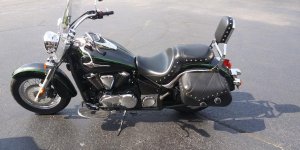
Broke down and bought this yesterday. It's a Vulcan 900. This is only the second bike I've ever owned, the other was a Suzuki 400 dual sport which hurt me to ride. Been doing a lot of research and this is kind of an entry level bike for me. It's a 2015 with a little over 3000 miles. I looked at some of the Harley's but apparently they're made of gold. I've signed up for a bike riders course so I can get my motorcycle license. Wish me luck.
 

Attachments

  • 20190511_100933~3(10).jpg
    20190511_100933~3(10).jpg
    105.9 KB
Broke down and bought this yesterday. It's a Vulcan 900. This is only the second bike I've ever owned, the other was a Suzuki 400 dual sport which hurt me to ride. Been doing a lot of research and this is kind of an entry level bike for me. It's a 2015 with a little over 3000 miles. I looked at some of the Harley's but apparently they're made of gold. I've signed up for a bike riders course so I can get my motorcycle license. Wish me luck.

Good for you. Get spare key made ASAP.
 
Good looking bike.

If your class isn't imminent, get your beginners permit right away and start practicing.

Key tip: look at where you want to go. Don't look down. Don't look at your bike. Don't look out front. For a u-turn, which will be on the test, look over your shoulder at where you want to go.

Second tip for test: motorcycle clutches and car clutches aren't the same. When doing low speed maneuvers on a bike, keep the engine revved and slip the clutch - it won't hurt it!
 
Second tip for test: motorcycle clutches and car clutches aren't the same. When doing low speed maneuvers on a bike, keep the engine revved and slip the clutch - it won't hurt it!

This is great advice but it is missing a key nugget -- some pressure on the rear brake is important for this maneuver. Drag the rear brake, slip the clutch and moderate with throttle, it "tightens" the whole bike up and gives excellent feel in low-speed turns and especially low-speed tight turns.

Try this, you'll be amazed.

Proficient Motorcycling by author David L. Hough is the finest book on street bike skill on the market. If you are the type that can read and digest, this is a fantastic purchase.
 
The test you take in Ohio to get the license most people would dump that bike somewhere during the test. Borrow something smaller from a friend to take the test on. That one won't cut it at all, at least here in Ohio. Sure an experienced rider could pass on it but it sounds like you aren't.
 
Don't go too small for a test. In MT, if you test on a motorcycle under 650 CC that is the maximum you can legally ride on. Testing on one over allows you to ride any size motorcycle. Prevents you from showing up on a 90 and purchasing a harley without showing proficiency.
 
Second tip for test: motorcycle clutches and car clutches aren't the same. When doing low speed maneuvers on a bike, keep the engine revved and slip the clutch - it won't hurt it!

A multi-plate motorcycle clutch works on very much the same principle as a manual clutch in an automobile. "Slipping the clutch" does cause excessive wear. The clutch is not used for speed control. Proper gear selection and the throttle are.
 
Nice bike! I have a Suzuki C50 and the weight and feel are much like the Kawi 900.
I know you'll enjoy it.
 
I second the recommendation on the book "Proficient Motorcycling" by author David L. Hough.

I started off on a Suzuki Volusia 805 (the current C50 Boulevard) and my riding buddy started out on a Kawasaki Vulcan 900. We used to swap off and ride each other's bike all the time and I really like the Vulcan. We put a lot of trouble free miles on those metric cruisers riding across most of the southern USA. For years we traveled to a different Civil War battlefield via motorcycle every spring and fall.

We have since upgraded from cruisers to touring bikes, he to a Honda Gold Wing and I with my Harley Electra Glide Ultra Classic. We still do trips to historic sights, Gettysburg is on our list this year, but the longer trips are a lot more comfortable on the touring bikes.
 
Last edited:
To re-familiarize yourself with riding do it in a low traffic area. If any of your friends have “dirt bikes” or smaller bikes that you could use in a vacant lot or parking lot, try that before whipping your new stead out in traffic. Bikes are great, I’ve been riding for over 50 yrs, just do what you need to do to be ready, when you’re ready.
 
Nice. The only motorcycle i ever owned was a 1973 Honda CL350. A big bike back in the day other than Harleys were 750cc. Think Kawasaki made a 900 back then. Loved riding! Long for those days again. At age 66 don't think I would trust myself on one now. Haven't been on one since 1979. I really like the retro looking Triumph Bonnevilles I have seen. Be careful out there.
 
Nice. The only motorcycle i ever owned was a 1973 Honda CL350. A big bike back in the day other than Harleys were 750cc. Think Kawasaki made a 900 back then. Loved riding! Long for those days again. At age 66 don't think I would trust myself on one now. Haven't been on one since 1979. I really like the retro looking Triumph Bonnevilles I have seen. Be careful out there.

I had a 1971 CL350 Honda bought new from R.E Garrett Sales & Service on Oak St. In New Orleans. Their factory exhaust systems had such a distinctive sound that I remember it to this day, some machines wind up being much more than the collection of their parts. Those “little” bikes were superb. Motorcycle collectors today know the appeal and importance of having a 350 Honda
 
Keep in mind that almost everything on the road is heavier than you; they are trying to run over you and even if you are in-the-right, you will be holding the short end of the stick. My most fun-filled bike was a 1961, 650cc, V-twin, Matchless.
 
Best of luck!! Whenever I hear Kawasaki it reminds me of the Mach 3 two stroke that came out around 69-70. One fast bike that loved to eat plugs. man what a sound from that bike.

For a 500cc motorcycle it certainly was fast, it’s raucous personality just added to the experience. It had a mind of its own, best to pull the trigger with nothing but straight road ahead
 
I think you chose a really good bike. It isn't to heavy yet not to light either. Kaw makes good bikes and the V-twins sound a lot like a Harley
Yes taking a riding class is a great idea. You have to respect a motorcycle at all times but if your thoughts are fears of going down then that is time to get off of bikes. 4 wheelers get full respect because they usually win in an accident. Loud pipes can cause people to notice you are on the road with them.
Motorcycles are a lot of fun as long as you ride smart. When I rode a motorcycle to commute to work I would always speed up to get out of a pack of 4 wheelers. I felt much safer riding ahead of traffic.
 
Last edited:
I had a 1971 CL350 Honda bought new from R.E Garrett Sales & Service on Oak St. In New Orleans. Their factory exhaust systems had such a distinctive sound that I remember it to this day, some machines wind up being much more than the collection of their parts. Those “little” bikes were superb. Motorcycle collectors today know the appeal and importance of having a 350 Honda

Yep ran like a top!! Had a 70 CB-350 with the blue/white tank. Bought new for $750 back then. Ended up with a used V-65 Magna. Thankfully nary a scratch and gave up riding 18 years back.
 
The CB was the twin down pipe exhaust Super Sport version. They also had a slightly higher redline than did the CL’s due to a perceived better flowing exhaust.

Sorry op for the nostalgic thread jacking
 
I had been riding for several years when I took the MRC in 1982, still learned some things from it, some of which carried over to driving a car as far as collision avoidance.

The Kawasaki 900 is a good bike that will take you places. Enjoy, ride safe.
 
Keep in mind that almost everything on the road is heavier than you; they are trying to run over you and even if you are in-the-right, you will be holding the short end of the stick. My most fun-filled bike was a 1961, 650cc, V-twin, Matchless.

Had a Matchless 650 single for a while, great bike!
 
A multi-plate motorcycle clutch works on very much the same principle as a manual clutch in an automobile. "Slipping the clutch" does cause excessive wear. The clutch is not used for speed control. Proper gear selection and the throttle are.


Actually, you are both right. In normal riding, use the clutch as you would a car clutch, without slipping it. But the MSF teaches a slow riding technique that I call trickling. With the motor at an idle, or just above, if necessary, ease the clutch in to move the bike forward, pull the lever to stop. It is a great drill for beginners to give them a feel for the engagement point.

Ride all around the range, using the clutch to start and stop the bike. Most bikes in good tune will tolerate this. Some lack the necessary torque at idle, and need a very light application of throttle. The clutch slips a little, but it is not abusive.

The other case that calls for deliberately slipping the clutch is off-road. On a steep climb, you may lose enough speed that you are in too high a gear, while, for any number of reasons, you are unable to downshift. Fanning the clutch while applying throttle will get the engine up into a rev range where there is more torque, and the bike will climb where it otherwise would bog down. Yes the clutch will slip, and you may well consider friction discs to be a consumable item, even though you might put 200,000 miles on a street without replacing the clutch.

I assume the OP’s Suzuki 400 is the DRZ-S. It is actually a wonderful touring bike, for the right conditions, but I would not presume to tour one without a custom seat, or at least some modifications. Something like Sweet Cheeks, a cordura throwover device, uses plastic water bottles to support the inner thighs. It can add many, many miles to your touring day.

To tell the truth, very few stock seats, even on touring bikes, are up to the rigors of serious touring.
 
Last edited:
"Ride like you are invisible" and a little faster than the other people around you.

Most drivers will never even see you, so be safe and have fun out there.

This advise was given me 45 years ago, and it's a gem.

"Pretend you are invisible." The guy that turns left in front of you, or the woman who pulls out in front of you, just simply doesn't see you.

I had two incidents in the past 3 years where people have pulled out in front of me. I survived both (had to leave the road once) because I saw them and thought, "They could pull out in front of me." Believing they wouldn't pull out because I had the right of way would have gotten me killed.

The man who pulled out caught me at a traffic light and apologized. The woman who pulled out, to this day I don't think she even knew that she had run me off the road. Completely oblivious. Completely invisible I was to her.
 
Had a Matchless 650 single for a while, great bike!

The Matchless Typhoon. (600) What a beauty!
I had a ‘54 Norton 500 single. That was a stump puller. The last rigid frame, with Roadholder forks.

I also suggest the OP study “the Proficient”.

Marshwheelings advice is right on the money.

My 2 cents is use a battery charger when you’re garaged... nothing destroys the sprag clutch starter more than low voltage.
 
Last edited:
This is great advice but it is missing a key nugget -- some pressure on the rear brake is important for this maneuver. Drag the rear brake, slip the clutch and moderate with throttle, it "tightens" the whole bike up and gives excellent feel in low-speed turns and especially low-speed tight turns.

Try this, you'll be amazed.

This is golden advice. Seen so many people drop bikes from using the front brake in low speed turns. The rear brake is your friend even in high speed turns and curves.

If you're going into a curve and find your going a little too fast for it, if you panic and grab the front brake the bikes not gonna like it very much...feather the back brake and you'll be fine.

The looking where you want to go is also a golden rule. The bike will go where you look. When I started riding around 40 years ago, there was a super tight curve with a guard rail on the side, at first I'd always focus on not hitting that guard rail and would always get too close and have to brake. A friend told me about looking where you want to go, and that guard rail never bothered me again.

If your going down a road and there are two massive pot holes 8" apart with no where else to go, if you focus on the pot holes your gonna get one. If you focus on that 8" spot between them that's exactly where you'll go.
 

Latest posts

Back
Top