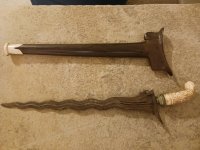
Kris Knife

Joined
Mar 21, 2021
Messages
1,859
Reaction score
9,529
City & State/Province
Sherman, Texas
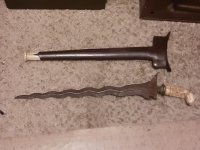
Have 3 old knives I would like some info on. Age, value, origin, etc.
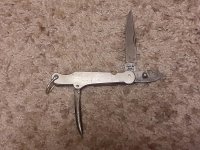
The folding knife says Encore, Oil Joints and Sheffield on the small blade. Large blade say Case XX, USA and has 10 dots I think. Seems someone told me the dots tell the age.
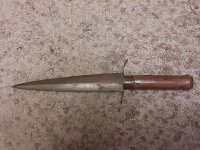
2nd knife looks to me like it is made of brass. My dad always thought it was Confederate. Maybe a powder knife or some such.
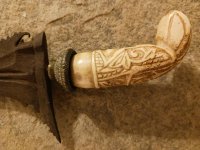
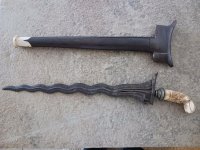
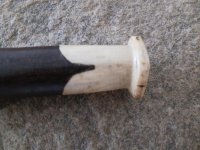
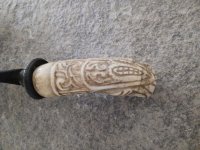
3rd knife looks to me like a bone or ivory handle and tip on the sheath.
Any information appreciated.

Since the thread ended up being just about the kris knife I changed the thread title.
 

Attachments
  • 20210702_093332.jpg
    20210702_093332.jpg
    138.1 KB
  • 20210702_093444.jpg
    20210702_093444.jpg
    138.2 KB
  • 20210702_093612.jpg
    20210702_093612.jpg
    93.6 KB
Last edited:
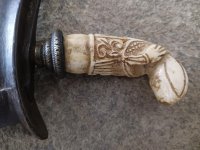
First knife is a sailor's knife with a marlin spike to work rope. Middle knife, I haven't a clue, especially if it's made of brass. Third knife is a kris, I think Indonesian. I remember when kris daggers were on sale as tourist knives, although don't know about yours. You can look it up.
 
Have 3 old knives I would like some info on. Age, value, origin, etc.
The folding knife says Encore, Oil Joints and Sheffield on the small blade. Large blade say Case XX, USA and has 10 dots I think. Seems someone told me the dots tell the age.
2nd knife looks to me like it is made of brass. My dad always thought it was Confederate. Maybe a powder knife or some such.
3rd knife looks to me like a bone or ivory handle and tip on the sheath.
Any information appreciated.


"Oil the Joints" is a famous George Wostenholm/Sheffield slogan. Why would it be on a Case knife? That's very odd. A contract knife??


--------------------
 
Last edited:
I don't think the "Case" knife is really a Case. I think it is an English (Sheffield) knife that has had the master blade replaced with a Case blade.

This is a link to what a Case metal riggers knife should look like.
Case XX Antique Rigging Knife Stainless Steel

A Case 10 dot would have been made in 1970
 
Last edited:
I don't think the "Case" knife is really a Case. I think it is an English (Sheffield) knife that has had the master blade replaced with a Case blade.

This is a link to what a Case metal riggers knife should look like.
Case XX Antique Rigging Knife Stainless Steel

A Case 10 dot would have been made in 1970

I'm guessing the thumb stud on the reamer blade could be one of the first of it's type, though pretty common these days. Just an armature's guess.
 
I don't think the "Case" knife is really a Case. I think it is an English (Sheffield) knife that has had the master blade replaced with a Case blade.

This is a link to what a Case metal riggers knife should look like.
Case XX Antique Rigging Knife Stainless Steel

A Case 10 dot would have been made in 1970


Great detective work! What's being referred to in that ad as a "reamer" is actually an early version of a can opener. The stud is used not only to facilitate opening the blade, but for use as a fulcrum when using it to open cans.
 
.

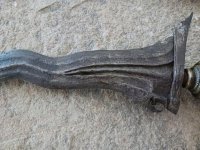
Some tips on researching this would be appreciated. Did a search of kris and found a knife that looked similar that had an asking price of $1295. Said it was Indonesian and made about 1850. It was in better condition than mine. Think my trim is either ivory or bone. Do you have an opinion?
 
Hi David, it is difficult / challenging to render an opinion or more direction, without better photos. Please post them if you have a chance.

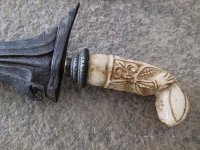
My 'gut feeling' is that it is late 1800s fittings--handle and scabbard--but that the blade has more age to it, based on the design and characteristics. It was a fairly common practice on these and around the world in other cultures to 'repurpose' a blade and fit it in new, serviceable hardware for the time period. My guess is ivory (do you see lines in the material or is it porous when looking closely or under magnification?); it is challenging to guess with the one photo not being optimal. I am also really hesitant to state a value not knowing all the facts/particulars, but should everything check out, north of $1K should be readily attainable on a resale / market basis.

If you are able to post or message me, I can further review.
 
TheHobbyist,
Here are some more pics. I know my photography is not very good. If these don't help I will try to take some more tomorrow with natural light.

attachment.php


attachment.php


attachment.php


attachment.php


attachment.php
 

Attachments

  • 20230916_194806.jpg
    20230916_194806.jpg
    143.4 KB
  • 20230916_194748.jpg
    20230916_194748.jpg
    96 KB
  • 20230916_194657.jpg
    20230916_194657.jpg
    116.9 KB
  • 20230916_194846.jpg
    20230916_194846.jpg
    145.3 KB
  • 20230916_194832.jpg
    20230916_194832.jpg
    100.1 KB
Last edited:
Looks like ivory to me but I’m not an expert.

You can test it to find out. Heat a little sewing pin red hot then apply it to an inconspicuous spot (don’t push hard!) and smell the resulting smoke. Hold the pin in pliers. If it smells like burnt hair, it’s ivory.
 
Pics in natural light. Also put a little oil on the blade and wiped it down.

attachment.php


attachment.php


attachment.php


attachment.php
 

Attachments

  • 20230917_130228.jpg
    20230917_130228.jpg
    147.7 KB
  • 20230917_130219.jpg
    20230917_130219.jpg
    152.1 KB
  • 20230917_130159.jpg
    20230917_130159.jpg
    130.4 KB
  • 20230917_130214.jpg
    20230917_130214.jpg
    123.2 KB
Last edited:
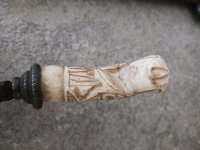
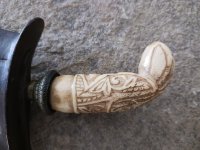
Cannot render an opinion on the first two, but the third appears to be a pre-1900 Kriss from either Indonesia or Malaysia, and less possibly the Philippines. Pressed for an answer, I'd say Indonesia.

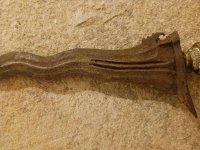
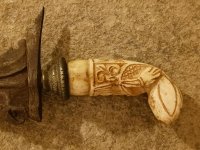
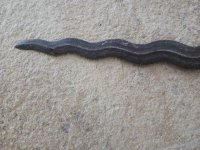
The engraving on the fittings and carving of the grip and chape would indicate it was made, or an older ancestral blade reconfigured for, a person of wealth and staus. Unless I miss my guess the blade would be pattern welded damascus. You would want to be VERY careful in cleaning it as that can reduce value seriously if not done correctly.

I'd have that one professionally appraised but assuming authentication of ivory and age, I'd estimate north of $1000-1500 in value.

Thanks for sharing them, and I'd add that the Kriss certainly presents well and has great character.
 
Last edited:
The museum where I volunteer has several Kris knives from the Philippines. Similar details on the hilt of yours. None of ours has a metal sheath.

Given the condition of the blade, I agree that it is probably 19th century.

If you Google Kris with metal sheath and click images, there are many similar to yours and most are considered Indonesian.
 
The short blade on the folder is a can opener, among other things. Poke the blade into the can, rest the stud on the rim, and lever the blade upward. I have never used one, so I have no idea how well they work. I don’t think anybody makes can openers like that any more, which could tell you something.
 
You rotated the handle on the Kris when you oiled it.
Post more pics of the handle and scabbard tip on all sides.
 
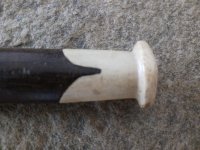
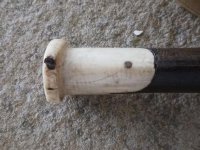
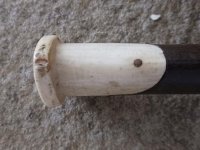
pics of the tip

See some of the pics not real clear. LMK if better needed.

attachment.php


attachment.php


attachment.php


attachment.php


attachment.php
 

Attachments

  • 20230918_123907.jpg
    20230918_123907.jpg
    109.7 KB
  • 20230918_123916.jpg
    20230918_123916.jpg
    102.6 KB
  • 20230918_124035.jpg
    20230918_124035.jpg
    132.6 KB
  • 20230918_124047.jpg
    20230918_124047.jpg
    77.7 KB
  • 20230918_124001.jpg
    20230918_124001.jpg
    34.4 KB
Last edited:
pics of the handle

attachment.php


attachment.php


attachment.php


attachment.php
 

Attachments

  • 20230918_123811.jpg
    20230918_123811.jpg
    118.6 KB
  • 20230918_123745.jpg
    20230918_123745.jpg
    90.3 KB
  • 20230918_123832.jpg
    20230918_123832.jpg
    76.6 KB
  • 20230918_123734.jpg
    20230918_123734.jpg
    88.7 KB
Last edited:
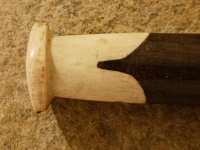
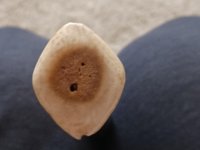
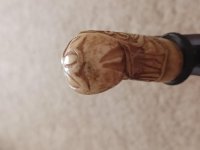
Butt of the handle.

The materials look similar to me. My guess is the handle is bone also.

attachment.php
 

Attachments

  • 20230918_140154.jpg
    20230918_140154.jpg
    31.9 KB
Last edited:
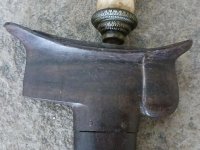
Inusuit,
Not a metal sheath. A dark wood. Maybe this pic will show it better.

attachment.php
 

Attachments

  • 20230918_141430.jpg
    20230918_141430.jpg
    119.5 KB
Last edited:
Thanks for the information.
To summarize, my kris knife;
Is probably Indonesian
19th Century
Bone handle and sheath tip

One more question. What kind of bone?
My guess is an antler of some kind.
Was reading on the internet that bone in USA might be cow bone.
 
Last edited:
There are several species of deer in Indonesia. Our museum has several edged weapons from the Philippines with handles that are clearly antler but I don't know the species.
 
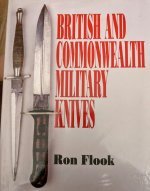
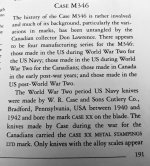
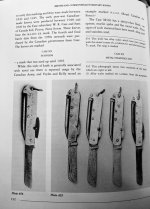
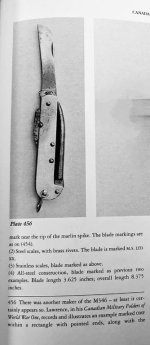
During and after WWII, the. Canadian armed forces procured knives from different sources, including "Knife, Clasp, with Marlin Spike and Tin Opener" from W.R. Case. Like all British Commonwealth territories, they followed British Department of Defense guidelines, and so you see some "clasp" knives from Canada, Australia, etc. (as well as Great Britain, of course) with the "0il the Joints" making. See attached for more details.
 

Attachments

  • PXL_20231011_030754446.MP~2.jpg
    PXL_20231011_030754446.MP~2.jpg
    60.1 KB
  • PXL_20231011_025834921.jpg
    PXL_20231011_025834921.jpg
    91.4 KB
  • PXL_20231011_030153319.jpg
    PXL_20231011_030153319.jpg
    71 KB
  • PXL_20231011_030206936~2.jpg
    PXL_20231011_030206936~2.jpg
    36 KB
Back
Top