
You are using an out of date browser. It may not display this or other websites correctly.
You should upgrade or use an alternative browser.
You should upgrade or use an alternative browser.
Lend Lease
- Thread starter doc540
- Start date



Absalom
SWCA Member, Absent Comrade
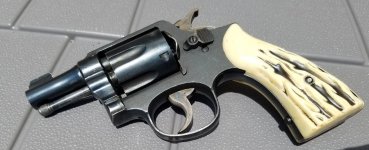
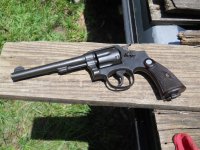
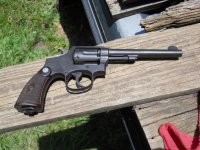
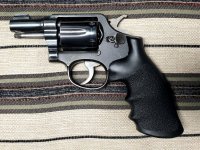
An interesting one. The serial makes it a pre-Victory from spring 1942. It would have been modified after coming back.
Looks like the frame might still have the original finish. Hammer and trigger look unmolested original. But the barrel is both cut and standard blue, with a resoldered filed-down front sight, so whether it’s the original depends on what serial is on the underbarrel flat.
With the bulged cases, the cylinder was originally .38 S&W. Does the cylinder serial match the butt serial?
Looks like the frame might still have the original finish. Hammer and trigger look unmolested original. But the barrel is both cut and standard blue, with a resoldered filed-down front sight, so whether it’s the original depends on what serial is on the underbarrel flat.
With the bulged cases, the cylinder was originally .38 S&W. Does the cylinder serial match the butt serial?

tenntex32
Member
What caliber is it, .38/200?
It was originally marked .38S&W, caliber wise. Yes .38/200 type ammo is what the Brits may have used in it.
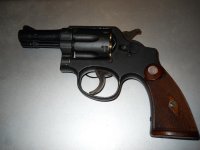
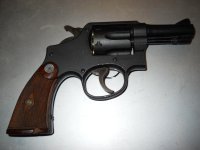
I am assuming you now know that the chambers have been altered/lengthened to accept the longer cased .38spl ammunition.
The bulge you see is due to .38S&W ammo having a slightly larger case diameter than .38spl. The .38S&W ammo also had a slightly larger bullet diameter than .38spl.
I have no way of knowing if the lengthening of the chambers will diminish the accuracy if using .38S&W ammo...….but it surely couldn't help accuracy if now using .38S&W!
Dale
Last edited:

krsmith58
Member
Victory Model
congrats on your Victory model . the history behind them really appeals to some including me .
i have one that the same thing was done to . I've only shot 1 cylinder of 38 specials through it . the brass looked the same as yours . I bought 38 S&W from SGAmmo.com . a little more expensive than 38 special but I didn't care for the way the special brass was deformed or reformed or how ever else to describe it . mine seemed to be accurate enough with specials and I couldn't tell any difference with the 38 S&W but like I said I only shot one cylinder . that is the revolver I was researching a year ago that led me to this site and woke up a sleeping interest in S&W revolvers that I can't seem to satisfy . nice catch , Kenny
congrats on your Victory model . the history behind them really appeals to some including me .
i have one that the same thing was done to . I've only shot 1 cylinder of 38 specials through it . the brass looked the same as yours . I bought 38 S&W from SGAmmo.com . a little more expensive than 38 special but I didn't care for the way the special brass was deformed or reformed or how ever else to describe it . mine seemed to be accurate enough with specials and I couldn't tell any difference with the 38 S&W but like I said I only shot one cylinder . that is the revolver I was researching a year ago that led me to this site and woke up a sleeping interest in S&W revolvers that I can't seem to satisfy . nice catch , Kenny
Attachments

Targets Guy
US Veteran
I am two for three on brass bulging with .38/200 conversions. My Cogswell & Harrison was done very well.


It shipped 4/1942.
My Parker-Hale conversion was also excellent. They sleeved the cylinder chambers.


no noticeable bulging.
The last one was done by an unknown outfit. Not such a good job so I only shoot .38SWs out of it now.

It shipped 4/1942.
My Parker-Hale conversion was also excellent. They sleeved the cylinder chambers.
no noticeable bulging.
The last one was done by an unknown outfit. Not such a good job so I only shoot .38SWs out of it now.
Targets Guy
US Veteran
Here are the culprits.......
Cogswell & Harrison, shipped 4/1942

Parker-Hale conversion, shipped Jun 1941

Unknown company, shipped Dec 1941

I removed the 4" S&W .38 special barrel and put a 5" .38SW Victory barrel on it and now it looks like this

Cogswell & Harrison, shipped 4/1942
Parker-Hale conversion, shipped Jun 1941
Unknown company, shipped Dec 1941
I removed the 4" S&W .38 special barrel and put a 5" .38SW Victory barrel on it and now it looks like this
Targets Guy
US Veteran
The Parker Hale is the best shooter among them
 forum photo hosting
although I've gotten pretty good picking off English walnuts with the Cogswell Harrison.

forum photo hostingalthough I've gotten pretty good picking off English walnuts with the Cogswell Harrison.
tenntex32
Member
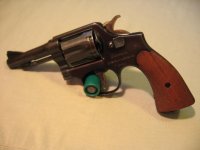
Plot thickens
Gunsmith mic'ed the cylinder and chambers today.
It appears to have been expertly and intentionally bored slightly larger than .38 S&W.
Gunsmith surmises that someone wanted a snub nose with safe-to-shoot .38 Specials that would make for quick Speed Loader reloads and empty dumps.
I won't argue with your gunsmith...…...but I have seen way too many converted BSR examples that did the exact same thing due to a simple lengthening of the chambers to accept .38spl ammo. I doubt it was done for any tactical reload purposes.
I even owned a decent looking "38spl" Cogswell & Harrison conversion for a while that also had the simple lengthening of the chambers...……..as well as a shortened barrel. It too did the same exact thing with regards to the cases bulging. No splits, albeit I never ran any hotter .38spl+P through it.
Dale
Attachments
Last edited:

You can also try .38 S & W ammo in it, readily available at about $20 per 50 rounds.
As mentioned above the lack of chamber shoulders may make accuracy suffer, but the brass should not expand.
As mentioned above the lack of chamber shoulders may make accuracy suffer, but the brass should not expand.

DWalt
Member
- Joined
- Dec 19, 2009
- Messages
- 36,645
- Reaction score
- 33,863
- City & State/Province
- South Texas & San Antonio
Plot thickens
Gunsmith mic'ed the cylinder and chambers today.
It appears to have been expertly and intentionally bored slightly larger than .38 S&W.
Gunsmith surmises that someone wanted a snub nose with safe-to-shoot .38 Specials that would make for quick Speed Loader reloads and empty dumps.
Hundreds of thousands of surplussed-out BSRs received that same rechambering treatment back in the 1950s and 1960s to make them more salable to Americans, as .38 Special ammunition was far more common than .38 S&W. No one had even heard of speedloaders back then.
DWalt
Member
- Joined
- Dec 19, 2009
- Messages
- 36,645
- Reaction score
- 33,863
- City & State/Province
- South Texas & San Antonio
What we do know is that an enormous number of these chopped and rebored BSRs exist and there is nothing noteworthy about them.
tenntex32
Member
Even the 38 S&W chambers are slightly too loose.
That's why my gunsmith thinks it was intentionally machined that way for speedloaders.
Your gunsmith is just not schooled up with regards to converted BSR examples is all this is.
Now think for a second about wartime expediency and manufacturing. The tolerances were probably a bit looser due to the dire situation.
It would not be uncommon to find BSR examples with chambers a bit larger than expected, exactly as expected, or a bit tighter than expected as tooling went from being brand new to well worn.
I doubt the 38S&W round was hot enough to generate much concern with regards to chambers being a bit on the larger side of the spec.
Wartime chamber specs tend to have more variance than typical commercial peacetime produced guns...…..and probably for good reason.
Dale
Last edited:
What we do know is that an enormous number of these chopped and rebored BSRs exist and there is nothing noteworthy about them.
That's most helpful.
What will be "noteworthy" is for less money than an RG Industries revolver I'll have a fine shooting, smooth action, .38 that is nearly 80 years old and will be back in service.
This will be the first handgun my students will have ever fired.
And it will be a delightful and encouraging experience for them which they will note and remember for the rest of their lives.
Absalom
SWCA Member, Absent Comrade
Wartime chamber specs tend to have more variance than typical commercial peacetime produced guns...…..and probably for good reason.
And let’s not forget, even on peacetime guns, tolerances weren’t that exacting. The “old-time craftsmanship” some folks like to wax about poetically wasn’t all it’s cracked up to be. You can find quite a few older .38 Special revolvers (not of wartime vintage) that will fully chamber .38 S&W cartridges, sometimes only on a few chambers and not the others.
needsmostuff
Member
As a professional trainer something you should look at.
One thought that has not reared it's ugly head is the gun's safety after being shortened to that point.
The forward , under barrel detent latch was removed ! Muy Malo !
This is not a meaningless system and is one of only two things that keep the cylinder closed and in alignment with the barrel.
This , coupled with the bullets possibly wobbling as they leave a cylinder with oversized chambers is a perfect recipe for lead to spit sideways.
If your students eyes and fingers and or your liability are important to you , find another gun!
It is important .
ANY gunsmith versed in safe to fire revolvers should have red flagged this revolver on the spot.
Sorry , sounds harsh but a bad situation cannot be sugar coated.
One thought that has not reared it's ugly head is the gun's safety after being shortened to that point.
The forward , under barrel detent latch was removed ! Muy Malo !
This is not a meaningless system and is one of only two things that keep the cylinder closed and in alignment with the barrel.
This , coupled with the bullets possibly wobbling as they leave a cylinder with oversized chambers is a perfect recipe for lead to spit sideways.
If your students eyes and fingers and or your liability are important to you , find another gun!
It is important .
ANY gunsmith versed in safe to fire revolvers should have red flagged this revolver on the spot.
Sorry , sounds harsh but a bad situation cannot be sugar coated.
Last edited:
DWalt
Member
- Joined
- Dec 19, 2009
- Messages
- 36,645
- Reaction score
- 33,863
- City & State/Province
- South Texas & San Antonio
Your gunsmith is just not schooled up with regards to converted BSR examples is all this is.
I'd agree, at least to the extent that he may not understand the case diameter difference between the .38 Special and .38 S&W cartridges. After all, at least today, there are many knowledgeable shooters who are completely unfamiliar with the old .38 S&W cartridge and the extent to which the BSRs had their cylinders elongated to accept .38 Special cartridges.
I have no opinion about the safety of a chopped BSR given that the under-barrel lug to support the extractor rod has been eliminated. I have not heard of any consequences, but I would recommend not using any ammunition other than standard velocity .38 Special ammunition in one.
To most in this area of the forum, a BSR snubby is best relegated to use as a truck/car or nightstand gun so that if it is stolen, there is no big loss. They are fully adequate for such purposes, noting that Lee Harvey Oswald allegedly used one to kill Officer J. D. Tippett of the Dallas PD immediately after the JFK assassination.
I have seen .38 Special and .357 Magnum revolvers which can chamber .38 S&W cartridges, but most will not. I can say the same about .38 Super cartridges.
Last edited:
tenntex32
Member
The fact that it has a S&W logo on the sideplate is a strong buying point for some folks. When I finally decided to part with my converted BSR example I looked at what average buying prices were and added some wiggle room in my favor for haggling. I told the shop owner exactly what it was when he listed it as a consignment piece, as I didn't want him getting an earful from anybody that may have tried to return it. I even placed a hangtag on it describing it as such so that anyone who picked it up could read exactly what it was.
It sold for my original price. He said the buyer never tried to talk him down. Now my example, while having a shortened barrel, did still have the locking lug on the barrel, so maybe they buyer's concern was less due to that.
Dale
It sold for my original price. He said the buyer never tried to talk him down. Now my example, while having a shortened barrel, did still have the locking lug on the barrel, so maybe they buyer's concern was less due to that.
Dale
Even a rube like me understands (as did my gunsmith) that cylinder lock up to forcing cone alignment is what's important here.
It's perfectly within specs.
That the brass end of the cylinder may be sloppy by a thousandth or so (as noted above due to tens of thousands of cylinders being bored by machines at varying times in their useful life) has no bearing whatsoever on safety.
The exposed extractor rod is of no consequence to safety just as it's no consequence on the various early Colt Agents I've owned.
It's a .38 S&W.
The barrel modification was well done.
The bullet ends of all six cylinders are exactly .357.
It's safe.
It will make a fine shooter and a fine training piece.
Not to be harsh.
It's perfectly within specs.
That the brass end of the cylinder may be sloppy by a thousandth or so (as noted above due to tens of thousands of cylinders being bored by machines at varying times in their useful life) has no bearing whatsoever on safety.
The exposed extractor rod is of no consequence to safety just as it's no consequence on the various early Colt Agents I've owned.
It's a .38 S&W.
The barrel modification was well done.
The bullet ends of all six cylinders are exactly .357.
It's safe.
It will make a fine shooter and a fine training piece.
Not to be harsh.
tenntex32
Member
Just something to chew on...…………..Colt cylinders turn clockwise nudging the cylinder/crane assembly into the frame.
S&W cylinders turn counterclockwise nudging the cylinder/yoke assembly away from the frame, hence why S&W went with an additional front locking lug and why Colt did not feel the need for such.
At one time S&W even felt the need for 3 locks...……….
I would think that if it truly didn't need to be there and would pose no safety issues S&W would have gotten rid of it a long time ago as a costcutting measure. The reason it has remained is most likely due to safety and liability.
You are comparing apples to oranges by using Colt in your reasoning.
Sounds like you have a handle on things though.
Dale
S&W cylinders turn counterclockwise nudging the cylinder/yoke assembly away from the frame, hence why S&W went with an additional front locking lug and why Colt did not feel the need for such.
At one time S&W even felt the need for 3 locks...……….
I would think that if it truly didn't need to be there and would pose no safety issues S&W would have gotten rid of it a long time ago as a costcutting measure. The reason it has remained is most likely due to safety and liability.
You are comparing apples to oranges by using Colt in your reasoning.
Sounds like you have a handle on things though.
Dale

"The barrel modification was well done."
Point of order : The barrel has been shortened in such a way as to eliminate the ejector rod locking lug. IMO opinion , that negates "well done".
Nothing personal OP , just one man's opinion.
Point of order : The barrel has been shortened in such a way as to eliminate the ejector rod locking lug. IMO opinion , that negates "well done".
Nothing personal OP , just one man's opinion.

Kurusu
Absent Comrade
And let’s not forget, even on peacetime guns, tolerances weren’t that exacting. The “old-time craftsmanship” some folks like to wax about poetically wasn’t all it’s cracked up to be. You can find quite a few older .38 Special revolvers (not of wartime vintage) that will fully chamber .38 S&W cartridges, sometimes only on a few chambers and not the others.
And I have also found this in recent and new revolvers. Both .38 spl and .357 Mag.
gmarshall99
Member
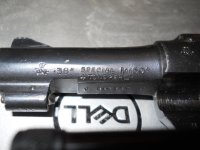
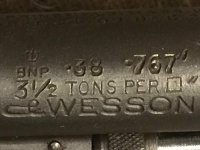
Sorry to butt into this discussion, but i was wondering if someone could tell me what the 4 ton stamping on the barrel means? 'm looking at a revolver that has a similar _Ton marking
Absalom
SWCA Member, Absent Comrade
Sorry to butt into this discussion, but i was wondering if someone could tell me what the 4 ton stamping on the barrel means? 'm looking at a revolver that has a similar _Ton marking
"4 tons per square inch" was the pressure standard for .38 Special commercial proofing at the Birmingham and London proofhouses. For .38 S&W (British), it was 3.5 tons.
Attachments
gmarshall99
Member
Thats what this one that I'm looking at says "3 1/2 tons. Thanks!!
Gary
Gary
DWalt
Member
- Joined
- Dec 19, 2009
- Messages
- 36,645
- Reaction score
- 33,863
- City & State/Province
- South Texas & San Antonio
When the British sold off the surplus military Victories to the civilian market in the 1950s-60s, British law required they be proof-tested first.
Similar threads
Expired/Withdrawn
Lanyard Swivel for Victory, Lend-Lease, 1917
- Replies
- 0
- Views
- 60
- Replies
- 2
- Views
- 690
- Replies
- 13
- Views
- 850


- Locked
- Replies
- 3
- Views
- 578
- Replies
- 6
- Views
- 841


