

You are using an out of date browser. It may not display this or other websites correctly.
You should upgrade or use an alternative browser.
You should upgrade or use an alternative browser.
Low Serial Victory Model
- Thread starter GRI
- Start date


Mistered
Member
I have V120XXX
OP
GRI
Member
I have V120XXX
I think you mis-read my post. The whole number is V729.
Mistered
Member
Got it! That IS low!The whole number is V729
OP
GRI
Member
Got it! That IS low!
Thanks, very early, the gun was made 24/25 April 1942.

Targets Guy
US Veteran
Check out the Victory data base on this forum.

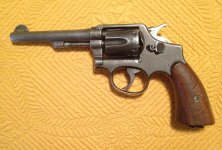
I am wondering if anyone has a lower serial number than my Victory Model #V729.
I ended up with V572, a 4" .38 spl about a year ago from a police auction. It was cheap, but it was ugly too as some idiot had spray painted it black. I wouldn`t have even bid on it if it weren`t for the low serial number. I didn`t even notice the "U.S. NAVY" marking on top of the frame until after I got it home. After having my gunsmith clean the paint off and fix a couple mechanical issues, it looks pretty fair now. I will try to get a picture next time I have it handy.

Thanks, very early, the gun was made 24/25 April 1942.
I was wondering where you got the information on the date?

gjamison
Member
I have V489 with a 4" barrel.

DWalt
Member
- Joined
- Dec 19, 2009
- Messages
- 36,645
- Reaction score
- 33,863
- City & State/Province
- South Texas & San Antonio
The lowest Victory SN on my list is V16 shipping on 6/2/42. I also have three more listed having SNs somewhat lower than yours, which shipped at about the same time. But just because it has a low SN doesn't necessarily make it any more valuable. Now if it were in the V1 to V5 range, you would really have something. All those were made up as presentation pieces.

Absalom
SWCA Member, Absent Comrade
I was wondering where you got the information on the date?
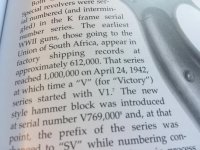
I was wondering the same thing. My suspicion would be that it's an extrapolation from Charles Pate, who states in his book that the V-prefix production started with V 1 on April 24.
Attachments
Last edited:
OP
GRI
Member
The lowest Victory SN on my list is V16 shipping on 6/2/42. I also have three more listed having SNs somewhat lower than yours, which shipped at about the same time. But just because it has a low SN doesn't necessarily make it any more valuable. Now if it were in the V1 to V5 range, you would really have something. All those were made up as presentation pieces.
What serial did the true 5 inch export model begin?
OP
GRI
Member
I was wondering the same thing. My suspicion would be that it's an extrapolation from Charles Pate, who states in his book that the V-prefix production started with V 1 on April 24.
Yes, but I am talking about birthdate not to be confused with shipping date.
DWalt
Member
- Joined
- Dec 19, 2009
- Messages
- 36,645
- Reaction score
- 33,863
- City & State/Province
- South Texas & San Antonio
What serial did the true 5 inch export model begin?
I don't know what "the true export model" means. S&W started selling M&Ps to the British commonwealth militaries early in 1940, and I am not sure what the barrel length distribution was at that time. The earliest South African shipments had 4" barrels.
Absalom
SWCA Member, Absent Comrade
What serial did the true 5 inch export model begin?
Those actually started long before the V-prefix, as low as the upper 600-thousands I believe, with "pre-Victory" models being delivered to Britain and other Commonwealth nations like Canada, South Africa, and Australia, mostly through the British Purchasing Commission in New York. They came in all three barrel lengths 4, 5, and 6 inch, and didn't standardize on 5 inches until fall 1941, somewhere in the upper 800-thousands.
OP
GRI
Member
I don't know what "the true export model" means. S&W started selling M&Ps to the British commonwealth militaries early in 1940, and I am not sure what the barrel length distribution was at that time. The earliest South African shipments had 4" barrels.
Yes, I have a South African 1940 pre-Victory model. I am talking about when the 5 inch barrel .38 S&W first appears in the Victory Model serial number range.

kwill1911
Member
Sorry for the nitpick but it was the British Empire until 1949.
DWalt
Member
- Joined
- Dec 19, 2009
- Messages
- 36,645
- Reaction score
- 33,863
- City & State/Province
- South Texas & San Antonio
I'd say for the .38/200 Victories, all of them were shipped with 5" barrels. Although I could be wrong about that. I don't believe that there were any original .38/200 Victories with 2" barrels.
Yes, but I am talking about birthdate not to be confused with shipping date.
Sorry but there is no such thing as a birthdate. There is no way to follow a frame until it has been given a serial number. Even then there is no tracking until it is in the vault and eventually shipped.
DWalt
Member
- Joined
- Dec 19, 2009
- Messages
- 36,645
- Reaction score
- 33,863
- City & State/Province
- South Texas & San Antonio
Sorry but there is no such thing as a birthdate. There is no way to follow a frame until it has been given a serial number. Even then there is no tracking until it is in the vault and eventually shipped.
At that time, S&W was shipping them out ASAP to meet increasing demand. It's reasonable to assume that an assembled military revolver would be unlikely to sit in factory inventory more than a month or so, maybe even less.
DWalt
Member
- Joined
- Dec 19, 2009
- Messages
- 36,645
- Reaction score
- 33,863
- City & State/Province
- South Texas & San Antonio
Sorry for the nitpick but it was the British Empire until 1949.
" In 1931, the British Commonwealth of Nations was founded under the Statute of Westminster with five initial members - the United Kingdom, Canada, the Irish Free State, Newfoundland, and the Union of South Africa. (Ireland permanently left the Commonwealth in 1949, Newfoundland became part of Canada in 1949, and South Africa left in 1961 due to apartheid but rejoined in 1994 as the Republic of South Africa)."
Absalom
SWCA Member, Absent Comrade
Sorry for the nitpick but it was the British Empire until 1949.
Sorry to have to nitpick back, but the term "British Commonwealth of Nations" served as a legal substitute for "British Empire" in dealings between the major de-facto independent member countries at the latest since the Anglo-Irish treaty of 1921, and is in fact quite a bit older. There was a distinction between the Empire, which included direct British possessions like Gibraltar and the Falklands, and the Commonwealth, which included nations that had been self-governing since the 19th century.
opoefc
US Veteran, Absent Comrade
From my records of Victory models in my collection or other private/public collections that I'm familiar with and have personally examined, with serial numbers lower than V729 are: V1 in the Truman Library collection, V3 in the NRA Museum, V5 in the S&W factory collection, V16, ( V16 is a 38/200 5 in. ), V114, V369 and V462. Don says there is no such thing as a birthdate. I disagree. I think it's reasonable to define "birthdate'"for a Victory Model as the day the gun is complete and accepted by the Gov't Inspector, therefore a birthdate exists for every military Victory model. Remember, the Gov't was running S&W in WW2 and paying the factory for completed guns. Those records, by serial number, most likely exist somewhere in the dusty & jumbled folder boxes in the National Archives. Your assignment, Don, if you care to accept, is to go find those records ! ( Hint: Don't forget to look in the dumpster.) Ed.
Absalom
SWCA Member, Absent Comrade
From my records of Victory models in my collection or other private/public collections that I'm familiar with and have personally examined, with serial numbers lower than V729 are: V1 in the Truman Library collection,.....
By the way, Charles Pate says in his book, referencing Roy, that the V1 in the Truman Library isn't the "real" one; the original V1 was shipped to the War Dept., and another V1 was produced after the war and presented to Truman.
OP
GRI
Member
From my records of Victory models in my collection or other private/public collections that I'm familiar with and have personally examined, with serial numbers lower than V729 are: V1 in the Truman Library collection, V3 in the NRA Museum, V5 in the S&W factory collection, V16, ( V16 is a 38/200 5 in. ), V114, V369 and V462. Don says there is no such thing as a birthdate. I disagree. I think it's reasonable to define "birthdate'"for a Victory Model as the day the gun is complete and accepted by the Gov't Inspector, therefore a birthdate exists for every military Victory model. Remember, the Gov't was running S&W in WW2 and paying the factory for completed guns. Those records, by serial number, most likely exist somewhere in the dusty & jumbled folder boxes in the National Archives. Your assignment, Don, if you care to accept, is to go find those records ! ( Hint: Don't forget to look in the dumpster.) Ed.
Note that the Springfield Research Service records V50 and V506 to Badger Ordnance Works, most likely for ammunition testing.
DWalt
Member
- Joined
- Dec 19, 2009
- Messages
- 36,645
- Reaction score
- 33,863
- City & State/Province
- South Texas & San Antonio
The concept of a birthdate for any manufactured product is nebulous at best as it can be interpreted in multiple ways. Probably the most logical and satisfactory definition to many as it regards a revolver would be the date the completely assembled and finished handgun was placed in its shipping box and sent to inventory, representing its "birth" as a fully functional weapon, ready to shoot. One might say that for military weapons the date of acceptance by the government is the birthdate, but then how do you apply that concept to civilian guns? However, as all these dates are unknown, I'll quote a former Secretary of State and say "What difference at this point does it make?"
OP
GRI
Member
The concept of a birthdate for any manufactured product is nebulous at best as it can be interpreted in multiple ways. Probably the most logical and satisfactory definition to many as it regards a revolver would be the date the completely assembled and finished handgun was placed in its shipping box and sent to inventory, representing its "birth" as a fully functional weapon, ready to shoot. One might say that for military weapons the date of acceptance by the government is the birthdate, but then how do you apply that concept to civilian guns? However, as all these dates are unknown, I'll quote a former Secretary of State and say "What difference at this point does it make?"
I think giving a gun a birth date is probably more a sign of affection, but it is also a way to separate the date of physical manufacture from shipping. With early Colts it could be several years between manufacture and the shipping date.
rburg
Absent Comrade
I'll quote a former Secretary of State and say "What difference at this point does it make?"
Quoting her won't win you many friends within the gun community.
Absalom
SWCA Member, Absent Comrade
The concept of a birthdate for any manufactured product is nebulous at best as it can be interpreted in multiple ways. Probably the most logical and satisfactory definition to many as it regards a revolver would be the date the completely assembled and finished handgun was placed in its shipping box and sent to inventory, representing its "birth" as a fully functional weapon, ready to shoot. ....
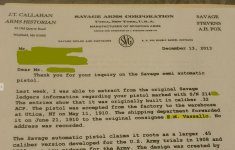
That's actually what the Savage historian uses in their history letters. The letter for my Savage 1907 gives the date it was logged into the warehouse and the date (about six weeks later) when the gun shipped to the consignee.
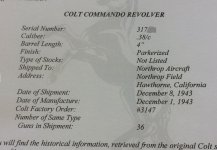
I don't know what records Colt Archives uses, but they also provide a date of manufacture, in addition to the date of shipment, but only if you know to specifically ask for that. So it does seem to require an extra effort, but not enough to charge extra. Most people don't know that.
Attachments
opoefc
US Veteran, Absent Comrade
Absalom, at the time Charlie Pate wrote his book it was believed that the V1 given Pres. Truman was not the original V1 delivered to a General "Kundsen" , per the S&W factory records. I did a forensic examination of V1 at the Truman Library and wrote an extensive article for the Journal of the S&W Collectors Assoc. That analysis proved the gun was not made as part of the standard production line processes, and it had been assumed that V1 was a standard production gun. Later I discovered a note by Carl Hellstrom in the records saying that 5 Victory Models, V1 through V5, and one Pre-Victory were made, by the Service Dep't, on his order, as high polish blue finish with fancy grain stocks for presentation purposes. The Pre-Victory was serial number 1,000,000, which is in the factory collection. That explained why the V1 of Truman's was not a standard production gun with military inspectors and fitters marks. Extensive research did not locate a General Kundsen anywhere in the WW2 Allied Military. By more research, I discovered that there was one General in the US Army appointed by Pres. Roosevelt, that did not have a military record. He was Bill Knudsen, Chairman of General Motors who was appointed by the President to head up all wartime production and given a commission of Lt. General for access to military bases and records. BINGO! Kundsen was a misspelling of Knudsen by the clerk entering the shipping info at S&W. After the war, Bill Knudsen returned the V1 to his friend Carl Hellstrom. Hellstom had the gun redone and the new safety hammer block installed and the presentation was made for Pres. Truman by Congressman Cecil King, Truman's friend an shooting buddy, who took V! and delivered it to Pres. Truman. Truman kept V1 and took it home to Independence, Mo.when he left office. It was his "beside gun" until he passed away. Truman was a S&W collector and quite a few nice S&Ws, with interesting stories behind them, are in the vault at the Truman Library. The factory gifted him and his military advisor, Major Gen. Vaughn, with a nice pair of Pre-Model 27 .357 Magnums, as Truman liked to target shoot at the basement range across the street from the White House. Someday, I'll write "The Rest of the Story" on Truman's S&Ws. Ed.
Last edited:
Similar threads


- Replies
- 6
- Views
- 371
- Replies
- 47
- Views
- 1K


