Russ is correct. You have a mid-1920s revolver that originally had a longer barrel (probably 5", as many M&Ps of that era had barrels that length).
I'm not sure that the short barrel now on the gun now is a portion of the original barrel. The flared portion where the barrel mates with the frame has a profile that looks slightly off to me. The underside of the barrel, where the proof stamps are, would be completely flat from frame to ejector knob cut if that were original. Perhaps the original barrel was further milled to create a place to stamp the marks, but that's conjecture. I would also expect to see remnants of caliber label stamps or patent dates on the barrel, but those are gone. Polished off? Or simply never there because this was not originally a S&W barrel?
Given the date of the gun, this would have been chambered in .38 Special originally, so despite the Commonwealth proof marks it has not been rechambered from .38/200.
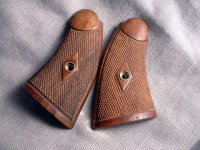
The stocks on the gun now appear to be from the late '50s judging by the shoulder profile. Your gun would originally have had the smaller service stocks with half-round tops and no medallions.