

M&P Target Model

Joined
Apr 27, 2006
Messages
85
Reaction score
54
City & State/Province
Big Sky Country
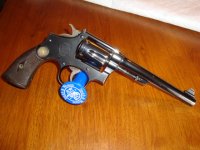
Just acquired a M&P Target from a local sporting goods store. It was marked as a K-38. Looks to be original except for the front sight blade. The blade is a W.F. Sheard #35. All numbers match, serial #245619. Nothing on the right side of the gun other than the crest on the sideplate. Gun shows some blueing wear but is in good shape other than that. $350.00 paid.
 

Attachments

  • DSC00982.JPG
    DSC00982.JPG
    136.8 KB
That's a screaming bargain. Going by the serial number, that is one of the earliest fourth change 1905s. I bet it dates to 1915, which would explain the double diameter ejector rod knob, large deep dish medallions on the stocks, and lack of the "Made in USA" stamp on the right side of the frame.

What a cool score! Congratulations.
 
I'm quite certain the Sheard sight was available as an option-----would have been shipped with a 'U' notch rear blade-----and needless to say, both sight blades could have been changed later on. A letter will tell you for sure---if you specifically ask about the sights.

Of far more importance is the rear sight, which may be the very rare "Large Screw Spring Up" sight. They are found on .38 K frame targets between #195504 and #379988-----on 32/20's between 76613 and 95573. The sight assembly appears quite normal at first glance----except the rear screw (elevation adjustment) is a cap screw which passes completely through the sight assembly and threads into the frame. On all other rear sights (pre-war--except K-22 2nd) the sight is forced to go up/down by what I will call a "jack screw". On this sight the tang has been bent (and tempered---as a spring) and will rise when the rear screw is loosened-----and go back down when the screw is tightened.

It is a truly horrible sight (shoots loose) unless the spring action is very strong. S&W's inability to maintain quality control with the tempering was the problem--------some springs are strong, others are weak. I have examples of both.

From my perspective, the most interesting part of this story is the fact this sight was not treated in Bob Neal's article (The Evolution of S&W Target Sights). I discovered this article and the omission shortly after I discovered this sight about 12 years ago. (And that should read as stumbled on to the sight rather than discovered it. When I went to Mr. Roy with all my exhaustive research, he already knew all about it----more than I did even----as difficult as that may be to believe----sort of.)

Ralph Tremaine
 
I'm quite certain the Sheard sight was available as an option-----would have been shipped with a 'U' notch rear blade-----and needless to say, both sight blades could have been changed later on. A letter will tell you for sure---if you specifically ask about the sights.


Ralph Tremaine
Agreed.
In this era, you almost never see anything BUT a Sheard or a Paine or a Round Top(shark fin) front sight.
If your rear sight is a U, it is probably original.

I don't think Patridge sights had been invented at that time. Even if they had, I've never seen one on a gun that early that I felt was original.
 
Ralph

You are right about the spring-up rear sight assembly. I had a lot of
them, at one point, and indeed it was totally missed in that article.

On this particular gun, I think the price was fair, given the amount
of blue wear on the barrel. It almost looks like something got
splashed onto the barrel. But - its still a nice example of a 1905
M&P target.

Mike Priwer
 
I don't think Patridge sights had been invented at that time. Even if they had, I've never seen one on a gun that early that I felt was original.

You're probably right. What I saw was probably a much later 1905 4th change but I was forgetting how many 1905 4th changes there were, over 700k, correct? They were also made from the teens until replaced by the V prefix in 1939 or thereabouts.
 
Wow, nice score! That's how I got my pristine 1927 M&P target, the shop had it tagged as a K-38 also.
 
Lee, and others

Re the Patridge sight - it is no later than 1907, and actually I think
it was available earlier than 1900. I have a presentation revolver that
was given to Charlie Call on his 25th anniversary with the factory.
This was in 1907, and it has a Call gold bead on a Patridge sight
blade. I've owned, years ago, 1899's and 1902's that had a Patridge
blade, but I was never sure about their origin. Somewhere, though,
I know I heard that it appeared in the late 1890's.

Regards, Mike Priwer
 
Well, you made me look! The first place I looked was at one of my "Large Screw Spring Up" rear sight guns--------#238778. Guess what?!! It has a Patridge front sight (and a square notch rear)---and it at least looks like it's been there all along. So the next place I looked was Mr. Google. Mr. Google says Mr. Patridge developed the sight which bears his name in 1892-----and who am I to argue with Mr. Google?!

Ralph Tremaine
 
Interesting.
I've never seen a Patridge on an earlier S&W than the mid 20's that I felt was original, but I cannot say they didn't do it.

BTW-
Did you know that "Patridge style" does NOT necessarily mean a front sight with a vertical rear face?
The term refers to the sight picture: Flat top front with parallel sides centered in a square notch.
In Aug, 1923, the order was issued to "square" the sights on all the I frame and K frame fixed sight guns.
Catalog D-3 from the 1923-25 era shows that change this way---

handejector-albums-hammers-picture4365-img-3419.jpg


So, I bet you didn't know your 38 M&P had Patridge sights, didja?
Well didja? :D
For that matter, your 38 RP, 32 HE, or 38 Terrier could have them also!

Oddly, the order to 'Square' the sights on the N frame fixed sight guns did not come till Oct, 1927.
Obviously, this is why the early Model 1926's have round tops.


Interestingly, the 22 Single Shot is first shown in D-3 with a Patridge. It still had a Paine bead in the preceding Cat D-2:

handejector-albums-hammers-picture4367-img-3423.jpg


But, they did not change the pic for the 22/32 in D-3. It still shows a Paine bead:

handejector-albums-hammers-picture4368-img-3424.jpg


The succeeding 1925 catalog went into much more detail about many features, including sights.
Mike, note that in 1925, they were calling the Call Gold bead "New". They have also settled on the Patridge as 'Standard'---

handejector-albums-hammers-picture4366-img-3422.jpg
 
Lee

Here is a picture of the end of the barrel. With 150% or 200% setting,
you'll see the presentation date - year is 1907. Charlie Call started
with the factory in 1882, and I know this was not the first Call gold
bead Patridge front sight.

mikepriwer-albums-mlp3-picture4369-six-priwers-1-053.jpg


Regards, Mike Priwer
 
Mike,
That is really cool.
Did not mean I doubted you. Just repeating their pitch.
Have you seen many Call's before the 20's? I've never seen one till this one.

I can see the inscription, but can't make it out.
What does it say?
Is it Young engraved?

More pics would be delightful.....:D
 
------------and what the Boss Man said about the Patridge "sight" is 100% correct----flat top/square sides (front & rear)/sight picture/etc. Mr. Google (and company) referred to Mr. Patridge's development as a "sighting system"-----near as I recall.

Ralph Tremaine
 
I used to have a .32-20 Target model that shipped in March 1907 and it had a Shread front sight. I never had it lettered, but I'm sure it came that way from the factory.

"Catalog D-3 from the 1923-25 era shows that change this way---"

Did anyone else notice that the catalog referred to a PARTRIDGE TYPE sight????
 
Did anyone else notice that the catalog referred to a PARTRIDGE TYPE sight????
I did.
Thought that would get a giggle. I really imagine that was a typesetter.
By the next catalog, D-4, it was corrected, but note the odd change in wording and layout that hyphenates Patridge.

handejector-albums-hammers-picture4370-img-3426.jpg
 
Back
Top