M638 Issues

Out of morbid curiosity, I got my Model 38 from about 1985 out. The Yoke/Frame fit is tight and the assembly number on the yoke matches the frame. Pic attached.
 

Attachments

  • 20170409_142422.jpg
    20170409_142422.jpg
    48 KB
The number opposite the yoke is "425" and the ones that are underneath the stocks are "B15" which is easy to see and "21562 360" which is quite faint. The numbers don't match.
Unfortunately I can't take off the grips. Don't have a allen ranch small enough. However the number opposite of yoke is 622 which are not part of the S#

Sent from my XT1650 using Tapatalk
 
Newer alloy frame J's definitely do not have the fit of their older steel predecessors. My 438 has about .002" gap just below the ejector rod, but locks up tight with no play at all. What should be of concern is the misalignment of the ejector rod-to-barrel lug and detent, plus the non-concentricty of the ejector rod into the yoke bearing surface. The cylinder may be cocked slightly in the frame, exhibited by the e-rod alignment. By eyeball, you can see way more than a few thousandths out of kilter. This could cause problems down the road, even if there is currently no lead shaving.

Easiest way to determine if the chamber-to-forcing cone alignment is within spec is to have a gunsmith check it with a Go-No-Go gauge.
 
Last edited:
Newer alloy frame J's definitely do not have the fit of their older steel predecessors. My 438 has about .0002" gap just below the ejector rod, but locks up tight with no play at all. What should be of concern is the misalignment of the ejector rod-to-barrel lug and detent, plus the non-concentricty of the ejector rod into the yoke bearing surface. The cylinder may be cocked slightly in the frame, exhibited by the e-rod alignment. By eyeball, you can see way more than a few thousandths out of kilter. This could cause problems down the road, even if there is currently no lead shaving.

Easiest way to determine if the chamber-to-forcing cone alignment is within spec is to have a gunsmith check it with a Go-No-Go gauge.

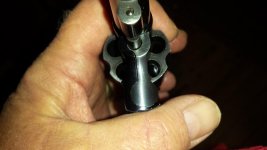
I hadn't noticed that in his photo until you mentioned it! If the barrel is on straight - then the ejector rod is noticeably out of whack. And, that would explain the left-right difference in B/C gap. Now I'm going to have to check my J's ... :(

Edited to add: I envy your calibrated eyesight - you are able to distinguish 2/10,000ths??
 
Last edited:
I should also mention the gap widens when I put pressure on the opposite side of the cylinder.

Clearly, the gun I bought is a dud. I am selling it with a disclaimer and plan to use the cash for a new 642 no-lock.
 
I'm sure that the gun was fine when new. It deserves repair. The "dud" was a previous owner.
 
I'm sure that the gun was fine when new. It deserves repair. The "dud" was a previous owner.

This might be true. But the fact that the cylinder/yoke is obviously a replacement. I smell a rat, like maybe the original owner blew up the cylinder or otherwise damaged it and threw a replacement on to it that wasn't fitter properly. Not sure.
 
It sure looks like a replacement yoke to me - the fit just doesn't look right. I had the good fortune of picking up a used 640 yesterday - it had the correct box so I know it was made in 2016. I just thought I'd post one more photo to show that S&W can do a great job of fitting and finishing J-frames - even up to 2016. OK - so it doesn't have the hair-line seam of the old days Smiths - but it looks great to me!
VkWdoxk.jpg
 
In Photo #1, you can see where the open side of the frame at the yoke pivot is tweaked. Alloy frames are relatively malleable compared to steel. If it were mine, I'd make a jig and chuck it up in a large vice between two chunks of wood and give it an educated whack with a medium ball peen hammer, driving about a 12" long, 3/4" dowel of rock maple or white oak toward dead-center of the barrel. Simple eyeball geometry will show you at which point to strike... the frame is clearly curled slightly away at the open side of the yoke pivot point, maybe about a 1/4" section at the 5 o'clock position, per the pic. This would clearly get everything back to where it should be. It's just a matter of getting the right setup for the procedure. Some gunsmiths have a jig for doing just such a thing. It's pretty much like tightening up the slide on an old and worn 1911, of which I've done a time or two.

It ain't rocket science.
 
Last edited:
Back
Top