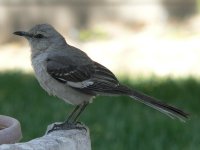
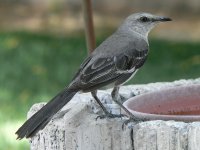
I seem to have two types of Mockingbird in my yard. First is the classic looking bird with a round topped head. Second is what i call a Flathead. Is this a male/female or adult/juvenile thing?
As an aside, while teaching a course in Belize, I saw a southern mockingbird (we have, obviously, the northern species). Looked nothing like ours but behavior was so identical, you could identify it in an instant.
I think the bird facing to the right goes to a better barber and takes more time each morning applying feather gel to his head. He's probably also more OC about keeping his nest and orderly.
We have lots of them around here and a few hang around our back yard, which is great. They all seem to look like that little dude on the right. The more streamlined bird. We used to have magpies all over the place. They were more passive to the smaller black crows who would push them around. Now, both those types haven't been around awhile. We've also been adopted by a blue bird who has claim jumped our back yard. I watched an ariel "dogfight" between him and a couple sparrows the other day.
The mockingbird is the state bird of Mississippi and I think Texas. I didn't know they ranged that far west. (Cali & Nev) I think the bird on the left is a juvenile while the slicker looking bird is an adult, especially if the left wing bird is bothering the other for something to eat. Mockers are very entertaining except when they decide to belt out a few songs outside your window on a moonlit night at 3:00 a.m.
We have a pair of mockingbirds on the grounds of my apartment complex. Virtuosi at singing every known birdsong non-stop at fine volume. Love to listen to them, but I can afford to because they spend their time a good distance from my flat and I don't hear them at night.
I think the bird facing left is a juvenile and the one facing right is an adult. But while we are on the subject, does anyone know how this irritating nuisance got to be named Texas state bird and just who's idea it was? They are noisy and disruptive to other birds, back yard pets and humans trying to sleep past sunrise in the mornings.
I am almost certain that the one facing left is a juvenile as some others have already pointed out. We have many of them here in GA and a lot of them nest here on our property along with blue jays, bluebirds, thrushes and lots of wrens. I was raised in the south and then moved west and lived above 9000 ft for over twenty years. I had no idea how much I missed the mockingbird until I left the high country and moved to Tucson. For those who don't know, there are almost no songbirds at higher elevations. Chickadees just don't cut it! The mockingbirds there in AZ reminded me how much I really missed the deep south. I love to hear them even when they are courting in the spring and sing all night. And in my book, nobody needs to be sleeping after sunrise.