Hi Armorer951 i was wondering if it would be ok to lightly polish the SA & DA notches of the Hammer just to help smooth & slip better? Just polishing no stoning or altering in anyway
Sent from my iPhone using Tapatalk
NO. Leave the edges of the notch surfaces alone. This isn't something with which the kitchen table/garage bench enthusiast ought to fool.
Going to a new style MIM hammer and MIM sear will probably help quite a bit when it comes to the DA trigger pull, for the reasons illustrated by the excellent pics in the previous thread by armorer 951. Some of those machined hammers could be very rough, depending on the sharpness of the cutters. The sear nose would
drag across the roughness, and the slower you pulled, the more you felt it.
There's another spot under the rear of the hammer, behind the throw-notches, where rough machining could also be felt during the take up of the SA trigger stroke, as the tail of the drawbar dragged across them (even though it's a short surface), and that's another spot where the MIM hammers were very smooth.
Going to a soft plastic (nylon?) mainspring plunger (hammer spring cup) can also help smooth out some minor roughness during a DA trigger pull, as the soft edges of the plunger/cup wouldn't create undue "drag" as the bottom coils might touch and rub against the edge as the spring was compressed. This is a spot where some smiths used to discuss stoning, but the plastic plunger/cup was pretty friction-free by its material.
As was also mentioned by armorer951, removing (red stone) any obvious burrs on the stirrup, against which the inside of the spring coils might rub, was sometimes helpful, too.
There are some other spots that can be chaceked and dressed for burrs, but it's too easy to get carried away with stoning (or the "P" word, meaning polishing

) if you aren't familiar with what you're doing.
Stay away from trying polish things just because it might look better for edges to be polished. Dulled & worn edges on the drawbar and hammer hooks, in particular, can become the cause of functioning problems.
Replacing the sear spring typically isn't considered necessary unless the top edge has become curled (causing loss of tension), or the spring is split (lengthwise).
FWIW, there's usually a resulting minor curve to the sear pin when it's installed, so it holds the spring. It can become a bit of a pain, and frustrating, trying to hold the advancing end of the pin "down" (forward) so it meets the opposite frame hole during installation. I'm told they use a jig/fixture and press to do this nowadays.
I've done it, using punches to keep the pin under tension (and the spring from "dropping" as I installed it), as well as drift it into place, and while it worked out to be easier than I'd anticipated (being closer to a pessimist than an optimist

) , I'd just as soon not do that repair on a regular basis. In my case the gun had an aluminum alloy frame, which added a bit to my concern about the possibility of damaging the soft frame, like wallowing out and damaging the pin hole.
Just some thoughts.
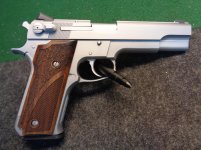
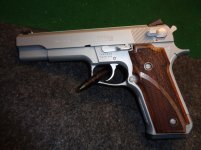
Nice looking 645, BTW. Did a previous owner have the original manual safety/decocker assembly replaced with a 3rd gen assembly (meaning no more screw attachment for the ambi lever)? I don't remember whether the older slides were thinner and therefore didn't require the angled relief cut on the right side of the slide for removal of then ambi lever. The later production .45's eventually did away with needing the relief cut, as I think they made the slides a little thinner.
If you have any trouble with decocking timing, email me and I can give you the sizes of the numbered drill bits used as "gages" for checking the timing as the left lever is lowered. The fitting/filing of a new sear release lever is required to correct out-of-time decocking, though.
Also, after installing a new hammer/sear, it's necessary to check for fit with your existing drawbar. This usually includes checking for push-off in SA (done
gently, to avoid actually
causing a wear/damage problem to occur by exuberantly SHOVING the hammer notches over the sear nose); checking for rocking-off in DA (to check for a Skips-DA/premature DA hammer fall issue) and normal DA function (full length trigger/hammer travel and hammer release). Every once in a while a new drawbar might be required to work with a new hammer and/or sear, depending how they fit and the wear of the drawbar notches.
Congrats.