Need help identifying

Joined
Oct 14, 2016
Messages
3
Reaction score
4
City & State/Province
Beaumont, California
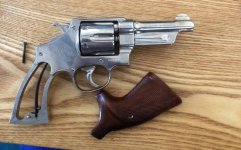
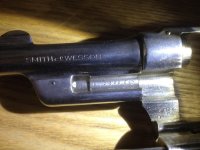
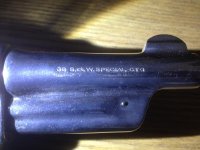
I inherited a number of firearms years ago and have just begun to research them. This is one I am unsure of. It is a Smith & Wesson Hand Ejector without a model number behind the yoke. It has a reg. number of S 63592 followed by what appears to be an “s” with a diamond. It has a 3 inch barrel, hand ejector fixed sights, five screws plus a strain screw. It has a serial of S635XX on the butt. Any information would be appreciated.
 

Attachments

  • IMG_3342.jpg
    IMG_3342.jpg
    103.5 KB
  • IMG_3340.jpg
    IMG_3340.jpg
    99.4 KB
  • IMG_3341.jpg
    IMG_3341.jpg
    90.6 KB
Welcome to the forum.
That looks like a 38/44 Heavy Duty from about 1946. The barrel is probably a 4", measure from in front of the cylinder out to the end of the barrel.
Looks like the hammer and trigger are nickeled which usual means an after market nickel job.

Are you saying the serial number on the butt does not match the number in the barrel shroud? This would mean the barrel has been changed, they should match.
 
Last edited:
The serial number on the butt matches the number in the barrel shroud except the shroud number also has what appears to be an “s” with a diamond. The barrel is 4" from the front of the cylinder to the end of the barrel. Thank you.
 
S63592 makes it definitely an early post-WWII Heavy Duty. The closest SN on my list is S636xx which shipped in 7/46; However, yours may have shipped several months later than that as S&W did not ship in SN order. Indeed, if its hammer and trigger are nickeled, it indicates a nickel plate refinish done outside the factory. The S inside the diamond means it was originally blued, or possibly reblued at some earlier time. That refinish negatively affects its value considerably. You should check to see if its chambers have been lengthened to accept .357 Magnum cartridges.

To finish the story, yours is built on what S&W calls the N frame, somewhat larger and stronger than the more common K frame. It was intended to allow comfortable shooting of the .38-44 round, which is a more heavily loaded version of the .38 S&W Special cartridge. The .38-44 cartridge has not been factory loaded for over 40 years. Of course, any .38 S&W Special ammunition may be used in it.
 
Last edited:
He did not say "an S in a diamond" he said "an S with a diamond" and that is what the picture shows. That stamping I believe is an indication of a replacement barrel from the service department. I agree that the gun has been refinished as evidenced by the line around the side plate being prominently visible. The service trigger has been replaced by a later target trigger. A good picture of the left side of the grip frame might tell us if any of the changes were done by the factory.
 
Welcome to the forum.

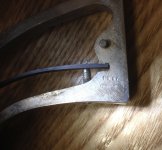
The S with the diamond in the barrel shroud means the barrel was replaced at the factory in the Service Dept as Skeeter57 posted. That also means you will find a factory date stamp at the bottom of the left side grip frame at the "toe" which is the date the work was done.
 
Last edited:
cylinder appear to be bored to the same diameter their entire length to accept .357 Magnum. So it appears I have an N frame from 1946, with a nickel plate refinish done outside the factory, the addition of a target trigger and had a new barrel at the factory in Oct 1957. My thanks for the information so I can get an idea as to the high / low value.
 

Attachments

  • IMG_3366 S&W.jpg
    IMG_3366 S&W.jpg
    78.3 KB
I don't see anything like this on the grip frame, and due to the lack of factory protocol used for the re-finish, I believe you're correct; re-finished outside the factory:

standard.jpg

Photo thx to Masterpiece.

Boring the chambers all the way thru w/o a shoulder is another clue to non-factory work.

Although some believe th cyl does not have the proper strength for 357, documentation indicates the N frame 38 in addition to the 357 retained the cyl heat treating process when it was discontinued on all other calibers. Still, it might be better to err on the safe side and not shoot 357 in it.

NOTE: Heat treatment was eliminated by order Oct. 12, 1945 for cylinders on the .22 & .32 ‘I’ frames, K22, K32 & K38, and the 44 & 45 N frames, from 'S&W 1857 – 1945'. The 38 N frame is not specifically listed. This likely means that 38/44s retained heat treated cyls, initiated on all model HEs by 1921 and continued thereafter until the 1945 change. And the .357 continued to have heat treatment as well as all subsequent magnum cartridge models. May be cost cutting, improved metallurgy, or more probably, both.
 
Last edited:

Latest posts

Back
Top