Not “&”

Joined
Feb 26, 2022
Messages
42
Reaction score
201
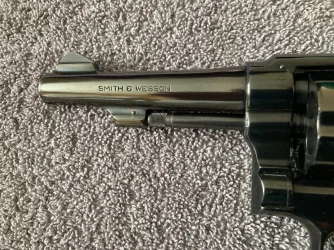
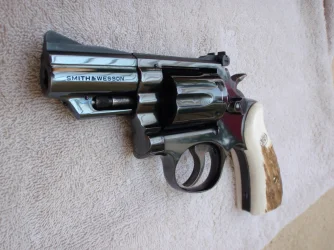
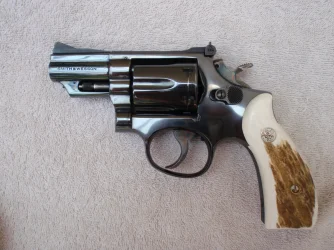
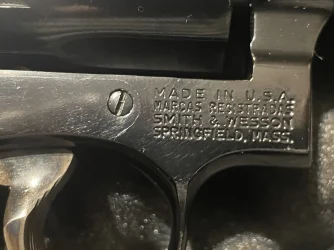
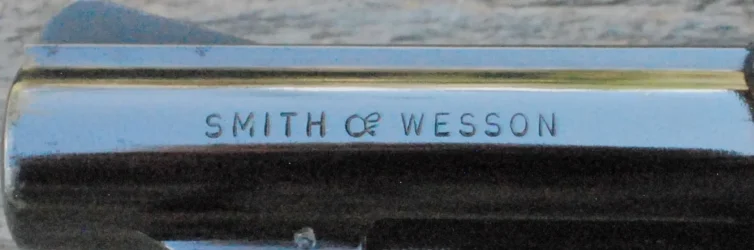
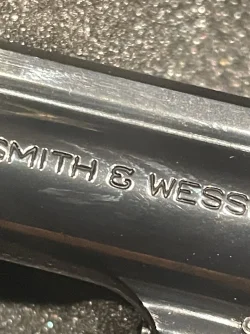
Hi all from Italy! I’ve a K14 dash 3, single action only, of 1975.
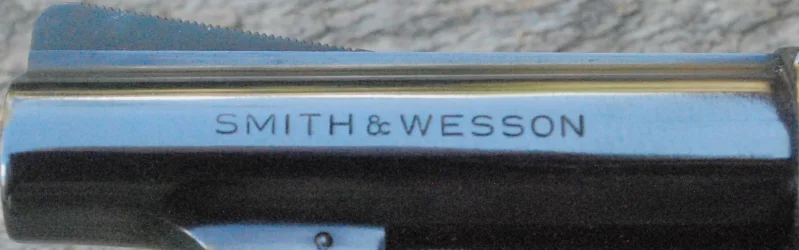
Why this gun has not classic write “Smith&Wesson”?
Thank you!
 

Attachments

  • IMG_1911.webp
    IMG_1911.webp
    367.1 KB
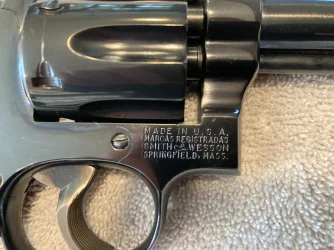
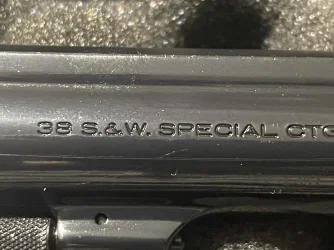
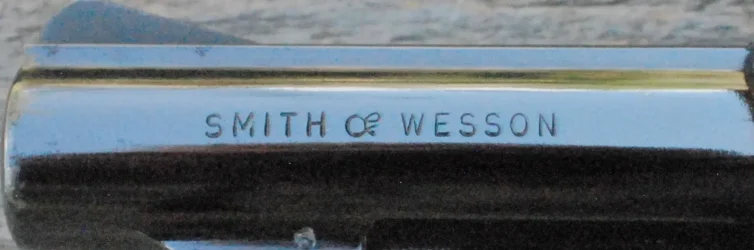
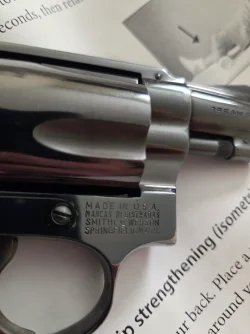
For a very long time the "&" was not the classic typeset ampersand we know today, but looked more like a cL in script writing, with the characters tied together. That looks like a choppy letter "E". If the stamp were worn or damaged, it would still look much like a classic "&" but the top loop is too big. Do you have pictures of the factory logo on the sides, the serial on the gun butt, and the caliber stamping on the other side of the barrel?
 
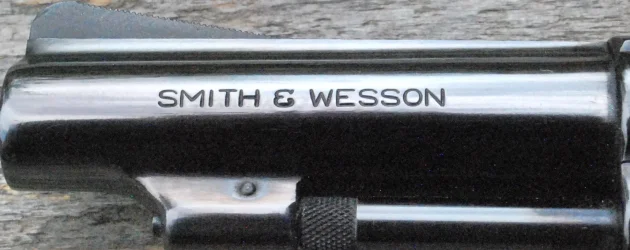
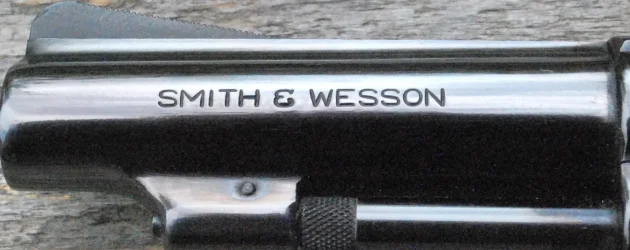
I have a couple that don’t have the classic &. And some have the pregnant &.
Different time periods is all.

76 10-5 is like yours. The 19-3 looks like a 8c. Pregnant & on 17-3. Lots of different ones. 😎
IMG_0293.webpP8080097.webpIMG_1427.webp
 

Attachments

  • P8080093.webp
    P8080093.webp
    656.2 KB
For a very long time the "&" was not the classic typeset ampersand we know today, but looked more like a cL in script writing, with the characters tied together. That looks like a choppy letter "E". If the stamp were worn or damaged, it would still look much like a classic "&" but the top loop is too big. Do you have pictures of the factory logo on the sides, the serial on the gun butt, and the caliber stamping on the other side of the barrel?
IMG_1918.webp
 

For a very long time the "&" was not the classic typeset ampersand we know today, but looked more like a cL in script writing, with the characters tied together. That looks like a choppy letter "E". If the stamp were worn or damaged, it would still look much like a classic "&" but the top loop is too big. Do you have pictures of the factory logo on the sides, the serial on the gun butt, and the caliber stamping on the other side of the barrel?
IMG_1919.webp
 

Attachments

  • IMG_1919.webp
    IMG_1919.webp
    424.7 KB
  • IMG_1918.webp
    IMG_1918.webp
    377 KB
I only track Chiefs Specials so these dates may or might not apply to other models.

The first decade of Chiefs showed many variations on what I note as S&W's traditional ampersand. Here's a 1951:

&&&, 1951.webp

Here's a 3" from 1959:

'59 &&&.webp

In the early-to-mid '60s the company began to move away from its traditional ampersand to a more generic style: &.

Whoever chose ampersands for Smith & Wesson revolvers in the '70s seemed to have either a sense of humor or was trying to "find" just the right one, especially on Chiefs with 3" barrels.

Some 3" Chiefs from 1969 through 1975 had a generic ampersand, and some through 1973 had an ampersand on the left side of the barrel that resembled the number 8 with a lower case letter c kerned close to it:

DSC_0004 - Copy (7).webp

In 1973 the company made at least one bunch of 3" Chiefs primarily for an export market that displayed the traditional ampersand. This one, serial number J218925, is one of two I've seen from a shipment of 488 to a New York City exporter:

CS-1 J218723, & on L bbl.webp

For two years in the mid '70s I've documented 3" Chiefs with the Greek letter epsilon ampersand (like the one in the OP's post):

'75 & on bbl.webp

After 1976 the ampersands on Chiefs were all generic, forcing OCD collectors to focus on other features.
 
Wow. I have never seen this on a gun. Can "epsilon" even be considered an ampersand?

686992-79385eda9496095f6588655376a6a045.webp


I have also never seen this particular ampersand, but I don't focus much on post 4 screw guns:

686991-42913f3fdeef787cf23c6e665af57f8c.webp
 
Wow. I have never seen this on a gun. Can "epsilon" even be considered an ampersand?

View attachment 808564


I have also never seen this particular ampersand, but I don't focus much on post 4 screw guns:

View attachment 808565

If epsilon isn't an ampersand, why did S&W use it in that context?

Both of these 3" Chiefs (top is a Model 36; bottom is a Model 36-1) are three-screw models from the 1970s.
 
Wow. I have never seen this on a gun. Can "epsilon" even be considered an ampersand?

View attachment 808564


I have also never seen this particular ampersand, but I don't focus much on post 4 screw guns:

View attachment 808565
These are taken from manuscript styles.
In Medieval Latin manuscript I have seen the top one commonly and when I practice the old writing I do it sometimes. You are writing the word “et”. Make the large E just like you would make the capital epsilon and then sweep up the end of it and cross it. It looks like an epsilon because they left off crossing the t as they did not want to lift the pen to cross it, because you would get an extra loop unless you are careful. Being careful defeats the point.
The bottom one works like the lower case sigma when you write it. You start on the right with the cross part of the t and move the pen left to make the big circle, loop up for the top of the E and down to finish. It really is quicker when you get used to it but it can end up scribble looking. The bottom one really is the one we are used to just tilted over to the right.
Kind Regards,
Brian D
 
If epsilon isn't an ampersand, why did S&W use it in that context?

Both of these 3" Chiefs (top is a Model 36; bottom is a Model 36-1) are three-screw models from the 1970s.
The medieval abbreviation of “et”, for some scribes, was a lower case e with a straight line directly over it. It can be confusing learning what that straight line means over different letters. We use it only to indicate a long vowel. Our plus sign is just a letter t without the vowel. For a personal style, any loop thing with a straight line incorporated in it will work as long as you are consistent with it in a given manuscript. Mine looks like a plus sign with a loop on the left of the cross.
(Moveable type from Gutenberg onward imitated handwriting, and likewise here metal stamping or engraving. Since the word “et” is always obvious in the text, as a scribe you could either rush over it with a quick abbreviation, or you could use the opportunity to make a flourish, as in the S&W logo.)
 
My '69-'70 Model 36. I like the looks of this ampersand the best.
 

Attachments

  • 20250622_080935.webp
    20250622_080935.webp
    277.4 KB
The medieval abbreviation of “et”, for some scribes, was a lower case e with a straight line directly over it. It can be confusing learning what that straight line means over different letters. We use it only to indicate a long vowel. Our plus sign is just a letter t without the vowel. For a personal style, any loop thing with a straight line incorporated in it will work as long as you are consistent with it in a given manuscript. Mine looks like a plus sign with a loop on the left of the cross.
(Moveable type from Gutenberg onward imitated handwriting, and likewise here metal stamping or engraving. Since the word “et” is always obvious in the text, as a scribe you could either rush over it with a quick abbreviation, or you could use the opportunity to make a flourish, as in the S&W logo.)
Correction:
I looked back and found no examples of the titulus used in “et”.
I found a dot over the e and other much more common abbreviations and sigla especially the Tironian sign which looks like a 7 with a strike through.
 
This is why I love this group! Now I am impelled to pull out all my Smiths to examine them 😊
 
Back
Top