Model 14 Question

23669d

Member
Joined
Mar 1, 2007
Messages
68
Reaction score
68
City & State/Province
Wallkill NY
It is my understanding that you could order a model
14 in single action only. Why not just use standard 14 in single action. How can you tell other than factory letter if gun was ordered that way or converted later.
 
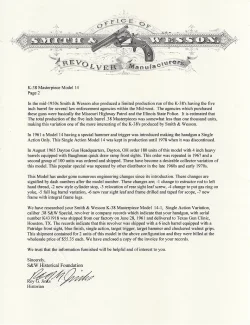
The Model 14 SAO was in production from 1961 until 1978 (SCSW says 1982, but Dr. Jinks indicates production ended in 1978). The earliest units were Model 14-1 and the first two shipped on June 28, 1961. Experience indicates that more were produced in the 14-3 period, than in the other dash ranges.

There are various theories about your "why" question, so I will not venture an opinion.

As to your final question, you can't. There really is no way to be absolutely certain without obtaining a Letter of Authenticity from the SWHF. If the unit is in a known range of the SAO revolvers, we can make an educated guess, but that is less than a certainty.
 
Does SAO feature if verified by letter dramaticaly increase value?
I don't know how to evaluate "dramatically" in this context. That said, the SCSW 5th Edition cites a 25% premium for a confirmed factory SAO. A seller can include that in his asking price, but whether he can actually get it depends entirely on the market at the time of the sale and the interest level of the buyer. In my rather large collection of K-38 Masterpiece revolvers, I have two that are confirmed Model 14-3 SAO. I did not pay a premium over the market price at that time for either one of them. In fact, one of them cost me a price that was below market for a standard Model 14-3.
 
There have been a lot of discussions of the SA Model 14's on this forum over the years. And in most of those discussions, we could rely on Ralph Tremaine to participate in said discussions. Here's what Ralph had to say:

"There are two ways to make a SAO K-38 from a double action K-38: One is to remove the double action sear. The other is to install the conversion kit.

How about if it's been altered with the conversion kit------but doesn't letter"? That's done by cocking the hammer and looking down at the front of the hammer. If it looks pretty much like a standard hammer without the D.A. sear, then that's what it is. If it doesn't look anything like a standard hammer, and there's no place to attach a D.A. sear, then it's a SAO hammer from a conversion kit (or it was born that way).

If you wouldn't know a D.A. hammer or a S.A.O. hammer from a bale of hay, then get a ruler of some sort. A machinist rule is best (easiest to use), but a yard stick will work. In the beginning, SINGLE ACTION ONLY K-38's were more properly known as SHORT ACTION SINGLE ACTION K-38's. So, get a regular, everyday K-38, cock the hammer, and measure from the tip of the firing pin to the rear of the rear sight housing-----1/2" right? Get your S.A. K-38 and measure the same thing. If it's less (I've forgotten how much less, and my SAO K-38 is long gone.), then you have a SHORT ACTION SINGLE ACTION K-38 made that way by the factory, or pretty much anybody else that knows which end of a screwdriver to hold onto."

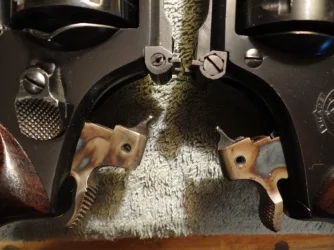
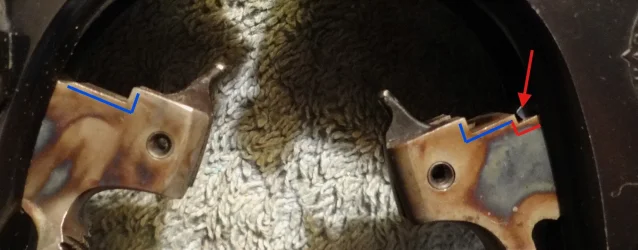
Lots of folks suggest that simply removing the DA sear will get you a SAO revolver. That is true as far it goes. However, you must remember that the SAO hammer/trigger has a different geometry to it than the normal sa/da hammer/trigger. Also, keep in mind that the SA version was introduced for formal Bullseye competition, and there were a lot of very serious competitors who would do what it takes to gain the slightest advantage. With the SA parts installed, the hammer does not travel as far back as with the DA hammer, thus taking less time to cock the hammer. This in turn provides for a shorter travel for the hammer firing pin to strike the primer. Faster cocking time + quicker lock time = less wobble = better scores--at least theoretically. For the best shooters of the day, it likely did provide a slight advantage.

Here are a couple of pics showing the difference in a SA hammer vs a DA hammer at full cock. Note the SA hammer has less distance to travel to strike the primer.
1782603129287.webp

This one also shows the physical difference between the two...SA on left, DA on right.
1782603173626.webp

So by simply removing the DA sear, you have gained zero mechanical advantage.

As Jack stated, the ONLY way to tell if a SA Model 14 is factory or altered after the fact is a Letter of Authentication. S&W offered SA Trigger Kits that were drop-in, so they were easily converted to the Short Action Single Action, as Ralph stated.
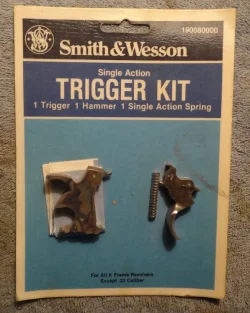
1782603620446.webp

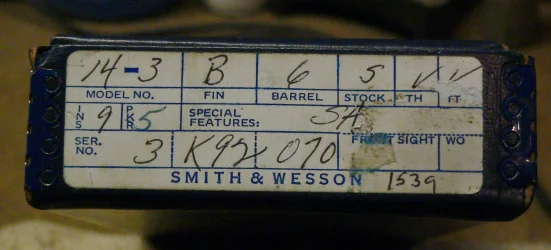
I have a factory built Model 14-1 single action variation that was shipped June 28, 1961. It was in a shipment of two, both being the first factory shipped Single Action K-38 Masterpieces.
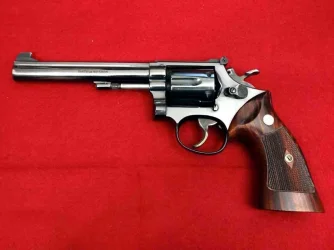
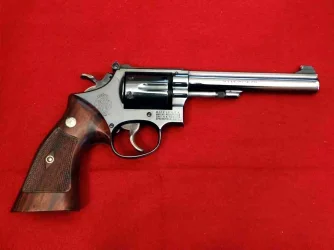
1782603844866.webp
1782603873909.webp
1782603988088.webp
 
19-4167.JPG

19-2.jpg
 
It is my understanding that you could order a model
14 in single action only. Why not just use standard 14 in single action. How can you tell other than factory letter if gun was ordered that way or converted later.
Not only could you order it that way (I have one), but you could buy the kit.
 
There is some really great information in this thread and I thank all the contributors. I have a nice M14-3 that I installed a S/A trigger kit in years ago. It quickly became my favorite revolver if for no other reason it was rather unique. It also confirmed my love for the wide trigger and hammer option. I kept the original D/A parts and stored them away, but the wide items just feel "right" to me.

I recently went on a quest to find a nice M17-3 to go with the M-14 and found one down in Texas. It has the wide hammer and trigger option and is blast to shoot. I installed red dots on both because my old eyes just don't accommodate iron sights much anymore. Although purists will be shocked at what I did by installing the optics on these revolvers the truth is I hadn't shot the M-14 for several years as I had little enjoyment with it using the iron sights. Now these two pistols have both become my favorite range guns. It is just too easy to shoot a bunch of ammo thru the M-17 so I have to only take one box of .22 ammunition with me to the range with the M-17 so I don't go crazy with it. The M-17 really seems to prefer CCI Pistol Match ammo which is rather surprising, but it does the job of knocking over spent shotgun shell hulls off the target stands at 50 yards quite well.

Thanks for some great information in this thread!

Rick H.
 
Thank you very much for info.
There is some really great information in this thread and I thank all the contributors. I have a nice M14-3 that I installed a S/A trigger kit in years ago. It quickly became my favorite revolver if for no other reason it was rather unique. It also confirmed my love for the wide trigger and hammer option. I kept the original D/A parts and stored them away, but the wide items just feel "right" to me.

I recently went on a quest to find a nice M17-3 to go with the M-14 and found one down in Texas. It has the wide hammer and trigger option and is blast to shoot. I installed red dots on both because my old eyes just don't accommodate iron sights much anymore. Although purists will be shocked at what I did by installing the optics on these revolvers the truth is I hadn't shot the M-14 for several years as I had little enjoyment with it using the iron sights. Now these two pistols have both become my favorite range guns. It is just too easy to shoot a bunch of ammo thru the M-17 so I have to only take one box of .22 ammunition with me to the range with the M-17 so I don't go crazy with it. The M-17 really seems to prefer CCI Pistol Match ammo which is rather surprising, but it does the job of knocking over spent shotgun shell hulls off the target stands at 50 yards quite well.

Thanks for some great information in this thread!

Rick H.
 
Back
Top