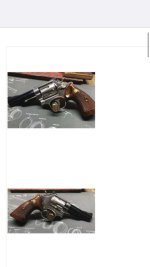
Interesting!
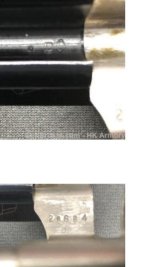
Pre 19s may or may not have a serial # on the cyl; the "soft fitting" protocal was eliminated dring the same period. After which the cyl was eventually no longer serial numbered. Is it serial #'d and if so, does it match the barrel # and at the most important location, the butt of the grip frame? Also what is the serial #? You've only shown the production (assembly) #. The answers may help tell us if it's been changed depending on those facts.
Even if the cyl was blue, it's not a traditional "Pinto" which had blue frames and nickel barrel/cyl going all the way back to the Model 1.
Charlie's idea above is a good one. And I'll offer another; some previous owner couldn't see the sight picture well with the shining nickel barrel.
Prior to the elimination of the soft fitting step, pre model SERIAL # LOCATIONS: To confirm all parts are original, one can check for the 6 matching serial # locations for fixed sight pre war Hand Ejectors and all post war Hand Ejectors thru ~1956 and a few as much as 3 years later.
NOTE: Observing serial #s for accuracy or even existence, especially on penciled stocks, requires magnification, bright light, and an attitude that it is there!
1. Grip frame butt (prefixed by a letter(s) following WWII) - or fore strap on I frame Regulation Police models and single shots with grips that cover the butt
2. Barrel - bottom of barrel or in extractor shroud, (Triple locks have tiny #s stamped in front end of the shroud; sideways/vertical if over 3 numerical digits, otherwise horizontal).
3. Yoke - on rear face only visible thru a chamber with a flashlight (except the .32 Model 1896 and no doubt a few others)
4. Extractor star - backside
5. Cylinder - rear face
6. Right stock only - on back, scratched or penciled depending on vintage and stock material, stamped after 1929, (except most post war target grips because individual fitting not required.)