Old School Calipers

Bronco89

Member
Joined
Jan 27, 2018
Messages
298
Reaction score
608
City & State/Province
TN Hills
I am curious. I have several calipers, and yes, even one is digital. Boy it's easy on the old eyes. However, My favorite is still the old slide rule type. The kind without digital or dials. I seem to have misplaced mine and was glad to have found another on amazon for under $15 bucks. No frills. Always accurate .

Anyone else use one of these old style calipers?
 
The first caliper that I bought back in the 70s was a 6" Mitutoyu dial caliper . . . wish I could remember where I put it :(

In more recent years I have switched to a digital simply because they are faster to zero and easier to read. Plus you can switch between inches and millimeters with the touch of a button . . . That is something my old Mitutoyu can not do

For those folks that are going to chime in "what if the battery dies"?

I actually have two of these in different parts of my house, but there is always a replacement battery in each case with the caliper.

Additionally since this is the same battery that other items I own use, there are always more of the batteries sitting in the freezer
 
Last edited:
I was talking with a reloader a few weeks ago about "Acceptable Tolerances." I was saying My original dial Caliper [for case length trimming] only measured to 1/100 of an inch, and weighing powder charges was on scales marked in 1/10 grain, but the scale was listed as accurate to within +/- 2/10 grain.(that meant the lightest to heaviest could very by 4/10 of a grain!)

Now I insist either on "NO Trim" cases (for my AR's) or the other extreme I trim to 5/10000" (for my 1000 yard bolt actions)

I have very good balance single and 3 beam scales the are within .05 to .10 grain, as checked by certified check weights and two good digital scales. However I got a notice from Sinclair International that they offer a scale that is 1/100 grain accurate (only 4 or 5 times the price)

In that same time frame (late 1970's), I checked match bullet weight consistency, Hornady Match 168 gr HPBT varied by up to 10%, back then Sierra was about 4%. Now days, Sierra very about .5% ON SECONDS!

In my assortment of tools I have a Starrett Micrometer that runs from 1" to 2". It was given to me by my oldest son because it only measured to .001" (1/1000") and he needed one for .0001" (1/10000") Is he a machinist? NO, he is an Airframe Helicopter Mechanic! and has to verify all materials used for repairs! (I guess that's why he makes the big money!)

Ivan
 
Last edited:
I started out using an old Craftsman Vernier caliper some 60 years ago. Graduated to a dial I think in the 70s, then to a digital maybe 5 years ago. About 4 years ago I got tired of chasing batteries and went back to the dials. Have one on the lathe, on the mill, at the reloading bench, and in the garage. Have to periodically check them against a micrometer because they do wear out. It still amazes me how versatile these tools are.
 
I worked as a machinist for the first 8 years of my career and in the beginning, all we have were the graduated scale vernier calipers. Funny thing was that when the first dial calipers came out, we didn't trust them to be as accurate. We adjusted in time. I guess that must be what it was like for some folks older than me going from slide rules to calculators. I learned how to use a slide rule, but never put it into practice.
 
I remember Dad, an engineer, using a slide rule all the time. This would be back in the 60s. Calculators were at his office, too expensive for home use.

I was doing automotive machine work in the early 80s, using vernier micrometers and dial calipers.

I've never used either vernier or digital calipers.
 
Bought an aged Vernier caliper soon after I started reloading, found it in a pawn shop for a $5 bill. Graduated to a Mitotuyo dial caliper some years later, and it still performs flawlessly. Probably one of the most important tools for a reloader to have and know how to use.
 
Yes, I still have one, and use it occasionally. It's a Browne & Sharp that I bought new in the 1960's. It's hard for me to read because my eyesight is not what it used to be. I have a pair of cheap digital ones that I use most of the time these days, since I have no reason to measure close tolerances.

Have a blessed day,

Leon
 
...I have switched to a digital simply because they are faster to zero and easier to read. Plus you can switch between inches and millimeters with the touch of a button...

I bought a replacement digital caliper for my reloading workbench recently & found one that also has the option of showing the reading in fractions.

My old RCBS dial caliper had decimals/fractions on the dial face & I found that feature comes in handy occasionally when checking bolt/pipe/washer sizes.

.
 
Last edited:
I'm an old machine head, started with verniers and went to dials about 1975 or so. Changed jobs and started working in an area that had a lot of aluminum and titanium dust that caused the dials to skip a tooth on the rack, most of the shop went back to verniers and took our dials home. Paid around $100 for my 1st scientific calculator now if you don't have one on your phone you can pick one up for less than $10.........Now I'm a grumpy old man thank god I'm retired.
 
A friend came into our Thursday night gathering about 10 years ago. He had a brand new digital caliper, that went to 5 points (.00000") We were measuring various random things. Most metal objects changed thickness just by holding them, The heat in our hands caused them to expand! Assuming it was accurate, it was too confusing to bother with. It sets in its box, on a shelf, collecting dust!

Ivan
 
I too, bought a Mitutoyo dial caliper, back in the 70's.

I was poor as a church mouse then, and I vividly remember paying $ 50 for it, a BUNCH back then.

I still have, and use it. Accurate as always.
 
I have a couple of digital calipers.
They are easy to use but the batteries are always dead.

I have a dial caliper that sits in its case.

My 200mm (8") NSK metric vernier scale caliper is my "go to" workhorse.

John
 
No good without a picture!

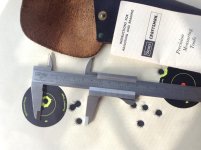
Bronco89: Is this what you're talking about? Vernier scale calipers I bought when I first started reloading around 1967. I prefer my 6" Starrett calipers that I found in a pawnshop for $25.
 

Attachments

  • image.jpg
    image.jpg
    56.8 KB
I had an all-plastic dial caliper until a machinist friend gave me a metal digital to get me to stop using the plastic one. I like it but have had to change batteries a couple times. Nice being able to switch from inch to metric on the fly.

Also still have my slide rule from tech school, but before graduating I mail-ordered one of the first small cheap 4-function calculators for $8.95 from a newspaper ad. The first month I used it I felt like I had to double-check its answers using the slide rule, LOL. Then the folks gave me an HP12C for Christmas and I've used that ever since, changing the batteries once. (Once in 45 years, not too bad!)
 
I started with digital about 5 years ago but found it deteriorating with time. So I "downgraded" (technology wise) to a Mitutoyo dial caliper which I absolutely adore. Rock solid. Repeatability is amazing.

If I came across a vernier caliper in a pawn shop or something I'd probably buy it....just to have. Would be interested to "downgrade" again. Although if I had it I don't know that I'd use it on a day-to-day basis. But it would be fun to have.
 
I have two dial calipers; a Mitutoyo and an Etalon. I have two vernier calipers; an SPI and a Mauser. Yes, Mauser made precision measuring instruments. The Mauser is the only one I regularly use. It is marked "Made in Germany", not "Made in West Germany". Could it be pre-WW2?
 
I have a Brown and Sharpe (dial), Lyman (dial) from the 1970's and a new Neiko (digital).

I really do not know if this is a true test for accuracy but every now and them I zero them the best my eyes will see then measure paper, coins, bolts etc. All three tools show the same measurement.

Brown and Sharpe was expensive the others were not.
 
Last edited:
A plain dial caliper and micrometer are not difficult to use and no batteries are needed. They are probably at least as accurate as the battery operated versions.
I have used precision measuring tools for most of my working life. I started in 1965 with a Craftsman set of 6" dial calipers and a 1" carbide tipped micrometer. Bot excellent tools and lasted me several years until they were stolen. In the late '80s I tried digital calipers. Worked OK for a short while and soon noticed wandering zero, every time I picked up the calipers I had to "zero" it. Changed batteries often, but it soon began to switch from metric to SAE and often back (I was using it to measure parts to .001"). Put that caliper away and bought an inexpensive dial caliper. The dial caliper as been accurate for 18+ years, and since I retired 10 years ago I only use it for reloading, and it remains as accurate as new...

I think if I went back to vernier style calipers I'd get some strong readers and a bright bench light. I use my magnifying visor when measuring dents in my bullet alloy to determine BHN...
 
Last edited:
I was taught to use vernier scale measuring instruments when I was a kid.
The Transits I used were Vernier scale and had to use a glass to read them no matter how good your eyes were. I have dial and digital instruments now but have never trusted them. I'm never happy until I check with the Verniers. Most of my stuff is Starret or Brown& Sharp. My slide rules are Post. The vernier stuff is top of the line and that's why I trust it. I always check the dial calipers against the Verniers before I use them. The big thing with precision measuring of any type is the tolerances you are working with.
With all the cheap digital instruments on the market a beginner should have them checked out for accuracy before using them.
 
My first caliper was a Mitutoyo dial caliper that I bought in 1973. It was a big expense I justified thinking it was for both work and reloading. About 15 years later in a different factory I had trouble with it gumming up with fine particles and traded it off then went to a 6" vernier Mitutoyo. I wish I just took the Mitutoyo dial caliper back to my reloading bench and left it there but at the time I could easily see vernier scales. Now I use a magnifying glass to read that old Mitutoyo vernier.

A couple months ago I bought a RCBS 6" dial caliper for $20. The seller was selling used reloading equipment. It is only marked in 0.001". I wonder who actually made it. At the same time I bought an old all plastic RCBS 4" caliper for $1. It measures in 1/64" and 1/10 MM increments. I did not know RCBS or any one else ever made such a cheapie. They must have thought it adequate for cartridge over all length. I only wanted it for measuring bolts & pipes.
 
Last edited:
I've bought a lot of decent Jap Mics off school kids. They make them buy stuff for machine trades in vocational school and kids sell it when they get out. They only use them as go& no go gauges because the instructors they have can't read Verniers themselves.
 
My "Old School" calipers are a General Tools No. 621. Kept in the drawer with the magnifying glass I use to read it.

General-621.jpg
 
I bought my first slider type back in the 70s and used it for years working on Allison automatic transmissions. Now that I'm retired and it's getting harder to see the lines, I picked up a dial. The dial works and I can see it great.
 
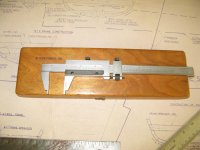
Here's mine.

I aquired this vernier caliper in 1969. I still use it occationally, inches on one side, milimeters on the other. I have several slide rules, too, but don't actually use them anymore.
 

Attachments

  • Calipers2.jpg
    Calipers2.jpg
    94.5 KB
Back
Top