Plunk Test Questions

PapaWheelie

Member
Joined
Nov 30, 2019
Messages
78
Reaction score
32
City & State/Province
Oshkosh, WI
I have just started to reload 9mm for my first pistol, though I've been reloading for my revolvers for a while, and have been reading about OAL and plunk testing. I still have a couple newbe questions and hope someone might help.

Once the length to just touch the bullet into the rifling is determined, how much do you shorten the OAL of the cartridge to get the best accuracy and reliability. I've seen .015" on a couple posts - is that a lot or too little?

Is the maximum OAL of a pistol cartridge always the best place to start to work up a load for a particular bullet?

Would plunk testing my .357 revolver's cylinders be worthwhile?

Thanks in advance.
 
I use the recommended OAL as listed in the manual. I load 9mm for target shooting and never try and load to the edge of the bore or the rifling for my 9mm loads. As far as always loading to the max OAL I would think you would not have enough bullet seated into the case in some cases. That is just me and I am mot the expert on reloading but have loaded thousands of 9mm bullets without a problem using load data and seating OAL listed.
 
In pistols the case will "Stop" where the chamber is reamed.
The bullet can move forward towards the lands with it's OAL settings.
Most, seat the bullet back from the lands, just incase it might move forward when it is forced into the chamber by the slides energy.

The case in a revolver is not set to a "Stop area" and you only need to worry if the OAL of the load, lets the bullet go beyond the length of the cylinder, in any way.

With the 9mm pistol..........
accuracy and pressures can happen with very short or x-long OAL of loads. You just need to find out what your certain pistol likes.
A short Ball FMJ and a short JHP can be totally different in their results and only time will solve what is best.

Good shooting.
 
For semi-auto handgun cartridges, I use the max OAL as long as the cartridge chambers and feeds reliably. If it doesn't, experimentation will be required for the OAL.

For revolvers, I seat to crimp groove or book recommended OAL. I've played with overall length from an accuracy standpoint with both revolver and pistol cartridges. My results have always been inconclusive. Seating depth doesn't seem to affect accuracy in handgun cartridges like it does with rifle cartridges.
 
As mentioned above, start with book OAL data for your particular bullet and check with the plunk test to make sure they will chamber freely in your gun. For hand gun loads where .005"-010" difference in OAL has little to nothing to do with accuracy, no need to determine "how far off the lands" your bullet should be. Even for rifle reloading, "chasing the lands" of very often the last step in looking/developing "The Load" for your gun.

I reloaded my first revolver ammo in '69 and seated the bullets to the crimp groove and/or cannalure and disregarded book OAL. I made sure the rounds were not too long for the cylinder and produced some very accurate handloads (I got consistent 2" groups from my 44 Magnums @ 25 yards, with my cast 429421s seated to the crimp groove). I still seat all revolver bullets to the crimp groove/cannalure. Semi-auto handloads are seated to book OAL for the particular bullet and checked with the plunk test and OAL tweeked to insure good chambering.

In my experience, I loaded all my 308 ammo to bullet manufacturer's recommended OAL for their particular bullet. Then after getting the best most accurate load, I bought a gauge and played with OAL from .005" to .025" distance from the bullet ogive to rifling. The absolute best load/OAL came when I used the Hornady OAL for the 155 gr. A-Max I was using, the data I started with, in my 308 handloads which gave me -1" loads and often 7/8" groups @ 100...
 
Last edited:
Thank you all for your responses. OK, here's my confusion. I've tried to read all I can find and there seems to be two distinct schools of thought.

One thought is that the OAL given in the book data is for the test gun used and not the definitive length for your pistols. By lengthening the OAL to the max in your gun you reduce pressures and increase accuracy. The only number I can find for minimum depth to seat the bullet in the case for 9mm is .300".

On the other hand, several have said that the OAL doesn't matter that much, just load to the book spec. and all will be well. I have been loading this way for now and although the gun functions perfectly I'm not happy the the groupings.

Both arguments are logical and make sense to me.
One question that is raised by the above responses is why would max OAL be important for a rifle accuracy load, but not a semi-auto pistol?
 
Last edited:
...One question that is raised by the above responses is why would max OAL be important for a rifle accuracy load , but not a pistol?

Max OAL is a defining dimension for the cartridge. Longer than that it won't fit the magazine or might even poke out the front of the cylinder. COL is how long it should be with a chosen bullet to replicate the tested results shown in the loading manual. Those dimensions may not be the same in every case.

The rifle equivalent of seating a bullet "out" to get closer to the rifling might make sense in a pistol, but puzzles me how you do it in a revolver. For me the point of the plunk test is to assure the round will chamber and the slide will go into battery.

Few things will cause as much bad language during a match as having the slide slam forward with enough vigor that you cannot extract the offending round by pulling on the slide nor can you coax it closed enough to make it fire.
 
There are 3 OAL's to think about:

1. Max OAL for the cartridge

2. Max OAL your gun will chamber (may be shorter than #1)

3. Load-recipe-specified minimum OAL (don't go shorter than this)

So really, anywhere inbetween #2 and #3 will work for you. You can't go longer than #2, and shouldn't go shorter than #3. Within that range, you could certainly experiment.
 
Powders will make a difference also. My 9mm likes N340 & Unique for tighter groups. I had to seat the bullet a little deeper and back off on the powder charge to tighten up. Power Pistol is good also. My pistol doesn't like a long bullet.
 
Last edited:
The rifle equivalent of seating a bullet "out" to get closer to the rifling might make sense in a pistol, but puzzles me how you do it in a revolver.

Maybe it was a dumb question, but what I was thinking about when I talked about revolvers was if it made any difference in accuracy the closer the bullet was to the throat of the cylinder itself. As an example a .38 cartridge shot from a .357 would, in theory, be about .100" further away from the throat. Sorry if it sounded dumb, I'm just trying to eliminate some trial and error given the shortage of primers.
 
Maybe it was a dumb question, but what I was thinking about when I talked about revolvers was if it made any difference in accuracy the closer the bullet was to the throat of the cylinder itself. As an example a .38 cartridge shot from a .357 would, in theory, be about .100" further away from the throat. Sorry if it sounded dumb, I'm just trying to eliminate some trial and error given the shortage of primers.

It's irrelevant. I have the same excellent accuracy from a model 28(.357 mag) as I have from a model 14(.38 SPL) using .38 SPL wadcutters.
 
What complicates OAL length questions is the fact some manuals ONLY list cartridge OAL per SAMMI spec, completely ignoring if the round will feed/cycle in commonly used weapons.

These manuals use test barrel assemblies to develop their data, again completely ignoring the fact people do not shoot test barrels, they shoot real guns.
 
Code:
I think perhaps the OP is over thinking a part of reloading, that while important it isn't critical (unless very short OALs in a high pressure cartridge lead to over pressures). Yes chambers on 9mm pistols will vary but that is why we use the plunk test; start with book data and check with plunk test. I have 4, 9mm pistols and while they do vary in chamber length, only one requires a deeper seating from book data than the other 3 but it is only .005" difference with one specific bullet .

Reloading manuals give two OAL dimensions; the SAAAMI specs at the beginning of the cartridge section, and the OAL they used for a specific bullet (often supplied by the manufacturer, and why it is best to start with bullet manufacturer's data). While some high end 9mm pistols may benefit from chasing the lands, accuracy wise, most/many are just SD type and longer range (beyond 20 yds) accuracy isn't needed or incorporated in the pistol design.

I have been reloading for a long time and I don't have any pressure testing equipment so I depend on reloading manuals and my chrony for loads. IMO; using bullet seating to try and control chamber pressure is silly and at best a WAG. IMO; for a newer reloader (under 20K rounds and 10 years experience) it is best to stay with proven data from professional technicians that have state of the art pressure testing equipment.

But then again, any information is good and if the thread is for information and theory only, then great...
 
Last edited:
Code:
I think perhaps the OP is over thinking a part of reloading,

But then again, any information is good and if the thread is for information and theory only, then great...

You are correct, I probably am over thinking it but it it keeps me busy during the crappy weather days here. Although not quite new to reloading I am new to 9mm, my first semi.
I recently watched several YouTube videos where the max OAL seemed to be a critical factor in overall accuracy. I plunk tested my barrel and found that my Acme 115gr. LRN can chamber at a length of 1.1610". The Hodgdon data for this bullet and W231 has a COL of 1.100" to which I loaded a fairly large batch to take to the range along with some factory 115gr. fmj. I was disappointed with the reloads grouping compared to the factory and know I need to start working on it. One video suggested starting with length, then powder charges.
Just trying to eliminate some trial and error if I can. It's a long way to the range and trying to conserve primers.
 
I’ve been loading for over 50yrs and I have no idea what plunk test is. There, not all at same time but loaded for over 100 cartridges.
When you load for auto drop the finished bullet in the barrel. On a 1911 the finished bullet needs to fit flush with the hood and the brass not stick out any. It should also have a little wiggle. Another plunk when you have lead and ? drop it on concrete and the better lead material will have a duller thud.
 
Last edited:
I load long. Testing in pistols and rifles has always shown accuracy gets better at longer COL. YMMV.
If you work up the load with the bullet "kissing" the lede/rifling, you have minimized the head space gap.
First, the round must fit the magazine. Next, it must feed and chamber.
Manual COLs are NOT recommendations, but just the COL they tested at. If it had any real meaning, it would maybe be their guess at a COL that would work in all guns, but not the BEST in any gun.
 
The solution to chambering problems is to determine the cause:
Take the barrel out of the gun (or, open the cylinder of the revolver). Drop rounds in until you find one that won't chamber. Take that round and "paint" the bullet and case black with Magic Marker or other marker. Drop round in chamber (or gage or cylinder chamber) and rotate it back-and-forth a few times.
Remove and inspect the round:
1) Scratches in the ink on bullet--COL is too long (not a revolver issue)
2) Scratches in the ink on edge of the case mouth--insufficient crimp
3) Scratches in the ink just below the case mouth--too much crimp, you're crushing the case
4) Scratches in the ink on case at base of bullet--bullet seated crooked due to insufficient case expansion (not case mouth flare) or improper seating stem fit
5) Scratches in the ink on case just above extractor groove--case bulge not removed during sizing. May need a bulge buster.
 
When you load for auto drop the finished bullet in the barrel. On a 1911 the finished bullet needs to fit flush with the hood and the brass not stick out any. It should also have a little wiggle. Another plunk when you have lead and ? drop it on concrete and the better lead material will have a duller thud.

I guess I knew what it was for 50yrs, just didn’t know the technical name for it. I guess I wasted my time with calipers and such.
 
I started out loading for turnbolt rifles. I had the same thought you did on OAL.

Consistent start pressures are important for long range rifle shooting. Many of my rifle loads shoot better backed away from the lands.

When I load for any selfloader, pistol or rifle I use crimp to maintain start pressure consistency. Reliable feed and full battery lockup are my primary goals.

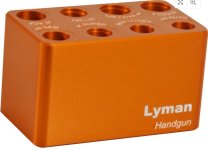
For my selfloading pistol rounds I use a Lyman cartridge tester for plunking. I load for several pistols in each caliber and the Lyman has yet to lie to me.

https://www.midwayusa.com/product ...d=1602752690[/IMG] /1016393015?pid=464540
 

Attachments

  • Lyman.jpg
    Lyman.jpg
    38.2 KB
What is the problem that you’re trying to solve?

You mentioned that the factory ammo grouped better than your reloads. Compare the LOA of each. Pull some projectiles from the factory ammo and compare diameter to your reloads. I think the LOA for auto loaders is more concerned with function than accuracy(within pressure parameters, of course).
 
I have just started to reload 9mm for my first pistol, though I've been reloading for my revolvers for a while, and have been reading about OAL and plunk testing. I still have a couple newbe questions and hope someone might help.

Once the length to just touch the bullet into the rifling is determined, how much do you shorten the OAL of the cartridge to get the best accuracy and reliability. I've seen .015" on a couple posts - is that a lot or too little?

Is the maximum OAL of a pistol cartridge always the best place to start to work up a load for a particular bullet?

Would plunk testing my .357 revolver's cylinders be worthwhile?

Thanks in advance.

OAL so that the bullet is just shy of the barrel throat is important in rifle accuracy loads, but is not applicable to pistols and revolvers.
For semi-auto pistol rounds, seat bullets to the OAL recommended by the bullet or powder manufacturer or what is listed in reloading manuals. The OAL must allow for smooth operation of the magazine, reliable feeding, and a proper fit in the chamber.
For revolvers, you want to seat the bullet so that the case mouth can be roll crimped into the crimp groove on the bullet.
 
Again, thank you all for your responses. Very informative.

Those who load to length, how much clearance do you give between the bullet and the start of the leade/rifling? Is .015" a practical starting number? On this particular bullet I found that 1.061" was the longest I could go before touching the the rifling of the barrel. So if I reduce my 1.0610" maximum by .015" would 1.046" be my max. COL for this bullet in this pistol?
I have tested various lengths with dummy rounds and even the long ones, longest tested was 1.057", feed from the magazine and chamber and eject well.
 
I occasionally look at reloading/casting videos on Youtube, but just for entertainment and take anything I see with a grain of Bullseye. I've seen some very questionable methods that I would never use and recommend a newer reloader ignore the "experts". Of course there are some good reloading videos, but I prefer to get my info/data from published manuals and legitimate sources.
 
OP, while you're getting all wrapped around the axle on where your rifling is in the barrel, one of the limiting factors, especially with 9 mm, on OAL is your magazine. Particularly with RN bullets, which, in 9 mm aren't particularly accurate. FWIW, independent testing back in the 1980's showed that truncated cone/flat point pistol bullets were much more accurate than RN. The JHP design, for technical reasons, is frequently more accurate than others. The Hornady HAP line is an example.

Having said that: forget about where your rifling is. As has been noted, you're not loading bench rest rifle ammunition. Your personal wibbles and wobbles while trying to maintain sight picture during the trigger press will be a greater deviation than any theoretical accuracy improvement you might get from having the bullet just barely clear of the rifling.

While several things affect accuracy of handgun ammunition, depth of bullet seating/OAL generally isn't one of them. Personal experience has shown me that "target" ammunition, with reduced velocity increases time in the barrel and your wibbles, wobbles and follow through (or lack thereof) can have a greater effect on shot grouping than with standard velocity ammunition.

You don't mention your load data sources. Some specify a minimum OAL. some a maximum OAL and those from the bullet makers frequently give you the OAL(s) for the specific bullet(s) for the published load data. Hornadys manual does so, it's a good item to have. You can often generalize OALs for specific bullet types/profiles, like the truncated cone/flat nose bullets mentioned earlier. I personally use an OAL of 1.090 in for TC/FN/JHP bullets in 9 mm, one I copied from Remington factory ammo.

Yes, I've got a chronograph and the slightly shorter OAL than some published data means I use 0.4 gr or so less powder to get the same velocities.
 
Back
Top