Powder Equivalency Chart

jimmy.jet

Member
Joined
May 29, 2012
Messages
131
Reaction score
18
City & State/Province
alabama
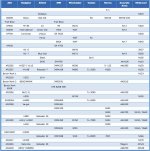
I've seen burn-rate comparison charts many times but never an equivalency chart like this one from Australia's ADI.They claim the powder burn rates to be within 5% of one another.
Powder equivalents, ADI Powders Handloaders' Guide
Safe to use to substitute loads for one powder for another?
 

Attachments

  • powderchart.jpg
    powderchart.jpg
    98.1 KB
Safe to use to substitute loads for one powder for another?

I would not substitute one powder for another based solely on that chart. There are other factors besides burn rate that need to be considered.
 
I would not substitute one powder for another based solely on that chart. There are other factors besides burn rate that need to be considered.

As a follow up to this reply as an example the chart has 4227 equivalent to H110 and WW296[while those two ARE equal] I don't think you want to use 4227 to try get the same 'pop' as they are capable of.
Note their disclaimer at the bottom.
 
That is a burn rate chart in a diff form, just grouping them by 5% diff instead of lining them up. They are NOT saying they are equiv, but close in burn rate if in the same space on the chart. Short answer, no, substituting would be foolish.
 
Last edited:
I would be very careful about this table. Here is one example:
they have 700x and AA#5 as equivalent????? On the burn rate table 700x is #12, BullEye is #13 and AA#5 is #41 with AA#2 not mentioned yet is between 700x and AA#5 @#25 in the table. IMO AA#5 is a medium burning powder (I use it alot) and 700x is a very fast burning powder.
 
It's nice to know

It's nice to know this stuff but I think there are more factors than just 'burn rate'. Amount of gas produced at what temperature, for instance. Densities, surface area, grain size, feedability are different so any volumetric measurements are out.
 
Last edited:
I saw a couple of cases where it's a case of someone selling a powder (in the US) made by someone else, but with "their" name on it. You can sorta pick those out in published load data.

I've gotta go along with everyone else though, don't mix data and powders. I've seen a few literally blown up guns caused by wrong powder for the data.
 
They are "equivalents" not substitutions.

I also believe it it is more that just a burn rate.They have a burn rate.

There are only a few places that actually produce powder/ Some in Australian, USA and Europe, That being, there are a lot of similarities in the formulas of powder. There can only be so many formulas to produce essentially the same results. Like the HP38/W 231, H110/W 296 powders and others.

Hodgdon Varget is made in Australia, the equivalent by the chart is their AR2208, Is it the same????

IMR Trailboss also made in Australia and yes they ADI calls it Trailboss also.

Benchmark is Benchmark

Some or many of the powders may actually be one in the same,

Compare the load data for "equivalent" powders
 
Please go by the powder manufacturers load suggestions. Do not use the suggested load from another manufacturer. Be safe. Just a word of caution

I was hoping to see a rifle powder we could use but no such luck. No powder available yet.
 
That is a burn rate chart in a diff form, just grouping them by 5% diff instead of lining them up. They are NOT saying they are equiv, but close in burn rate if in the same space on the chart. Short answer, no, substituting would be foolish.

^^^this....
though, with powder being a flaky commodity lately, this sort of info can help lead you to a load of similar yield, using its own data of course.
 
Safe to use to substitute loads for one powder for another?
No. Burn rate is a function of containment, among other things.
Internal ballistics is not only more complicated than usually understood, it is more complicated than people who do not have a working knowledge of systems of partial differential equations CAN understand.
Somebody is always trying to produce a simplified chart or program, but none of them are a substitute for actual firing data of the selected components. It can help you get an idea of which powders might work, THEN you go to the actual tables.
 
Last edited:
Good point......

^^^this....
though, with powder being a flaky commodity lately, this sort of info can help lead you to a load of similar yield, using its own data of course.

At least when shopping for non-existent powder if we see something 'close' we can buy it and adjust loadings accord to the manufacturer.
 
I sent a e mail to ADI powder in Australia.

They gave a very prompt response in the form of pdf which I am not linking to as it has my name and information.

Stated in this letter is the fact that their powder ADI AR2208 is indeed the exact same powder as Hodgdon Varget.

The other ADI powders are the same as those listed under Hodgdon and IMR as indicated in the chart.

As to the other brands they did not say.
 
^^^this....
though, with powder being a flaky commodity lately, this sort of info can help lead you to a load of similar yield, using its own data of course.
Why I prefer a numerical burn rate chart. If you are looking for something close to your powder of choice, one up or down the numerical chart is a better bet. As noted, 700x & aa#5, not anywhere close.
 
I have shot Alliant e3 in 12 Ga. and 38 special and do not think it is in the same ball park as w231.

I also have my doubts with 2400 and SR 4759 being alike in the pressure and fps department..........

But I don't have testing equipment, either.
 
Using a chart like that for substitutions is never a good idea.

ADI does make many of Hodgdon's powders and data can be interchanged. And there are cases where one powder is marketed by different manufacturers at the same time or one powder is made by different manufacturers at different times.

If you have any questions about them, the best thing to do is to contact the manufacturers involved. There is a publication by Wolfe Publishing titled "Propellant Profiles" that contains articles from "Handloader" magazine that is pretty good, although some of the articles are pretty dated. And make sure you get the latest edition.
 
The only "thing" about the information I received is that it lists the ADI powders and the Hodgdon Propellants.

Don't know about any one else but I have never seen a ADI powder here in the USA.:)

So equivalent is kinda of useless for those powders. Now if they also make powder for the say Alliant and Accurate it may be of use but they did not say.;)
 
Why I prefer a numerical burn rate chart. If you are looking for something close to your powder of choice, one up or down the numerical chart is a better bet. As noted, 700x & aa#5, not anywhere close.

another flaw in the data set I've observed was the AA#7 to Blue Dot relationship.
both saw service in a subsonic load of mine, and achieved yield within .2 grains of eachother.
ADI has these two significantly separated
in fact, I see 10.2 and 10.5 max for 158G JHPs in 357 between the two in published data.

The ADI chart might be a result of product differences between nations, thus largely useless to us.
 
Relative burning rates are determined by burning a small charge of powder in a solid, round ball of a given size. The actual burning rates will vary in actual use and may be no where near the charts.

The "numerical" charts are worse because they make people think the powders are "one" step apart from each other. This is just a ranking and not a value. You might have two powders that are almost the same while the next two might be a considerable distance away in actual usage.
 
Burn rate charts are relative and powders will exhibit different burn rates when used in different cartridges.

One very important point, a burn rate chart can tell which powders are slower or faster than each other but not how much faster or slower than the powder next to it on the chart.
 
The powder burn rate chart at the Accurate and Ramshot powder site is similar but much more accurate.
 
Back
Top