Pre Model 10 Hand Ejector

Joined
Sep 19, 2014
Messages
33
Reaction score
77
Hello kind Sirs.
I am seeking information on a .38 S&W Hand Ejector I purchased from GB.
It has Birmingham proof marks but no import marks.
Serial numbers (P 768107) are stamped on the butt of the grip, cylinder and barrel.
I was wondering if anybody can tell me the year of manufacture and if it is a lend lease revolver being as it has a lanyard ring (no US Property on top strap).
I am fascinated with the proof marks and the possibility that this old war horse was called upon to defend the Empire at one time.


d61d3aa53e6a4c18cd16b12e7bc55b81.jpg


a1f39936c1fd9229dc44274fb530ccc8.jpg


33adfd3df11e1267ce6d992b464d10bd.jpg


625d04634b504bb0af33c70dfd4a6b41.jpg


6b221473be6d043583b34cfe76cdde3b.jpg


7ec081cc2b049ff0947efc22959e877c.jpg


7d1802d160b2ee34ce7dd14a827b59f8.jpg


And the old war horse can shoot too.
Here is a 3 shot group fired at 10 feet (SA) using generic PPU 38 S&W rounds.
040a55eddf84eb34f4804dd5975a0d08.jpg


Sent from my iPad using Tapatalk
 
Last edited:
It's a pre-Victory BSR, and the grips are correct for that time. It probably shipped around mid-1941. I list SN 7671xx as shipping in 5/41. Too early to be Lend-Lease, rather it's Cash and Carry. Have the chambers been bored to accept .38 Special cartridges? It was proofed when the British military sold these off as war surplus in the 1950s-1960s. The P is a proof mark applied at manufacture prior to shipment. It appears all-original, therefore it's a fairly desirable piece, rather than one of the far more common butchered and rechambered BSRs.
 
Last edited:
I was wondering if anybody can tell me the year of manufacture and if it is a lend lease revolver being as it has a lanyard ring (no US Property on top strap). ....I am fascinated with the proof marks and the possibility that this old war horse was called upon to defend the Empire at one time.

Nice gun. Yes, your revolver did indeed serve. It was shipped from the factory around May, 1941. It went to the British Purchasing Commission, so it was not a Lend Lease item. It bears the Broad Arrow mark above the left stock indicating Crown property. It also has many post-war markings characteristic of those revolvers that were surplused out and underwent UK proof marking for civilian sale. The P marking on the butt is not part of the serial number but a mark indicating that it passed proofing at the factory. You will want to make sure that it was not modified, as so many were post-war, from .38 S&W to .38 Special.

Lots of history in that piece. Good for you.
 
It's a pre-Victory BSR, and the grips are correct for that time. It probably shipped around mid-1941. I list SN 7671xx as shipping in 5/41. Too early to be Lend-Lease, rather it's Cash and Carry. Have the chambers been bored to accept .38 Special cartridges? It was proofed when the British military sold these off as war surplus in the 1950s-1960s. The P is a proof mark applied at manufacture prior to shipment. It appears all-original, therefore it's a fairly desirable piece, rather than one of the far more common butchered and rechambered BSRs.

Thank you for the the reply.
It still is chambered for the .38 S&W.
BTW what is Cash and Carry and what is BSR? I apologize as I am not familiar with these terms.
Does cash and carry mean it was purchased by an individual?
 
Last edited:
Nice gun. Yes, your revolver did indeed serve. It was shipped from the factory around May, 1941. It went to the British Purchasing Commission, so it was not a Lend Lease item. It bears the Broad Arrow mark above the left stock indicating Crown property. It also has many post-war markings characteristic of those revolvers that were surplused out and underwent UK proof marking for civilian sale. The P marking on the butt is not part of the serial number but a mark indicating that it passed proofing at the factory. You will want to make sure that it was not modified, as so many were post-war, from .38 S&W to .38 Special.

Lots of history in that piece. Good for you.

Thank you for the reply.
It is still chambered for the .38 S&W, 38 specials do not go all the way in.
Jim
 
Thank you for the the reply.
It still is chambered for the .38 S&W.
BTW what is Cash and Carry and what is BSR? I apologize as I am not familiar with these terms.
Does cash and carry mean it was purchased by an individual?


Cash and carry means it was bought and paid for by the British Government. BSR stands for British Service Revolver. The official sidearm for the Brits was the Enfield topbreak; the S&W BSR was a substitute standard arm.

BTW, this is not a pre Model 10, since it still has the long action. Post WW II S&W went to a short action for its revolvers. Pre model is the term that collectors use for those post WW II revolvers that have the short action and have no model stamping upon them. Model numbers were assigned by S&W in 1957 and started showing up in 1958.
 
Last edited:
Your revolver actually has two stamping which are not part of the post-war Birmingham commercial proofing, but were applied when it entered British service in 1941.

I have 767114 which shipped to the British Purchasing Commission on May 12, 1941, in a shipment of 1000. The guns didn't necessarily ship in serial sequence, but as the others have pointed out, it is very likely yours went out around the same month, maybe even in that same shipment. Only a history letter would tell you.

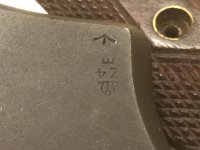
Sometime after that, but before the beginning of Lend-lease revolver shipments in late fall, this gun crossed the Atlantic to Britain. This is confirmed by the stamp on the left back frame. Charlie above referred to the broad arrow already; the whole array of symbols there actually belongs together and is most likely the acceptance stamp from the Royal Small Arms Factory at Enfield, which ceased once Lend-lease started, confirming the gun's processing before that. The symbols and numbers are not very clearly struck on yours; below a close-up of mine.

The other early stamp are the crossed pennants in front of the cylinder on the left side, that are partly overlapped by a post-war Brimingham Nitro Proof (BNP) stamp. I just recently found these crossed pennants there on another Pre-Victory BSR that was not post-war proofed, and they have been reported on other British handgun types unrelated to post-war proofing.
 

Attachments

  • IMG_3739.jpg
    IMG_3739.jpg
    65.1 KB
Last edited:
Your revolver actually has two stamping which are not part of the post-war Birmingham commercial proofing, but were applied when it entered British service in 1941.

I have 767114 which shipped to the British Purchasing Commission on May 12, 1941, in a shipment of 1000. The guns didn't necessarily ship in serial sequence, but as the others have pointed out, it is very likely yours went out around the same month, maybe even in that same shipment. Only a history letter would tell you.

Sometime after that, but before the beginning of Lend-lease revolver shipments in late fall, this gun crossed the Atlantic to Britain. This is confirmed by the stamp on the left back frame. Charlie above referred to the broad arrow already; the whole array of symbols there actually belongs together and is most likely the acceptance stamp from the Royal Small Arms Factory at Enfield, which ceased once Lend-lease started, confirming the gun's processing before that. The symbols and numbers are not very clearly struck on yours; below a close-up of mine.

The other early stamp are the crossed pennants in front of the cylinder on the left side, that are partly overlapped by a post-war Brimingham Nitro Proof (BNP) stamp. I just recently found these crossed pennants there on another Pre-Victory BSR that was not post-war proofed, and they have been reported on other British handgun types unrelated to post-war proofing, although I have nor found a conclusive explanation of the mark, which is not common; my May 12-shipped BSR has the Enfield mark, but no pennants.

Thank you very much for the reply Absalom. All this time I thought the crossed pennants in front of the cylinder were part of the Birmingham proof marks.
I greatly appreciate everyones input and help.
Jim
 
Last edited:
Your revolver actually has two stamping which are not part of the post-war Birmingham commercial proofing, but were applied when it entered British service in 1941.

I have 767114 which shipped to the British Purchasing Commission on May 12, 1941, in a shipment of 1000. The guns didn't necessarily ship in serial sequence, but as the others have pointed out, it is very likely yours went out around the same month, maybe even in that same shipment. Only a history letter would tell you.

Sometime after that, but before the beginning of Lend-lease revolver shipments in late fall, this gun crossed the Atlantic to Britain. This is confirmed by the stamp on the left back frame. Charlie above referred to the broad arrow already; the whole array of symbols there actually belongs together and is most likely the acceptance stamp from the Royal Small Arms Factory at Enfield, which ceased once Lend-lease started, confirming the gun's processing before that. The symbols and numbers are not very clearly struck on yours; below a close-up of mine.

The other early stamp are the crossed pennants in front of the cylinder on the left side, that are partly overlapped by a post-war Brimingham Nitro Proof (BNP) stamp. I just recently found these crossed pennants there on another Pre-Victory BSR that was not post-war proofed, and they have been reported on other British handgun types unrelated to post-war proofing, although I have nor found a conclusive explanation of the mark, which is not common; my May 12-shipped BSR has the Enfield mark, but no pennants.


Absalom,
I am looking at your attached photo and I noticed my broad arrow mark and yours are identical except the lower characters on yours looked like it was struck upside down.
If I invert your photo it looks like mine except for the broad arrow.
Here's my broad arrow mark.

6573e9e57626e33b8f515e14cd7cb69d.jpg


And here she is inverted and next to my mark.

f4c171b8bbfc100043bfc83327b40e6e.jpg


I appreciate you taking time to enlighten me about my revolver.
Jim.


Sent from my iPhone using Tapatalk
 
Last edited:
Absalom,
I am looking at your attached photo and I noticed my broad arrow mark and yours are identical except the lower characters on yours looked like it was struck upside down.
If I invert your photo it looks like mine except for the broad arrow.
Here's my broad arrow mark.
........

And here she is inverted and next to my mark.
.....

Excellent. I should have pointed out that the symbol is indeed an upside-down crown. The letter-number code gives it away. And the enlargement of yours clears it up considerably. The code identifies the inspector, by the way, and the E, which can be on its side or upright, but usually on its side on BSR's I've seen, identifies the place, in this case Enfield; I'm not aware of another place identifier either on BSR's.
 
The crown is not upside down, the entire inspector's stamp is! The Broad Arrow stamp was a separate one.

Crossed pennants was the British military proof mark, and would have been applied when the gun was being proofed, inspected and accepted for issue. This is why you will not see it on Lend Lease guns.

See my post here for an explanation: First S&w victory question

Peter
 
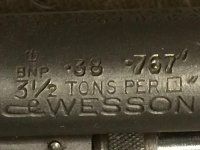
If my Enfield No.1MkVI is any indicator, .767 would be the case length, 3&1/2 tons would be the operating pressure. The British are know for the stamping all over a gun with proofs.
Steve
 
If my Enfield No.1MkVI is any indicator, .767 would be the case length, 3&1/2 tons would be the operating pressure. The British are know for the stamping all over a gun with proofs.
Steve

You are correct about the numbers. There is a standard set of numbers and symbols that makes up a Birmingham commercial proof, although frequently parts are missing, maybe due to space limitations or because the stamper had a pint too many at lunchtime. A perfect set for the standard .38 caliber, which would apply to a S&W as well as to a .38 Enfield or Webley, should look like the attached picture. The .38 proof pressure was 3.5 tons per square inch, the less commonly seen .38 Special proof, usually found on BSR's converted in Britain, was usually done in London and showed a 1.15 inch case length and 4 tons of pressure.

And like most countries with actual proof laws (unlike the US), major components required a mark, so the BNP stamp can be found on the frame and cylinder also.
 

Attachments

  • IMG_2376.jpg
    IMG_2376.jpg
    68.2 KB
Well, I was referring to a .455 Enfield. But the applies.
Steve
 
Well, I was referring to a .455 Enfield. But the applies.
Steve

Not to get to nit-picky, but the only Enfield No.1 Mk VI is a .303 rifle, and there never was an Enfield No. 1 revolver, only a No. 2, the .38 Mk 1.

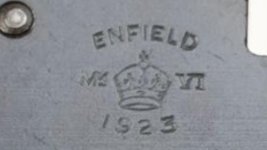
What you undoubtedly have is a .455 Webley Mk VI made at RSAF Enfield, and therefore stamped "Enfield" on the side of the frame. (See snip attached).

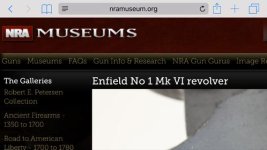
But don't feel bad; even the NRA museum got that one wrong on their website.
 

Attachments

  • IMG_4701.jpg
    IMG_4701.jpg
    11.3 KB
  • IMG_4702.jpg
    IMG_4702.jpg
    19 KB
Maybe but, mine is a revolver made in 1926(these were produced from 1919-1926 when Webley filed a suit for patent infringement and won, causing Enfield to stop production of their product. Therefore only Webleys in WWI and some Enfields in WWII. The Brits have always been tight with a shilling?
Steve
 
Maybe but, mine is a revolver made in 1926(these were produced from 1919-1926 when Webley filed a suit for patent infringement and won, causing Enfield to stop production of their product. Therefore only Webleys in WWI and some Enfields in WWII. The Brits have always been tight with a shilling?
Steve

Actually, it played out a bit differently. Webley & Scott found themselves accused of war profiteering by Parliament in 1919 (a fate that befell quite a few private arms companies in Europe and the US), and the Gov't directed the (government-owned) Enfield factory to continue production of the Mark VI revolver. It went from 1921 to 1926, and stopped when the new caliber decision in favor of .38 was made.

This all does get confusing. One problem is that Enfield, in contrast to Webley, was not a brand name, a company, or an inventor, but simply a location of a government facility, and anything developed there tends to get the Enfield name slapped on, whether it had other parents or not.

If you look up Enfield No. 2 on Wikipedia, the photo appears to show a Webley Mk VI. As I said, everybody seems to have trouble sorting these out ;) .
 
OK. if you say so but, not what I've read?
Steve
 

Latest posts

Back
Top