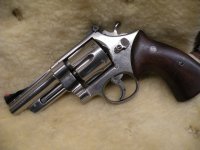
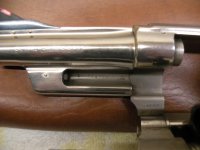
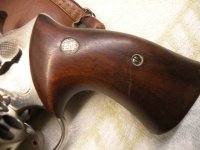
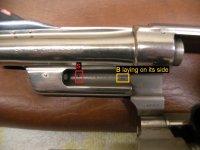
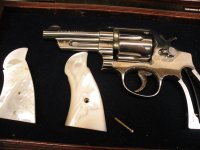
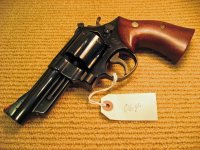
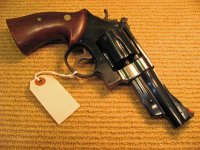
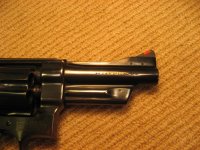
Just checked and Bill is correct about the B stamped in the injector rod shroud and there is a B on the grip frame. Also I'm pretty sure the hammer and trigger are plated.The revolver shows very little wear. I'm anxious to get to the range to see how it shoots.
When you first posted the photo of barrel shroud the letter prefix looked like an S when I zoomed in. You may want to check with magnification.
NOTE: B or N stamped or no stamp:
To determine if Blue or Nickel finish originally, a 'B' or 'N' stamped indicates an original Blue finish or an original Nickel finish respectively, based upon the corresponding letter. The absence (more prevalent after 1930) of either the 'B' or 'N' can also indicate that it left the factory nickeled.
Look in these locations for pre war and post war models if serial # is stamped on the barrel flat (or in barrel shroud):
Under barrel in front of serial #,
rear face of yoke looking thru a chamber with a flashlight,
on rear face of cyl separated from serial #,
behind the extractor star,
and by itself on right side grip frame on pre war commercial guns.
On post WWII models, once the serial # prefix letter (S on N frames and K frames) was introduced we no longer see the use of B or N except on left side grip frame. And no use of B or N at all on late 50’s models with no s/n on barrel and cyl.*
*The post war and the 1950s period, was one of much evolution. There was the usual transition when blue or nickel finish code letter stamps waned and s/n frame prefix letters began.
LARGER B FOR BRIGHT BLUE: will only appear on guns that had a Satin finish as standard, but could be ordered in the optional Bright Blue. It is usually only seen on the various models in the 5 Screw era. It is a larger B than the one used to simply indicate a blued part, and it is a different font - more deluxe with serifs. It is also AFTER the serial number on a barrel or in the barrel shroud, whereas the smaller B that simply meant "Blue" is seen preceding the number.
It appears from early into the post-war era till Bright Blue became standard in the mid 1950s.